When buyers compare laser marking machines, one question often comes up:
Why is a UV laser marking machine usually more expensive than a fiber laser marking machine?
Both systems can be used for industrial marking, and both can provide permanent, high-precision results. However, UV and fiber laser marking systems use different wavelengths, laser technologies, optical components, and application strategies.
A typical fiber laser marking machine operates at around 1064 nm, while a UV laser marking machine commonly operates at 355 nm. The shorter UV wavelength changes how the laser interacts with materials and makes UV particularly useful for applications where low thermal impact and high-contrast marking are important.
As a result, the higher purchase price of a UV laser marking machine is not simply because the machine has more components. The main difference is the laser source and the technology required to generate and control the shorter wavelength, together with the application-specific optical and process requirements.
Quick Answer: Why Does a UV Laser Marking Machine Cost More?
In general, a UV laser marking machine can cost more than a standard fiber laser marking machine because the UV laser source uses a more specialized architecture and optical technology, while the UV wavelength requires compatible optical components and careful system integration.
However, more expensive does not mean better for every application.
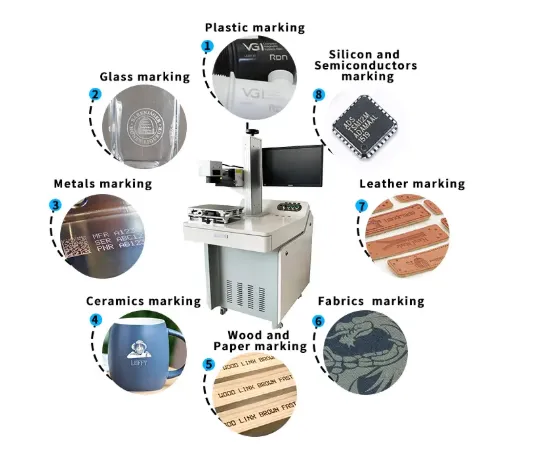
Fiber lasers are highly suitable for many metal marking and engraving applications, while UV lasers are particularly attractive for plastics, electronics, glass, packaging, and other materials where a lower thermal impact or a different absorption mechanism is beneficial. Coherent, for example, describes UV laser marking as particularly suitable for permanent marking of plastics and packaging where conventional infrared lasers may produce unwanted thermal effects.
The correct question is therefore not “Which laser is more expensive?” but:
“Which wavelength and laser technology are appropriate for my material and production process?”
1. UV Laser and Fiber Laser Use Different Wavelengths
The first major difference is wavelength.
| Laser Type | Typical Wavelength | Common Applications |
|---|---|---|
| Fiber Laser | 1064 nm | Stainless steel, carbon steel, aluminum, brass, copper, titanium and many metal applications |
| UV Laser | 355 nm | Plastics, electronics, PCB, glass, ceramics, packaging and heat-sensitive materials |
A 1064 nm fiber laser is widely used for metal marking and engraving. UV systems operating at 355 nm are used where the shorter wavelength provides a different interaction with the material.
TRUMPF, for example, currently lists 355 nm UV marking lasers alongside 1062 nm fiber lasers as different technologies within its marking portfolio. The company positions its UV technology for precise processing of sensitive materials, while its fiber lasers are described as general-purpose systems for marking and surface processing.
2. Why Is the UV Laser Source More Technically Complex?
One of the main reasons for the price difference is the laser source itself.
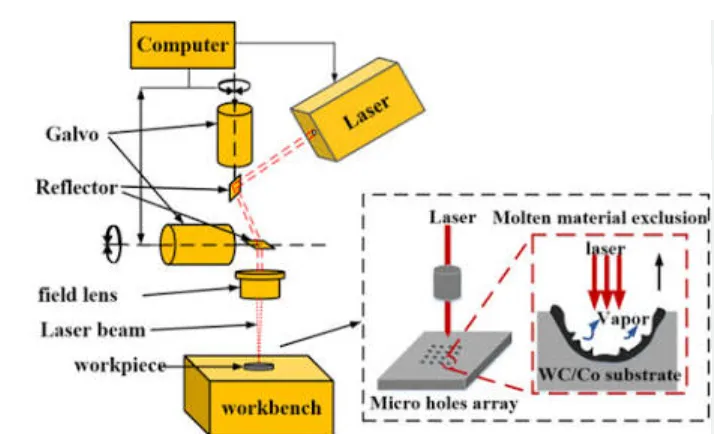
Many industrial UV marking lasers generate 355 nm output through nonlinear optical conversion from longer-wavelength solid-state laser radiation. In practical terms, this requires specialized optical components and careful control of the frequency-conversion process.
This is fundamentally different from the architecture of a conventional 1064 nm fiber laser source.
That additional optical technology can increase the cost of the UV source.
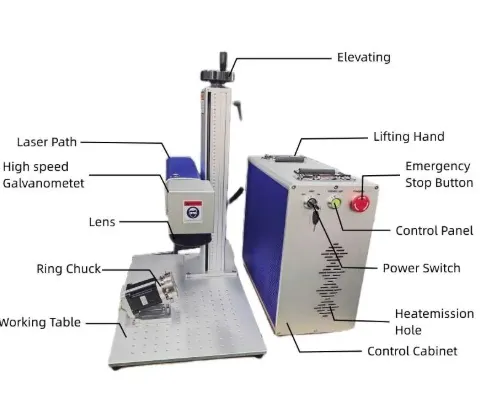
It is therefore important to understand that a UV marking machine is not simply a standard fiber laser with a different label. The laser source, optical path, coatings, thermal management, and system integration must all be appropriate for the UV wavelength.
Modern UV laser technology has also become considerably more accessible than it was in the past. For example, Coherent currently offers 355 nm UV marking lasers in 5 W and 10 W classes and states that its Matrix UV platform can achieve more than 15,000 hours of maintenance-free operation under specified conditions.
This is an important point for buyers: UV lasers should not automatically be described as short-life or unstable systems. The actual service life depends on the specific laser source, operating conditions, cooling system, maintenance requirements, and manufacturer.
3. UV and Fiber Laser Optical Components Are Not Interchangeable
Another reason for the price difference is the optical system.
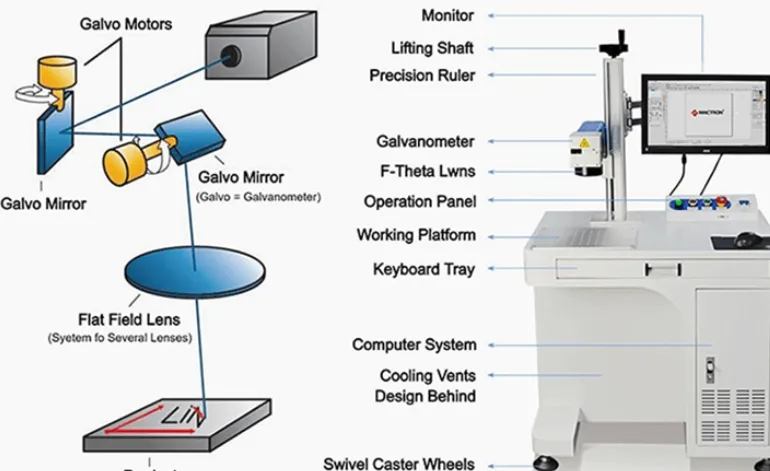
Fiber and UV laser marking machines do not simply use the same galvanometer scanner and F-Theta lens.
The optical components must be compatible with the wavelength and power density of the laser system. Coatings, substrates, transmission characteristics, and damage thresholds can differ between wavelength ranges.
This means that a component optimized for 1064 nm should not automatically be assumed to be suitable for 355 nm UV operation.
The same principle applies to the marking head, mirrors, lenses, beam delivery components, and other optical elements.
In a complete machine, these components must work together as an optical system rather than being selected independently.
4. Why Does UV Marking Often Cost More at the System Level?
The difference in purchase price is not necessarily caused by every component being dramatically more expensive.
In many systems, the main cost difference is concentrated in the laser source and the associated optical technology.
Other components, such as the galvanometer scanner, controller, computer, enclosure, worktable, electrical components, power supply, red-light pointer, foot switch, and other accessories may be relatively similar in overall machine architecture.
However, the exact configuration varies from manufacturer to manufacturer.
| Cost Area | Fiber Laser | UV Laser |
|---|---|---|
| Laser source | Generally more mature and widely available | More specialized optical technology |
| Wavelength | Typically around 1064 nm | Typically 355 nm |
| Optical components | Designed for near-infrared operation | Must be compatible with UV wavelength |
| Typical metal applications | Excellent fit for many metals | Application dependent |
| Plastic applications | Material dependent | Often strong choice for sensitive plastics |
| Thermal sensitivity | Depends on material and process | Often advantageous where low thermal impact is important |
| Initial machine cost | Often lower | Often higher |
5. UV Laser Does Not Mean “Better” — It Means Different
This is one of the most important points when comparing UV and fiber laser marking machines.
A more expensive UV laser is not automatically a better replacement for a fiber laser.
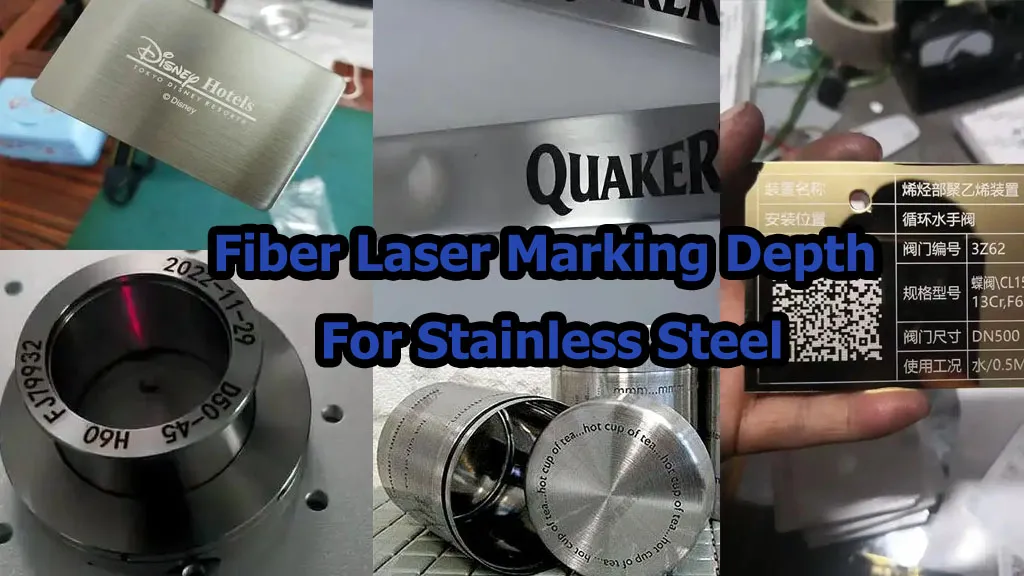
If your primary application is marking stainless steel, carbon steel, aluminum, brass, or other metal components, a 1064 nm fiber laser is often the more logical starting point.
If the application involves sensitive plastics, electronic components, PCB materials, glass, packaging, or other materials where thermal effects are a concern, a 355 nm UV laser may provide advantages that justify the higher investment.
Coherent’s application matrix similarly separates 1064 nm systems for metal marking and engraving from 355 nm systems used for applications such as plastic bleaching and other specialized marking processes.
6. Why Is UV Particularly Useful for Plastics?
One of the strongest reasons to choose UV is its interaction with certain polymers.
UV photons have higher photon energy than near-infrared photons. In suitable materials, this can promote photochemical changes rather than relying primarily on thermal processing.
Coherent describes UV marking of plastics as a photochemical process that can change the color of the material while minimizing thermal damage to the marked surface.
This can be valuable for applications involving:
- ABS;
- polyurethane;
- PE and HDPE;
- nylon;
- medical plastics;
- electronic components;
- pharmaceutical packaging;
- transparent plastics;
- colored plastics;
- plastic bottle caps and packaging.
However, material formulation still matters. Different plastics, additives, colors, surface finishes, and fillers can respond differently to the same laser wavelength.
That is why application testing remains important even when a material is generally considered “UV compatible.”
7. Why Fiber Lasers Remain a Strong Choice for Metal Marking
For many industrial metal applications, fiber laser technology offers a practical combination of cost, performance, maintenance requirements, and process flexibility.
Common applications include:
- stainless steel marking;
- aluminum marking;
- carbon steel marking;
- brass marking;
- copper marking;
- titanium marking;
- automotive components;
- tools and hardware;
- machine parts;
- nameplates;
- serial numbers;
- Data Matrix codes;
- QR codes;
- deep engraving.
For manufacturers whose production is primarily metal-based, the higher cost of UV technology may not provide enough additional value to justify the investment.
In such cases, a properly configured fiber laser can be a more appropriate production solution.
8. Fiber Laser vs UV Laser: Which One Should You Buy?
| Application Requirement | Fiber Laser | UV Laser |
|---|---|---|
| Stainless steel | Strong choice | Application dependent |
| Carbon steel | Strong choice | Usually not the first choice |
| Aluminum | Strong choice | Application dependent |
| Brass / copper | Common industrial option | Specialized applications |
| Deep metal engraving | Strong choice | Usually not the first choice |
| General metal identification | Strong choice | Often unnecessary |
| Plastic marking | Material dependent | Often advantageous |
| Heat-sensitive plastic | Application dependent | Often advantageous |
| PCB marking | Application dependent | Common choice |
| Glass marking | Application dependent | Often considered |
| Pharmaceutical packaging | Material dependent | Often suitable |
This table should be treated as a starting point rather than a universal process guarantee. The actual result depends on the material formulation, surface condition, required mark, laser configuration, and process parameters.
9. Don’t Compare Laser Machines by Price Alone
When comparing a fiber laser and a UV laser, buyers often focus on the initial purchase price.
That is understandable, but it can lead to the wrong decision.
A better approach is to compare the total production value of the system.
Ask:
- What material will be marked?
- What type of mark is required?
- What contrast is required?
- How deep does the mark need to be?
- How fast must each part be processed?
- How many parts will be marked per day?
- Does the system need automation?
- Does the system require vision inspection?
- What maintenance is required?
- What is the expected service life of the laser source?
- What technical support is available?
- Can the supplier test the actual production material?
A cheaper machine that cannot reliably achieve the required production result is not necessarily the lower-cost solution.
Likewise, paying more for a UV laser does not automatically create economic value if the application could be handled effectively by a fiber laser.
10. Test the Actual Material Before Choosing the Laser
For buyers who are unsure whether they need a fiber laser or UV laser, sample testing is often more useful than comparing brochures.
Send the supplier the actual material and provide:
- material type and grade;
- surface condition;
- marking artwork;
- required mark dimensions;
- required contrast;
- required depth;
- target production speed;
- daily production volume.
Then ask the supplier to document the test parameters and production time.
For example, if a manufacturer needs to mark 5,000 components per day, the important question is not simply whether the laser can create a visible mark.
The more useful question is:
Can the machine produce a consistent, readable mark on all 5,000 parts within the required production window?
This is the difference between a laboratory sample and a production-ready laser process.
11. What About UV Laser Maintenance and Service Life?
The original assumption that UV laser systems always have shorter lifetimes than fiber lasers is too broad to apply to every modern laser source.
Different UV architectures and manufacturers have different specifications. Some current industrial UV laser products are specifically designed for high-throughput production and long operating life. For example, Coherent states that its Matrix UV laser platform can provide more than 15,000 hours of maintenance-free operation under specified conditions.
Therefore, buyers should not judge UV lifetime based only on the wavelength.
Instead, ask the laser manufacturer for:
- rated operating hours;
- expected power stability;
- recommended operating temperature;
- cooling requirements;
- maintenance intervals;
- warranty conditions;
- power degradation specifications, where available;
- replacement component costs.
These figures are much more useful for evaluating the long-term cost of ownership.
12. Why Did UV Laser Prices Used to Be Much Higher?
The original Chinese-language article notes that UV laser sources were significantly more expensive when domestic production capacity was less developed. At that time, imported low-power UV sources could represent a very large portion of the total machine cost.
As domestic laser technology and supply chains developed, the cost of some UV sources decreased significantly.
This is an important lesson for buyers today: the price of a laser marking machine is influenced by the maturity of the underlying laser technology and supply chain.
The price gap between fiber and UV systems is therefore not fixed. It can change as laser-source technology develops, manufacturing volumes increase, and more suppliers enter the market.
13. When Does a More Expensive UV Laser Make Sense?
A UV laser can make economic sense when its technical advantages solve a problem that a conventional fiber laser cannot solve efficiently.
Examples may include:
- high-contrast marking on difficult plastics;
- applications where thermal damage must be minimized;
- fine marking of electronic components;
- PCB identification;
- pharmaceutical packaging;
- transparent or colored plastics;
- glass and ceramic applications;
- small, high-resolution marks.
In these situations, the higher initial machine cost should be evaluated against the value of improved marking quality, reduced rejects, better readability, or a wider production window.
TRUMPF similarly positions UV marking for sensitive materials and applications requiring precise, gentle processing, while its fiber laser systems cover medium- to high-performance marking and surface applications.
14. When Is a Fiber Laser the More Practical Choice?
If your production is mainly focused on metals, a fiber laser should normally be one of the first technologies to evaluate.
A fiber laser may be a practical starting point for:
- stainless steel parts;
- carbon steel components;
- aluminum products;
- brass and copper parts;
- automotive components;
- tools;
- hardware;
- machine components;
- metal nameplates;
- serial-number marking;
- Data Matrix traceability;
- deep engraving.
For a detailed overview of metal applications, materials, and machine configurations, see our Fiber Laser Marking Machine for Metal guide.
Final Answer: Why Is a UV Laser Marking Machine More Expensive?
There is no single reason why UV laser marking machines can cost more than fiber laser marking machines.
The main factors include the specialized UV laser source, wavelength-conversion technology used by many 355 nm systems, UV-compatible optical components, system integration, and the specific application requirements of UV processing.
However, the higher price does not mean that UV is automatically better.
Fiber and UV lasers solve different material-processing problems.
For many metal marking applications, 1064 nm fiber laser technology remains a highly practical choice.
For plastics, electronics, packaging, glass, and other applications where low thermal impact or specialized absorption is important, 355 nm UV technology may justify the additional investment.
The best way to choose between them is to start with the material and required production result, then select the wavelength, laser source, optical configuration, and power.
Don’t buy the more expensive laser simply because it is more expensive. Buy the laser that solves your actual production problem.
Frequently Asked Questions
Why is a UV laser marking machine more expensive than a fiber laser?
UV systems often use more specialized laser-source and optical technology. The 355 nm wavelength requires compatible optical components and, in many architectures, nonlinear frequency conversion, which can increase system cost.
Is a UV laser better than a fiber laser?
Not universally. Fiber and UV lasers are optimized for different applications. Fiber lasers are widely used for metals, while UV lasers are particularly useful for certain plastics, electronics, packaging, glass, and heat-sensitive materials.
Can a UV laser mark stainless steel?
UV lasers can process some metals, but for conventional stainless-steel identification and engraving, a 1064 nm fiber laser is often the more typical starting point. The actual choice should be based on the required mark and application test.
Can a fiber laser mark plastic?
Some plastics can be marked with fiber lasers, depending on polymer composition, additives, color, and required result. However, UV lasers can provide advantages for certain plastics where low thermal impact and photochemical marking are desirable.
What wavelength does a UV laser marking machine use?
Industrial UV marking systems commonly operate at 355 nm. Fiber laser marking systems commonly operate around 1064 nm.
Does UV laser marking require more maintenance?
Maintenance requirements depend on the specific laser source, cooling architecture, operating environment, and manufacturer. It is better to compare the actual maintenance schedule and service specifications of the proposed laser rather than assuming all UV systems require more maintenance.
Is a 20W fiber laser enough for metal marking?
It can be sufficient for many surface-marking applications, including logos, text, serial numbers, and identification codes. However, required speed, material, mark size, contrast, and engraving depth should be tested before selecting the final power.
Should I choose a 30W, 50W or 100W fiber laser?
The correct power depends on the application. Higher power can be useful for higher throughput or deeper engraving, but the highest available power is not automatically the best choice.
How can I know whether I need a fiber or UV laser?
Start with the actual material and required marking result. If the application is mainly metal marking, evaluate fiber first. If it involves sensitive plastics, electronics, packaging, glass, or applications requiring low thermal impact, evaluate UV and compare actual sample results.
Should I test my material before buying a laser marking machine?
Yes. Testing the actual production material is one of the most useful steps before purchasing a laser marking machine. The test should evaluate marking quality, contrast, cycle time, repeatability, and any thermal or material damage.