UV Laser Marking Technology Explained: Complete Industrial Guide
A complete guide to 355nm UV laser technology, covering working principles, applications, materials, advantages and how to choose the right UV laser marking machine.
Table of Contents
UV Laser Marking Technology In Modern Manufacturing
UV laser marking technology has become one of the most important precision marking solutions for industries that require extremely high accuracy, minimal heat damage and excellent contrast.
Unlike traditional fiber laser systems that mainly process metals through thermal effects, UV lasers operate using a much shorter wavelength of 355nm, allowing them to interact with materials through a photochemical process.
This unique characteristic makes UV laser marking especially suitable for sensitive materials such as:
- Plastics
- Electronics
- Glass
- Semiconductor components
- Medical devices
- Flexible materials
Modern manufacturers increasingly require permanent product identification, including:
- QR codes
- Barcodes
- Serial numbers
- Logos
- Safety information
- Traceability marks
UV laser marking provides these functions while maintaining the original appearance and structural integrity of delicate products.
Why UV Laser Technology Is Becoming More Important
he growth of industries such as electronics, semiconductor manufacturing and medical devices has increased demand for ultra-precise marking technologies.
Manufacturers need marking solutions that can achieve:
| Requirement | UV Laser Advantage |
|---|---|
| Small components | Extremely fine beam diameter |
| Heat-sensitive materials | Low thermal impact |
| High contrast codes | Excellent readability |
| Complex patterns | High precision processing |
| Clean production | No ink or chemicals |
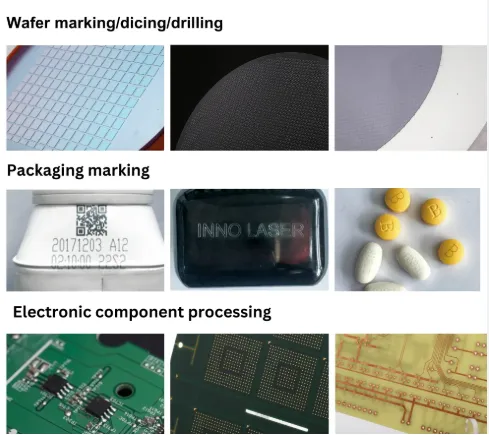
UV Laser Marking Technology Overview
| Parameter | Specification |
|---|---|
| Laser Wavelength | 355nm UV Laser |
| Laser Type | Ultraviolet Solid-State Laser |
| Processing Method | Photochemical Reaction |
| Heat Effect | Very Low |
| Main Applications | Electronics, Plastic, Glass, Medical |
| Precision | Micron-Level Processing |
What Is UV Laser Marking Technology?
Definition Of UV Laser Marking
UV laser marking technology uses ultraviolet laser energy to create permanent marks on material surfaces through a photochemical reaction.
The most common industrial UV laser wavelength is:
355nm
This wavelength belongs to the ultraviolet spectrum and provides a much smaller focused spot compared with infrared fiber lasers.
Why Does UV Laser Use 355nm?
The wavelength determines how laser energy interacts with materials.
Comparison:
| Laser Type | Wavelength | Main Effect |
|---|---|---|
| Fiber Laser | 1064nm | Thermal processing |
| UV Laser | 355nm | Photochemical processing |
| CO2 Laser | 10.6μm | Surface heating |
UV Laser Working Principle
When a 355nm UV laser beam reaches the material surface, photons directly break molecular bonds.
This process is often called:
Cold Laser Processing
because it creates minimal heat affected zones.
Thermal Effect Comparison
| Laser Type | Heat Impact |
|---|---|
| UV Laser | ★ Very Low |
| Fiber Laser | ★★★ Medium |
| CO2 Laser | ★★★ Medium |
Why Is UV Laser Called “Cold Laser”?
The term “cold laser” does not mean the laser has a low temperature.
It means:
- Less heat transferred into material
- Less thermal deformation
- Less burning
- Cleaner processing
This advantage is critical for precision industries.
UV Laser Technology Advantages
1. Ultra-High Precision
UV lasers can achieve extremely small marking details.
Typical applications:
- Micro text
- Small QR codes
- Semiconductor marking
- Electronic components
2. Minimal Material Damage
Compared with infrared lasers:
| Feature | UV Laser | Fiber Laser |
|---|---|---|
| Heat Generation | Very Low | Higher |
| Plastic Processing | Excellent | Limited |
| Fine Detail | Excellent | Good |
| Metal Processing | Good | Excellent |
3. Excellent Contrast
UV laser can create high-quality marks on:
- White plastics
- Transparent materials
- Electronic components
Engineering Insight
In practical production environments, UV laser selection is usually driven by material sensitivity rather than power requirements.
Many customers initially choose equipment based only on wattage, but precision industries require evaluating:
| Factor | Importance |
|---|---|
| Material melting point | Prevent deformation |
| Surface structure | Maintain appearance |
| Required marking size | Determine precision |
| Production speed | Select configuration |
| Contrast requirement | Optimize parameters |
For example:
A plastic electronic housing may require a 5W UV laser instead of a higher-power fiber laser because excessive heat can damage the product surface.
UV Laser Machine Components
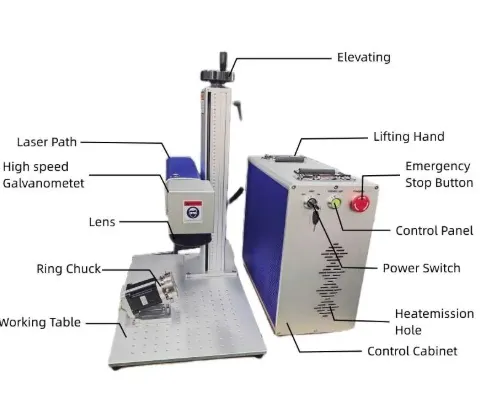
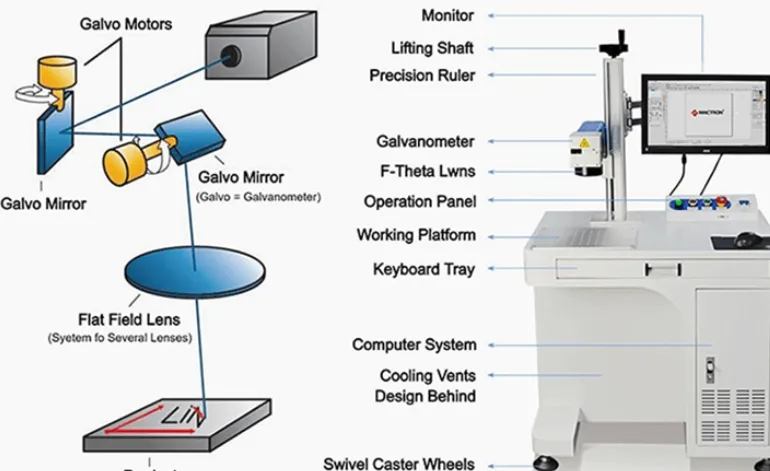
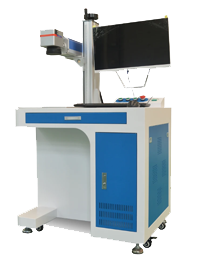
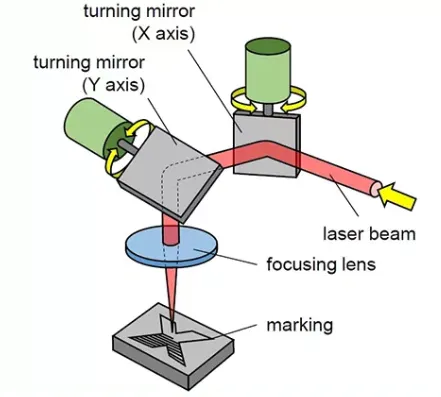
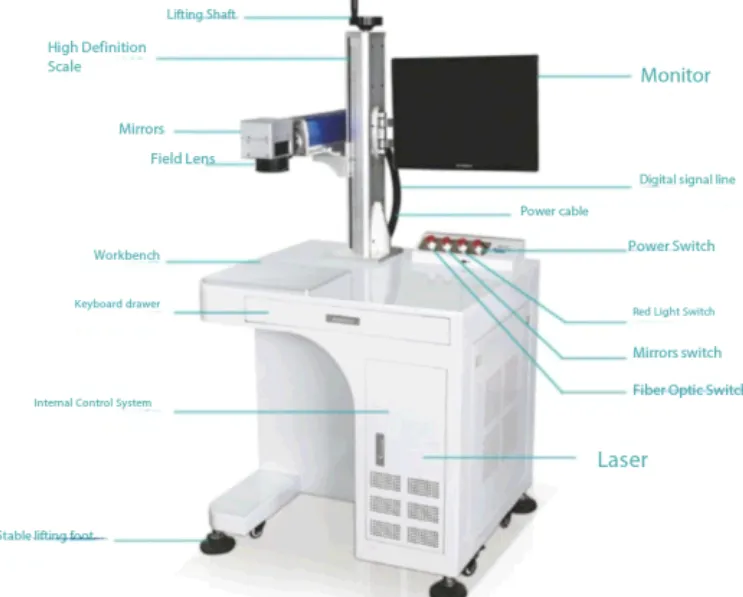
A professional UV laser marking machine consists of several precision components that work together to achieve high-quality marking results.
Compared with fiber laser systems, UV laser machines require higher optical precision because they are mainly used for delicate materials and micro-level processing.
The major components include:
- UV laser source
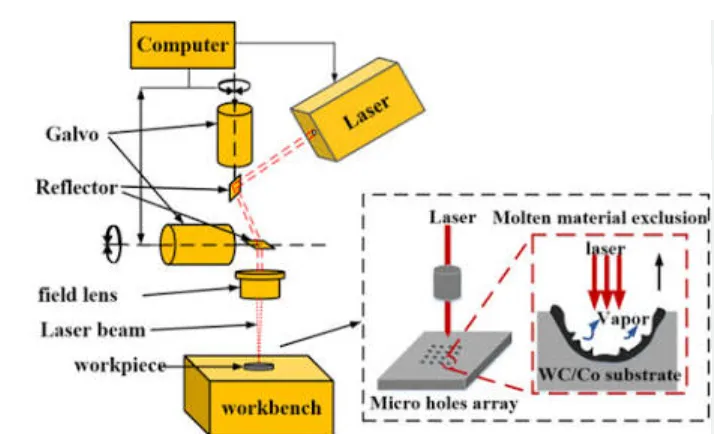
- Galvanometer scanner
- F-theta lens
- Control system
- Precision focusing system
- Cooling system
Main Components Of UV Laser Marking Machine
| Component | Function | Importance |
|---|---|---|
| UV Laser Source | Generates 355nm ultraviolet laser beam | ★★★★★ |
| Galvanometer Scanner | Controls laser movement and marking speed | ★★★★★ |
| F-Theta Lens | Focuses laser beam with high accuracy | ★★★★★ |
| Control Software | Creates text, graphics, QR codes and serial numbers | ★★★★ |
| Cooling System | Maintains stable laser operation | ★★★★ |
1. UV Laser Source
The UV laser source is the core component of the machine.
Unlike fiber lasers that commonly use ytterbium-doped fiber technology, UV lasers usually use a solid-state laser structure based on:
- Nd:YVO4 crystal
- Harmonic generation technology
- Third harmonic conversion
The process converts infrared laser energy into ultraviolet wavelength.
UV Laser Generation Process
| Stage | Process |
|---|---|
| Laser Generation | Infrared laser produced inside crystal |
| Frequency Conversion | Laser wavelength converted through crystals |
| UV Output | 355nm ultraviolet laser generated |
2. Galvanometer Scanner
The galvanometer scanner controls the movement of the laser beam.
High-quality scanning systems are essential for:
- Fast marking speed
- Accurate positioning
- Stable productio
Galvo Scanner Performance
| Feature | Production Benefit |
|---|---|
| High-Speed Movement | Improves production efficiency |
| Precision Control | Creates fine details |
| Digital Operation | Supports automation |
| Non-Contact Processing | Reduces product damage |
3. F-Theta Lens
The F-theta lens determines the laser marking area and focusing quality.
For UV laser applications, lens quality is especially important because many products require extremely fine details.
Common UV Laser Lens Options
| Lens Size | Marking Area | Main Application |
|---|---|---|
| 70×70mm | Small Area | Micro components |
| 110×110mm | Standard Precision | Electronics |
| 175×175mm | Medium Area | Industrial products |
| 300×300mm | Large Area | Large plastic panels |
4. UV Laser Control Software
Modern UV laser marking machines support various industrial marking functions.| Function | Application |
|---|---|
| Text Marking | Product information |
| QR Code | Traceability management |
| Barcode | Inventory tracking |
| Serial Number | Production identification |
| Logo Marking | Brand identification |
UV Laser Technical Specifications
Understanding technical specifications is important when selecting the right UV laser marking machine.
The most common industrial UV laser powers are:
- 3W
- 5W
- 10W
- 15W
- 20W
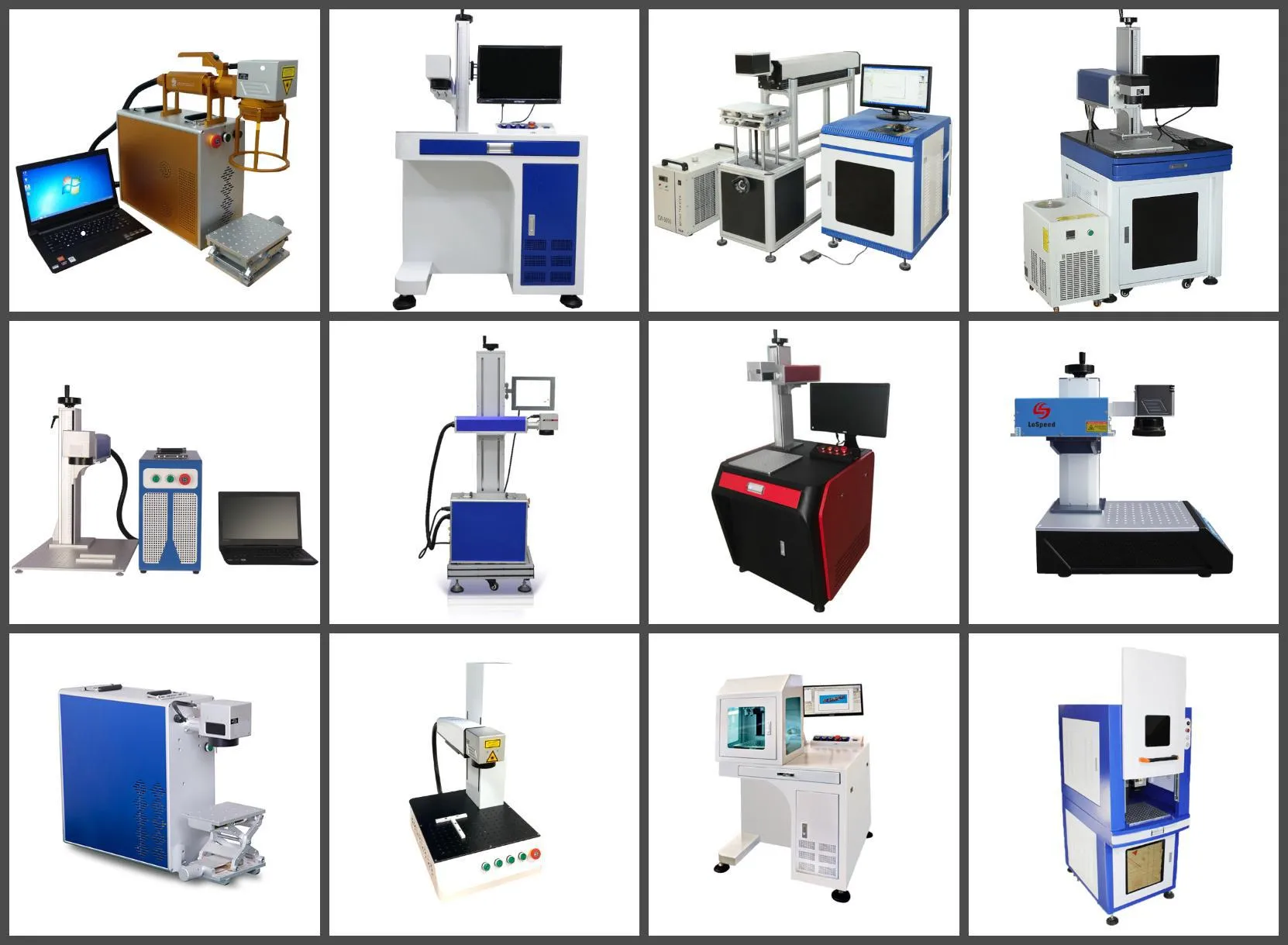
UV Laser Power Selection Guide
Higher power does not always mean better performance.
UV laser selection depends mainly on:
- Material type
- Marking speed
- Required precision
- Production volume
3W vs 5W vs 10W vs 15W UV Laser Comparison
| Feature | 3W | 5W | 10W | 15W |
|---|---|---|---|---|
| Precision | Excellent | Excellent | Very Good | Good |
| Processing Speed | Low | Medium | High | Very High |
| Plastic Marking | Excellent | Excellent | Excellent | Excellent |
| Large Production | Limited | Suitable | Excellent | Excellent |
| Investment Cost | Lowest | Medium | Higher | Highest |
Recommended UV Laser Power By Application
| Application | Recommended Power |
|---|---|
| Plastic electronic housing | 3W-5W |
| Mobile phone components | 5W |
| PCB marking | 5W-10W |
| Glass marking | 5W-10W |
| High-speed production line | 10W-15W |
UV Laser Marking Methods
UV laser technology can create different marking effects depending on material properties and laser parameters.
The main processing methods include:
- Surface marking
- Material removal
- Coating removal
- Micro engraving
1. Surface UV Laser Marking
Surface marking modifies the material surface without significant damage.
Common applications:
| Material | Application |
|---|---|
| Plastic | Product identification |
| Glass | Logo marking |
| Electronic parts | Traceability codes |
2. UV Laser Coating Removal
UV laser can remove surface coatings while maintaining the base material.
Examples:
| Material | Processing Result |
|---|---|
| Painted Plastic | Remove coating and create contrast |
| Anodized Aluminum | Create white marking |
| Electronic Housing | Expose internal layer |
3. Micro Laser Engraving
UV laser is widely used for micro-scale engraving.
Applications:
- Semiconductor components
- Medical devices
- Precision electronics
Advantages:
| Advantage | Result |
|---|---|
| Small Beam Diameter | Fine details |
| Low Heat | No deformation |
| High Accuracy | Clear micro marks |
UV Laser vs Fiber Laser Technical Comparison
| Feature | UV Laser | Fiber Laser |
|---|---|---|
| Wavelength | 355nm | 1064nm |
| Main Process | Photochemical | Thermal |
| Heat Effect | Very Low | Medium |
| Plastic Processing | ★★★★★ | ★★★ |
| Metal Processing | ★★★ | ★★★★★ |
| Precision | ★★★★★ | ★★★★ |
| Cost | Higher | Lower |
Engineering Insight
In industrial applications, UV laser selection is mainly determined by material sensitivity and precision requirements, not simply by laser power.
For example:
- A plastic electronic component may require a 5W UV laser to avoid melting.
- A metal part manufacturer may choose fiber laser because thermal processing provides faster engraving.
- A semiconductor manufacturer may choose UV laser because micron-level accuracy is more important than processing depth.
Professional evaluation should always consider:
| Evaluation Factor | Impact |
|---|---|
| Material Structure | Determines laser absorption |
| Heat Sensitivity | Affects laser selection |
| Marking Size | Determines precision requirement |
| Production Speed | Determines power selection |
Industrial Applications Of UV Laser Marking Technology
UV laser marking technology has become an essential solution for industries that require high precision, minimal heat impact and permanent identification.
Compared with fiber laser systems, UV lasers are especially valuable when processing materials that are sensitive to heat or require extremely fine details.
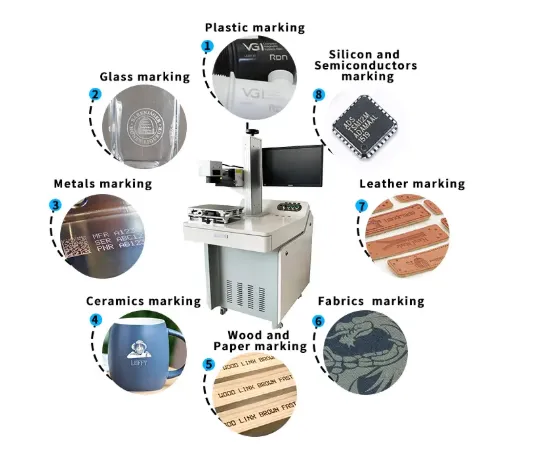
Modern industries use UV laser marking machines for:
- Electronic component identification
- PCB marking
- Semiconductor traceability
- Plastic product marking
- Glass marking
- Medical device identification
- Battery component marking
- Consumer electronics customization
Why Industries Choose UV Laser Marking
The main reason manufacturers select UV laser technology is its ability to create high-quality marks without damaging the product.
| Industrial Requirement | UV Laser Advantage |
|---|---|
| Heat-sensitive materials | Minimal thermal damage |
| Small components | Micron-level precision |
| High contrast marking | Excellent readability |
| Clean manufacturing | No ink or chemicals |
| Permanent identification | Lifetime durability |
Electronics Industry UV Laser Applications
The electronics industry is one of the largest application fields for UV laser marking.
Electronic products are becoming:
- Smaller
- More integrated
- More precise
Traditional marking methods often create problems such as:
- Heat damage
- Ink contamination
- Poor resolution
- Surface deformation
UV lasers solve these challenges through cold processing technology.
Electronic Components Marked By UV Laser
| Component | Material | Marking Content |
|---|---|---|
| PCB Boards | FR4, Ceramic | Serial number, QR code |
| IC Chips | Silicon, Semiconductor | Product identification |
| Connector Parts | Plastic, Metal | Batch information |
| Electronic Housing | Plastic, Aluminum | Logo and traceability |
| Sensors | Plastic, Glass | Permanent marking |
PCB Laser Marking Applications
PCB manufacturing requires extremely accurate identification because circuit boards contain many sensitive components.
UV lasers are widely used for:
- PCB QR code marking
- Component identification
- Production tracking
- Anti-counterfeiting marking
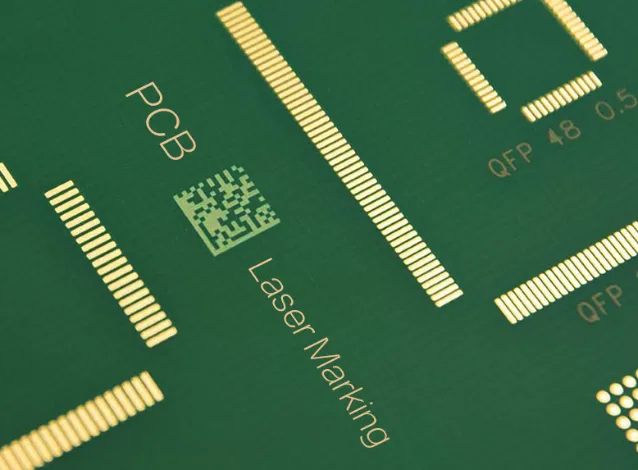
Why UV Laser Is Suitable For PCB?
| PCB Requirement | UV Laser Solution |
|---|---|
| No circuit damage | Low heat processing |
| Small marking area | Fine laser spot |
| High contrast | Clear identification |
| Fast production | High-speed scanning |
Semiconductor UV Laser Applications
Semiconductor manufacturing requires some of the highest precision marking standards in the world.
Applications include:
- Wafer marking
- Chip identification
- Semiconductor packaging
- Micro component marking
Semiconductor Marking Requirements
<table class=”seo-table”> <thead> <tr> <th>Requirement</th> <th>Reason</th> </tr> </thead> <tbody> <tr> <td>Ultra-small marking</td> <td>Components continue shrinking</td> </tr> <tr> <td>No material damage</td> <td>Protect electronic performance</td> </tr> <tr> <td>High readability</td> <td>Improve traceability</td> </tr> <tr> <td>Permanent marking</td> <td>Lifetime identification</td> </tr> </tbody> </table>
Plastic Laser Marking Applications
Plastic is one of the most important materials for UV laser technology.
Many plastics cannot tolerate high heat from infrared lasers.
UV laser provides:
- High contrast
- No melting
- Clean edges
- Permanent marks
Common Plastics Processed By UV Laser
<table class=”seo-table”> <thead> <tr> <th>Plastic Material</th> <th>Application</th> </tr> </thead> <tbody> <tr> <td>ABS Plastic</td> <td>Electronic housings</td> </tr> <tr> <td>PC Plastic</td> <td>Automotive components</td> </tr> <tr> <td>PVC</td> <td>Cable products</td> </tr> <tr> <td>Acrylic</td> <td>Display products</td> </tr> <tr> <td>Nylon</td> <td>Industrial parts</td> </tr> </tbody> </table>
UV Laser Plastic Marking Advantages
<table class=”seo-table”> <thead> <tr> <th>Advantage</th> <th>Result</th> </tr> </thead> <tbody> <tr> <td>Low heat input</td> <td>Prevents deformation</td> </tr> <tr> <td>High absorption</td> <td>Better marking contrast</td> </tr> <tr> <td>Fine beam</td> <td>Detailed graphics</td> </tr> <tr> <td>No consumables</td> <td>Lower operating cost</td> </tr> </tbody> </table>
Glass Laser Marking Applications
Glass is difficult to process because it is brittle and sensitive to thermal stress.
UV laser technology provides a solution by reducing heat accumulation.
Applications include:
- Glass bottles
- Optical components
- Medical glass products
- Consumer products
UV Laser Glass Marking Performance
<table class=”seo-table”> <thead> <tr> <th>Feature</th> <th>UV Laser Result</th> </tr> </thead> <tbody> <tr> <td>Surface damage</td> <td>Minimal</td> </tr> <tr> <td>Mark clarity</td> <td>High</td> </tr> <tr> <td>Fine graphics</td> <td>Excellent</td> </tr> <tr> <td>Permanent marking</td> <td>Yes</td> </tr> </tbody> </table>
Medical Device UV Laser Applications
Medical industries require extremely clean and permanent marking solutions.
UV lasers are commonly used for:
- Surgical instruments
- Medical plastics
- Laboratory equipment
- Disposable medical products
Medical Material Compatibility
<table class=”seo-table”> <thead> <tr> <th>Material</th> <th>Application</th> </tr> </thead> <tbody> <tr> <td>Medical Plastic</td> <td>Disposable devices</td> </tr> <tr> <td>Glass</td> <td>Laboratory products</td> </tr> <tr> <td>Stainless Steel</td> <td>Medical instruments</td> </tr> <tr> <td>Titanium</td> <td>Implants</td> </tr> </tbody> </table>
Battery Industry UV Laser Applications
With the rapid growth of electric vehicles and energy storage systems, battery manufacturers require advanced marking solutions.
UV lasers are used for:
- Battery shell identification
- Insulation layer marking
- Plastic battery components
- QR code traceability
Battery Material And Laser Selection
<table class=”seo-table”> <thead> <tr> <th>Battery Material</th> <th>Recommended Laser</th> <th>Reason</th> </tr> </thead> <tbody> <tr> <td>Plastic Battery Parts</td> <td>UV Laser</td> <td>Low heat processing</td> </tr> <tr> <td>Aluminum Shell</td> <td>Fiber Laser / UV Laser</td> <td>Depends on requirement</td> </tr> <tr> <td>Copper Components</td> <td>Fiber / Green Laser</td> <td>Reflectivity consideration</td> </tr> <tr> <td>Insulation Film</td> <td>UV Laser</td> <td>Precise coating removal</td> </tr> </tbody> </table>
UV Laser Material Compatibility Guide
UV laser technology can process a wide range of materials.
Plastic Materials
<table class=”seo-table”> <thead> <tr> <th>Material</th> <th>UV Laser Performance</th> <th>Application</th> </tr> </thead> <tbody> <tr> <td>ABS</td> <td>Excellent</td> <td>Electronic products</td> </tr> <tr> <td>PC</td> <td>Excellent</td> <td>Automotive parts</td> </tr> <tr> <td>PVC</td> <td>Good</td> <td>Cables</td> </tr> <tr> <td>Acrylic</td> <td>Excellent</td> <td>Displays</td> </tr> </tbody> </table>
Other Non-Metal Materials
<table class=”seo-table”> <thead> <tr> <th>Material</th> <th>Performance</th> </tr> </thead> <tbody> <tr> <td>Glass</td> <td>Excellent</td> </tr> <tr> <td>Ceramic</td> <td>Excellent</td> </tr> <tr> <td>Wood</td> <td>Limited</td> </tr> <tr> <td>Leather</td> <td>Limited</td> </tr> </tbody> </table>
UV Laser vs Fiber Laser vs CO2 Laser
Selecting the correct laser technology is critical for achieving the best marking result. <table class=”seo-table”> <thead> <tr> <th>Feature</th> <th>UV Laser</th> <th>Fiber Laser</th> <th>CO2 Laser</th> </tr> </thead> <tbody> <tr> <td>Wavelength</td> <td>355nm</td> <td>1064nm</td> <td>10.6μm</td> </tr> <tr> <td>Main Materials</td> <td>Plastic, Electronics, Glass</td> <td>Metal</td> <td>Wood, Leather, Acrylic</td> </tr> <tr> <td>Heat Effect</td> <td>Very Low</td> <td>Medium</td> <td>Medium</td> </tr> <tr> <td>Precision</td> <td>★★★★★</td> <td>★★★★</td> <td>★★★</td> </tr> <tr> <td>Plastic Processing</td> <td>★★★★★</td> <td>★★★</td> <td>★★★★</td> </tr> <tr> <td>Metal Engraving</td> <td>★★★</td> <td>★★★★★</td> <td>★</td> </tr> <tr> <td>Lifetime</td> <td>15,000-30,000h</td> <td>80,000h+</td> <td>20,000h+</td> </tr> </tbody> </table>
Engineering Insight
In industrial projects, the best laser technology depends on the customer’s actual application.
A common mistake is selecting equipment only based on price.
Professional evaluation should consider: <table class=”seo-table”> <thead> <tr> <th>Factor</th> <th>Decision Impact</th> </tr> </thead> <tbody> <tr> <td>Material Type</td> <td>Determines laser wavelength</td> </tr> <tr> <td>Heat Sensitivity</td> <td>Determines UV requirement</td> </tr> <tr> <td>Marking Size</td> <td>Determines precision</td> </tr> <tr> <td>Production Speed</td> <td>Determines power selection</td> </tr> <tr> <td>Future Expansion</td> <td>Determines system configuration</td> </tr> </tbody> </table>
For example:
- Metal parts factory → Fiber laser is usually more economical.
- Electronics factory → UV laser provides better quality.
- Plastic manufacturer → UV laser prevents melting and deformation.
How To Choose The Right UV Laser Marking Machine?
Selecting the correct UV laser marking machine is an important decision for manufacturers because different applications require different laser configurations.
Unlike traditional marking equipment, UV laser systems are mainly selected based on:
- Material characteristics
- Heat sensitivity
- Required marking precision
- Production speed
- Marking area
- Automation requirements
A higher-power UV laser is not always the best choice.
For precision industries, the correct wavelength, optical system and processing parameters are more important than simply increasing laser power.
UV Laser Machine Selection Checklist
| Selection Factor | Important Questions |
|---|---|
| Material | What material needs to be marked? |
| Heat Sensitivity | Can the material tolerate thermal impact? |
| Marking Content | Logo, QR code, text or micro marking? |
| Production Volume | How many products need processing daily? |
| Precision Requirement | What minimum line width is required? |
| Automation | Manual operation or production line integration? |
Recommended UV Laser Power Selection Guide
| Application | Recommended UV Laser Power |
|---|---|
| Small plastic products | 3W-5W |
| Electronic components | 5W |
| PCB production | 5W-10W |
| Glass marking | 5W-10W |
| High-speed production line | 10W-15W |
| Large batch manufacturing | 15W-20W |
UV Laser Configuration Recommendations By Industry
| Industry | Recommended Configuration | Reason |
|---|---|---|
| Electronics | 5W UV Laser | High precision and low heat |
| PCB Manufacturer | 5W-10W UV Laser | Fast traceability marking |
| Plastic Factory | 3W-5W UV Laser | Avoid melting and deformation |
| Medical Products | 5W-10W UV Laser | Clean permanent marking |
| Glass Products | 5W-10W UV Laser | Reduce cracking risk |
UV Laser Marking Machine Maintenance Guide
Although UV laser marking machines require less maintenance compared with traditional printing equipment, regular maintenance is necessary to maintain precision and extend equipment lifetime.
The main maintenance areas include:
- Laser source
- Optical components
- Cooling system
- Software system
- Working environment
Daily Maintenance Checklist
<table class=”seo-table”> <thead> <tr> <th>Maintenance Item</th> <th>Frequency</th> <th>Purpose</th> </tr> </thead> <tbody> <tr> <td>Clean working area</td> <td>Daily</td> <td>Prevent dust contamination</td> </tr> <tr> <td>Check lens condition</td> <td>Daily</td> <td>Maintain beam quality</td> </tr> <tr> <td>Verify marking quality</td> <td>Daily</td> <td>Ensure production stability</td> </tr> <tr> <td>Check cooling system</td> <td>Weekly</td> <td>Prevent overheating</td> </tr> <tr> <td>Backup marking files</td> <td>Monthly</td> <td>Protect production data</td> </tr> </tbody> </table>
Optical System Maintenance
The optical system is one of the most important parts of a UV laser marking machine.
It includes:
- UV laser output window
- Beam expansion system
- Galvanometer scanner
- F-theta lens
Contaminated optical components can reduce laser performance.
Common Optical Problems
| Problem | Possible Result |
|---|---|
| Dust on lens | Reduced marking quality |
| Lens contamination | Uneven laser energy |
| Incorrect focus | Blurred marking |
| Optical damage | Laser efficiency reduction |
Working Environment Requirements
UV laser equipment requires a stable operating environment. <table class=”seo-table”> <thead> <tr> <th>Factor</th> <th>Recommended Condition</th> </tr> </thead> <tbody> <tr> <td>Temperature</td> <td>10℃-35℃</td> </tr> <tr> <td>Humidity</td> <td>Normal industrial humidity</td> </tr> <tr> <td>Dust</td> <td>Low contamination environment</td> </tr> <tr> <td>Power Supply</td> <td>Stable voltage</td> </tr> <tr> <td>Workspace</td> <td>Clean and dry</td> </tr> </tbody> </table>
Common UV Laser Marking Problems & Solutions
Problem 1: Marking Is Too Weak
<table class=”seo-table”> <thead> <tr> <th>Possible Cause</th> <th>Solution</th> </tr> </thead> <tbody> <tr> <td>Low laser power</td> <td>Increase power setting</td> </tr> <tr> <td>Incorrect focus</td> <td>Adjust focal distance</td> </tr> <tr> <td>Fast marking speed</td> <td>Reduce speed</td> </tr> <tr> <td>Material difference</td> <td>Optimize parameters</td> </tr> </tbody> </table>
Problem 2: Plastic Surface Melting
Possible causes: <table class=”seo-table”> <thead> <tr> <th>Cause</th> <th>Solution</th> </tr> </thead> <tbody> <tr> <td>Excessive energy density</td> <td>Reduce power</td> </tr> <tr> <td>Slow scanning speed</td> <td>Increase speed</td> </tr> <tr> <td>Wrong frequency</td> <td>Optimize frequency</td> </tr> </tbody> </table>
Problem 3: Marking Is Not Clear
Solutions: <table class=”seo-table”> <thead> <tr> <th>Check Item</th> <th>Action</th> </tr> </thead> <tbody> <tr> <td>Focus position</td> <td>Recalibrate focus</td> </tr> <tr> <td>Lens condition</td> <td>Clean optical system</td> </tr> <tr> <td>Parameters</td> <td>Perform sample testing</td> </tr> </tbody> </table>
UV Laser Lifetime And Reliability
UV laser systems generally have a shorter lifetime than fiber lasers because UV generation requires more complex optical conversion technology.
Typical lifetime:
15,000-30,000 hours
However, UV laser systems provide unique advantages that cannot be replaced by fiber lasers:
- Lower heat impact
- Better precision
- Superior plastic processing
UV Laser Long-Term Cost Analysis
| Cost Factor | UV Laser | Traditional Printing |
|---|---|---|
| Consumables | No ink | Continuous cost |
| Maintenance | Low | Medium-High |
| Mark Durability | Permanent | Limited |
| Environmental Impact | Low | Higher |
| Automation | Excellent | Limited |
FAQ
What is UV laser marking technology?
UV laser marking technology uses a 355nm ultraviolet laser beam to create permanent marks through photochemical processing with minimal heat damage.
Why is UV laser called a cold laser?
UV laser is called a cold laser because it creates very little heat affected zone compared with traditional thermal laser processing methods.
What materials can UV laser mark?
UV lasers are widely used for plastics, glass, PCB boards, semiconductor components, ceramics and some metals.
What is the difference between UV laser and fiber laser?
UV lasers are designed for precision processing and heat-sensitive materials, while fiber lasers are mainly used for fast metal marking and engraving.
Can UV laser mark plastic products?
Yes. UV laser is one of the best solutions for plastic marking because it provides high contrast without melting or deforming the material.
How long does a UV laser marking machine last?
Industrial UV laser sources typically provide approximately 15,000 to 30,000 hours of operation depending on usage conditions.
What power UV laser should I choose?
3W-5W systems are suitable for precision marking, while 10W-15W UV lasers are recommended for higher production requirements.
Can UV laser mark glass?
Yes. UV laser can create permanent marks on glass with lower cracking risk compared with traditional thermal methods.
Does UV laser marking require consumables?
No. UV laser marking does not require ink, labels or chemicals, reducing operating costs.
Can UV laser machines be automated?
Yes. UV laser systems can integrate with conveyors, robots, production databases and vision systems.
UV laser marking technology has become a critical solution for industries requiring precision, reliability and minimal thermal impact.
With advantages including:
- 355nm ultraviolet wavelength
- Cold laser processing
- High precision
- Excellent contrast
- No consumables
- Clean manufacturing
UV laser systems are widely used in:
- Electronics
- PCB manufacturing
- Semiconductor
- Medical devices
- Plastic products
- Glass products
For manufacturers working with sensitive materials, UV laser marking provides a superior solution compared with traditional marking technologies.
Selecting the correct UV laser configuration requires professional evaluation of:
- Material characteristics
- Production requirements
- Marking precision
- Processing speed
A properly configured UV laser marking machine can significantly improve product quality, production efficiency and traceability.