Automatic Laser Marking Machine with Conveyor
Automate product marking with a conveyor-based laser marking system designed for continuous or indexed production. Mark serial numbers, QR codes, Data Matrix codes, logos, barcodes and product identification directly on moving or positioned parts.
JQ Laser can configure fiber, MOPA or UV laser marking systems with conveyors, photoelectric sensors, encoders, PLC control, fixtures, rotary positioning and optional vision inspection.
What Is an Automatic Laser Marking Machine with Conveyor?
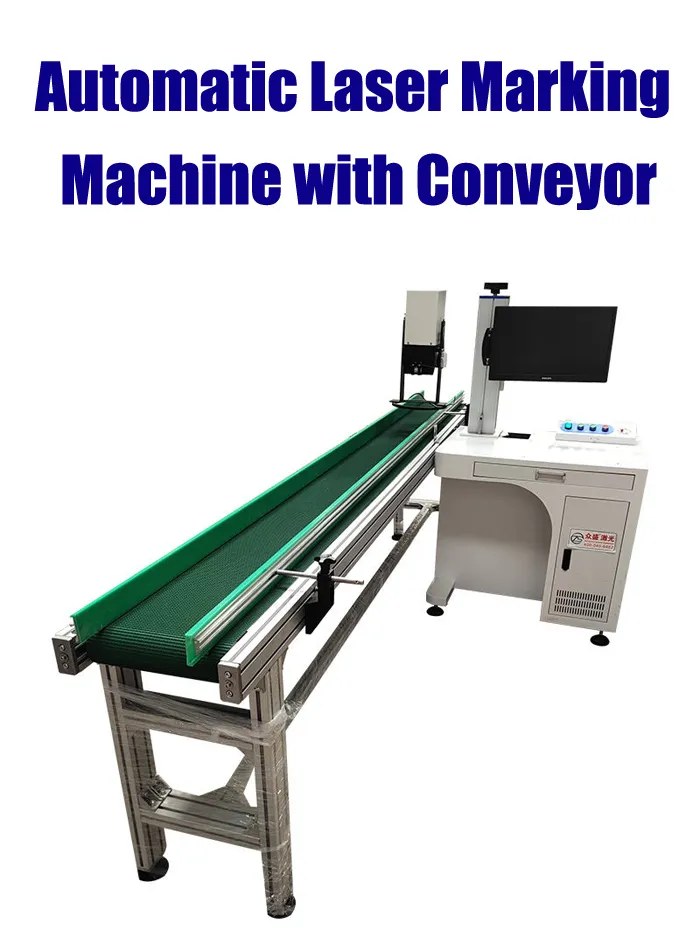
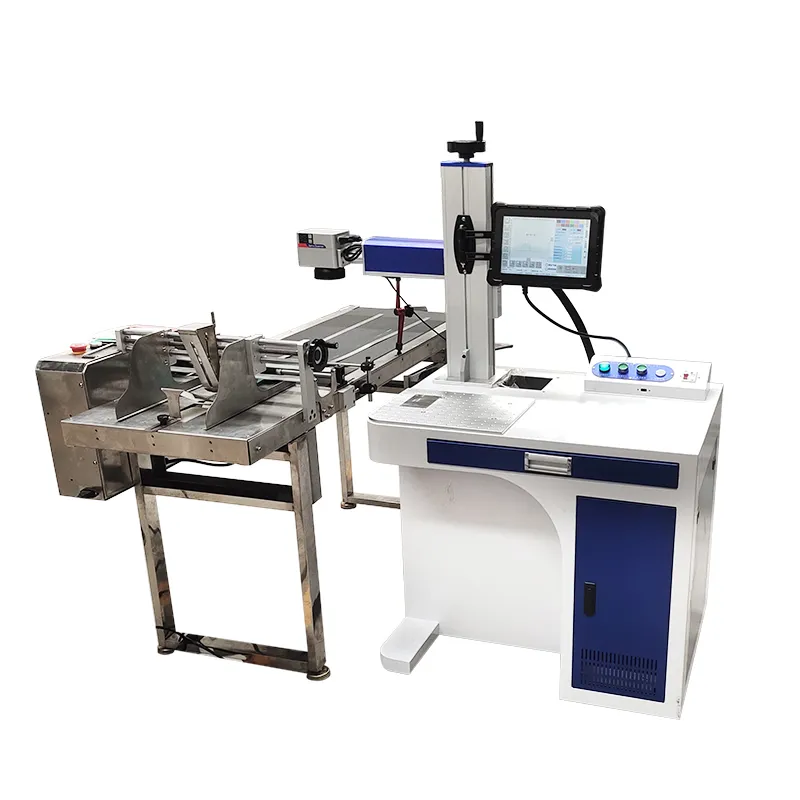
An automatic laser marking machine with conveyor combines a laser marking system with a controlled material-handling system. Instead of an operator manually placing every part under the laser, products are transported to the marking area automatically.
Depending on the application, the conveyor can either stop the product at a predefined marking position or continue moving while the laser performs mark-on-the-fly marking.
A typical system may include a laser source, galvo scanner, F-theta lens, conveyor, product sensor, encoder, PLC, controller and optional vision inspection system.
Conveyor transports the part
Sensor detects product arrival
Part is positioned or tracked
Required information is marked
Optional vision or code verification
Stop-and-Mark vs. Mark-on-the-Fly
A conveyor laser marking system does not always need to work while the product is moving. The correct method depends on the product, marking position, required accuracy and production takt time.
| Factor | Stop-and-Mark | Mark-on-the-Fly |
|---|---|---|
| Product Movement | Product stops at marking station | Product continues moving |
| Position Control | Fixture, stopper or index mechanism | Encoder and synchronized control |
| Typical Advantage | Simpler positioning and process control | Less stopping time for continuous production |
| Best Fit | Products requiring controlled positioning | Continuous conveyor production |
| Engineering Requirement | Usually simpler | Requires appropriate encoder and synchronization |
Stop-and-Mark vs. Mark-on-the-Fly
A conveyor laser marking system does not always need to work while the product is moving. The correct method depends on the product, marking position, required accuracy and production takt time.
| Factor | Stop-and-Mark | Mark-on-the-Fly |
|---|---|---|
| Product Movement | Product stops at marking station | Product continues moving |
| Position Control | Fixture, stopper or index mechanism | Encoder and synchronized control |
| Typical Advantage | Simpler positioning and process control | Less stopping time for continuous production |
| Best Fit | Products requiring controlled positioning | Continuous conveyor production |
| Engineering Requirement | Usually simpler | Requires appropriate encoder and synchronization |
How Does a Conveyor Laser Marking System Work?
Main Components of a Conveyor Laser Marking Machine
| Component | Function | Why It Matters |
|---|---|---|
| Laser Source | Creates laser beam | Determines suitability for material and marking process |
| Galvo Scanner | Moves laser beam | Affects marking speed and positioning |
| Conveyor | Moves products | Must match product size, weight and required line speed |
| Photoelectric Sensor | Detects product | Provides the trigger point |
| Encoder | Measures conveyor movement | Important for mark-on-the-fly applications |
| PLC | Controls sequence | Coordinates conveyor, laser and production signals |
| Fixture / Guide | Controls product orientation | Reduces positioning variation |
| Vision System | Positioning or verification | Useful for variable product position or automatic inspection |
What Can an Automatic Conveyor Laser Marker Mark?
Conveyor-based laser marking is particularly useful when the same type of identification needs to be applied repeatedly across a large number of products.
Unique product identification.
Product information and traceability.
Compact identification for industrial parts.
Automated product identification.
Permanent brand identification.
Model and component identification.
Production batch traceability.
Production or identification dates.
Which Laser Source Should Be Used?
Conveyor automation does not determine the laser type by itself. The laser source should first be selected according to the material and required marking result.
| Laser | Typical Materials | Common Conveyor Applications |
|---|---|---|
| Fiber Laser | Stainless steel, aluminum, brass, copper, titanium and other metals | Serial numbers, QR codes, Data Matrix, logos and industrial identification |
| MOPA Fiber | Metals, anodized aluminum and selected plastics | High-contrast marks, color marking and specialized material processing |
| UV Laser | Plastics, electronics, glass and selected sensitive materials | Fine identification and applications where heat impact needs to be controlled |
How Fast Can a Conveyor Laser Marking System Run?
This is one of the most important questions when designing an automated marking system. However, maximum galvo scanning speed should not be confused with actual production throughput.
A fiber laser system may have a published scanning speed of up to around 7,000 mm/s depending on configuration, but the real cycle time depends on the size and complexity of the marking, product spacing, conveyor speed, positioning, triggering, inspection and material response.
A small serial number is normally faster than a large detailed logo.
Distance between products affects available marking time.
Stop-and-mark systems may require additional indexing time.
Vision verification adds processing time when required.
Conveyor Design Considerations for Laser Marking
Product Size
Conveyor width and support should match the dimensions and weight distribution of the products.
Product Stability
Parts should remain sufficiently stable during marking to maintain the required position and mark quality.
Conveyor Speed
The conveyor speed must be considered together with marking content and available marking time.
Product Spacing
Consistent spacing makes automatic triggering and dynamic marking easier.
Marking Height
The laser focus position must be matched to the product surface.
Upstream / Downstream Equipment
Conveyor design should account for the equipment before and after the marking station.
Conveyor Laser Marking Applications
Automotive Parts
Mark part numbers, serial numbers, Data Matrix codes and traceability information.
Electronics
Identify electronic components, housings, connectors and PCBs.
Hardware & Tools
Continuous marking of metal tools, fittings and industrial parts.
Battery Manufacturing
Cell, module and pack identification and traceability.
Medical Devices
Permanent product identification and traceability marking.
Packaging
Variable date, batch and product identification applications.
Conveyor Laser Marking vs. Manual Loading
| Factor | Manual Loading | Conveyor Automation |
|---|---|---|
| Product Handling | Operator handles parts | Conveyor transports parts |
| Production Volume | Low to medium volume | Medium to high repetitive production |
| Operator Dependency | Higher | Lower for repetitive handling |
| Initial Cost | Lower | Higher |
| Flexibility | High | Depends on conveyor and fixture design |
| Best Application | Mixed and lower-volume jobs | Repeated production and inline marking |
How to Choose the Right Conveyor Laser Marking System
The conveyor should be designed around the product and production process, not selected as a separate accessory after purchasing the laser.
Confirm length, width, height, weight and how the product sits on the conveyor.
Determine whether the mark is on the top, side, bottom or another surface.
Specify parts per minute, parts per hour or required takt time.
Consistent spacing can simplify sensor triggering and dynamic marking.
Decide whether each product receives fixed or unique variable information.
Determine whether automatic position, OCR, barcode or Data Matrix verification is required.
JQ Laser Conveyor Marking System Configuration
| Laser Type | Fiber / MOPA Fiber / UV depending on application |
|---|---|
| Fiber Power Options | Common configurations include 20W, 30W, 50W, 60W and 100W |
| Wavelength | 1064 nm for standard fiber laser systems |
| Typical Marking Area | 110 × 110 mm standard configuration, with larger fields available depending on lens selection |
| Conveyor | Customized according to product size, weight and production process |
| Trigger | Photoelectric sensor or other suitable detection method |
| Encoder | Optional / required according to mark-on-the-fly design |
| Control | PLC and marking controller according to integration requirements |
| Vision | Optional for positioning and marking verification |
Final configuration should be confirmed after reviewing the actual product, marking content, production speed, conveyor layout and integration requirements.
Common Problems with Conveyor Laser Marking
Mark Position Changes
Product movement, inconsistent spacing or unstable positioning can affect the marking position.
Conveyor Vibrations
Mechanical vibration can affect product stability and therefore marking consistency.
Wrong Trigger Timing
Sensor location and signal timing must be matched to the product’s actual position.
Insufficient Marking Time
Conveyor speed may exceed the available marking time for the selected content and laser configuration.
Incorrect Variable Data
Variable-data systems require proper communication and data validation before the marking trigger.
Code Readability Problems
Material condition, contrast, code size, parameters and inspection conditions can all affect readability.
What Information Do We Need for a Conveyor Laser Marking Project?
You do not need a complete automation drawing to start. Product and production information is enough for an initial engineering review.
Automatic Laser Marking Machine with Conveyor FAQ
Can the laser mark products while they are moving on the conveyor?
Yes. Mark-on-the-fly laser marking can be used when the laser controller, trigger system and encoder are properly configured for the conveyor movement.
Does a conveyor laser marking machine need an encoder?
Not every conveyor system needs an encoder. A stop-and-mark system may use a sensor and positioning mechanism, while mark-on-the-fly applications generally require suitable movement synchronization.
Can the conveyor laser marking machine connect to a PLC?
Yes. PLC integration can be used for product detection, trigger signals, machine status, conveyor control and production sequencing. The exact interface depends on the customer’s automation system.
Can each product receive a different serial number?
Yes. Variable serial numbers, batch numbers and other production data can be marked when the marking system is properly integrated with the required data source.
Do I need a vision system?
Not necessarily. Vision is useful when product position varies, automatic alignment is required, or the final marking needs to be automatically verified.
What materials can be marked on a conveyor system?
Fiber lasers are commonly used for metals such as stainless steel, aluminum, brass, copper and titanium. MOPA and UV lasers can be selected for applications involving anodized aluminum, selected plastics, electronics and other materials.
How fast is a conveyor laser marking machine?
Actual throughput depends on the marking content, product spacing, conveyor speed, positioning method, laser configuration and inspection requirements. Maximum galvo scanning speed should not be treated as the complete production cycle time.
Related Laser Marking Solutions
Automated laser marking systems for industrial production.
Laser Marking Machine for Production LineProduction-line integration, PLC, MES and traceability.
Fiber Laser Marking MachineIndustrial fiber laser marking for metals and selected materials.
MOPA Fiber Laser Marking MachinePulse-controlled marking for specialized applications.
UV Laser Marking MachineFine and low-heat marking applications.
TCO & ROI CalculatorEstimate investment, operating costs and payback.
Need a Conveyor Laser Marking Solution?
Send us your product photos, material, marking content and production requirements. We can evaluate the laser type, conveyor configuration, triggering method and automation requirements for your application.
Request a Conveyor Marking Solution