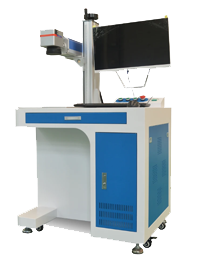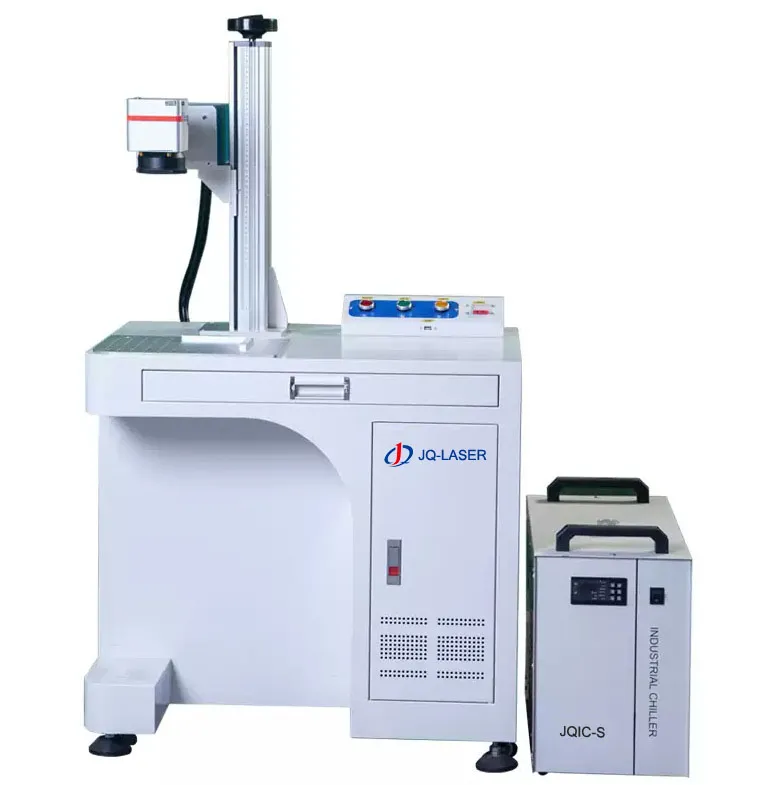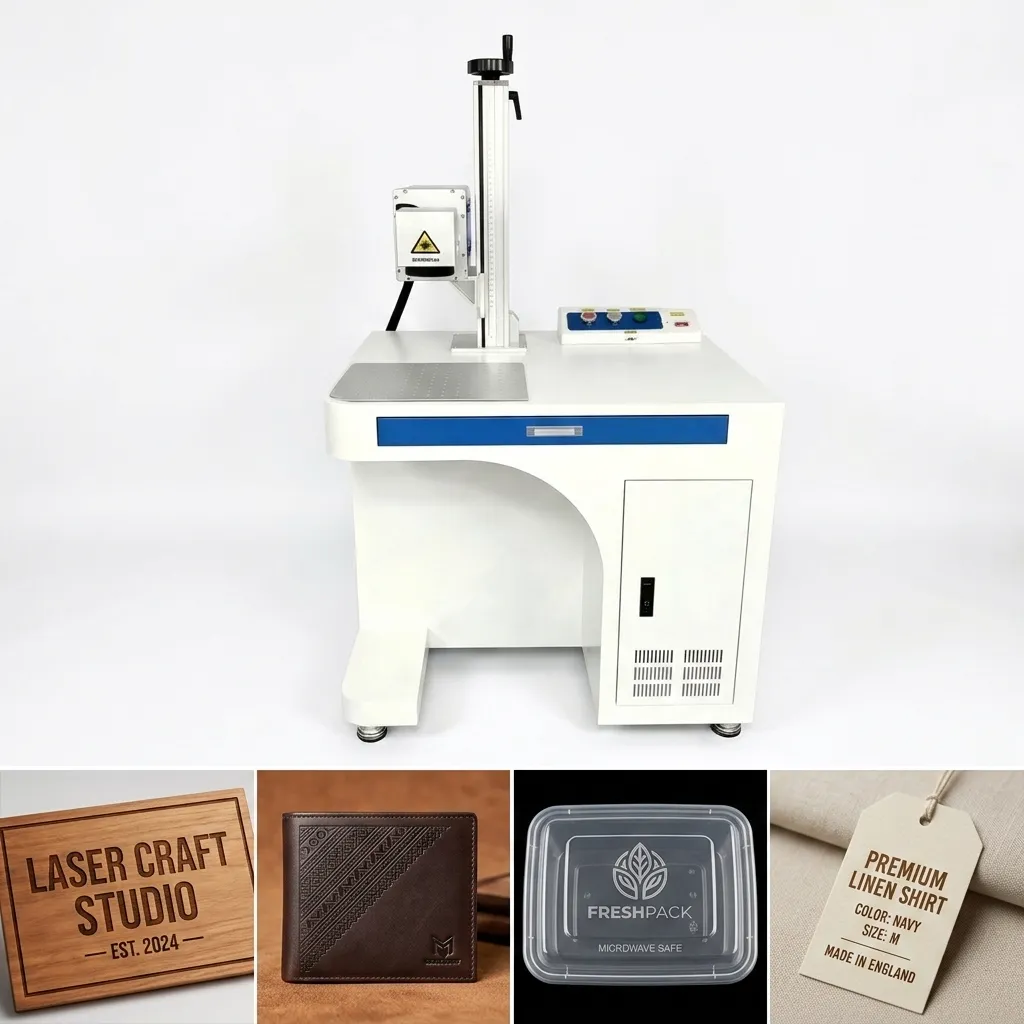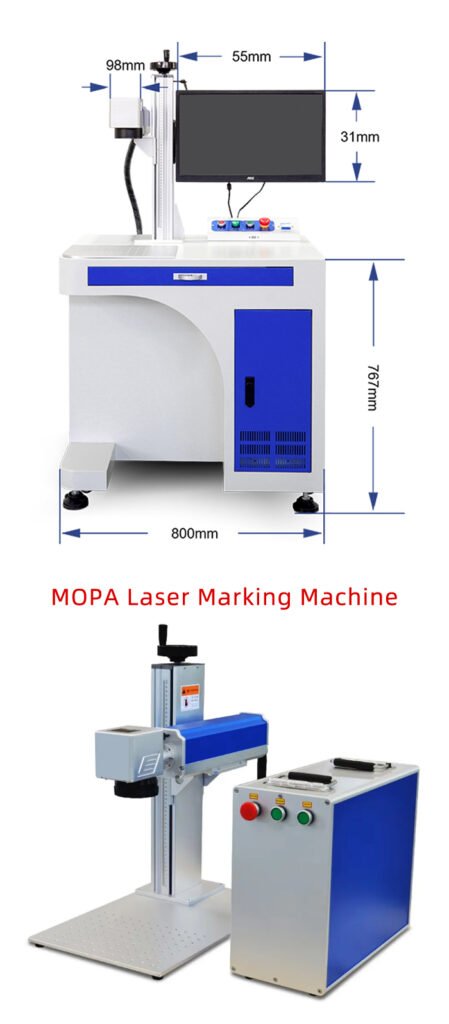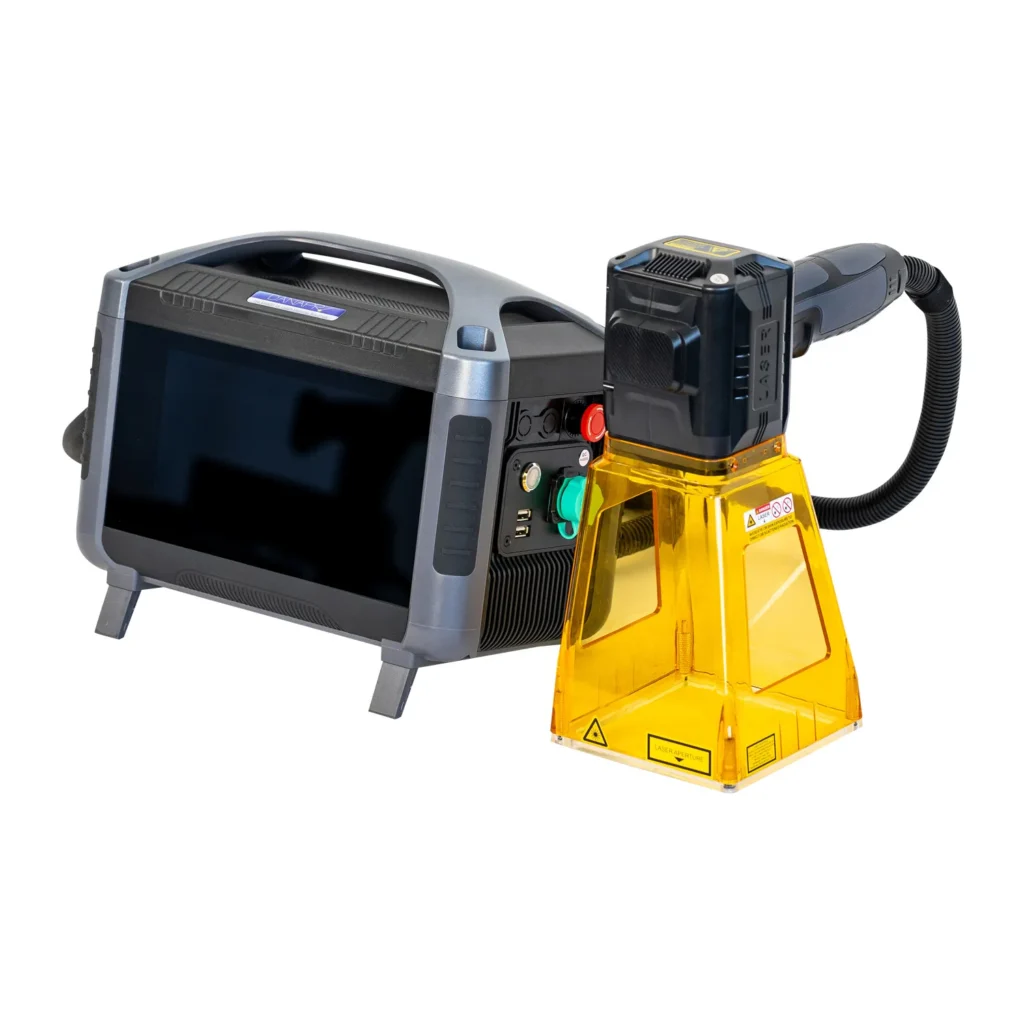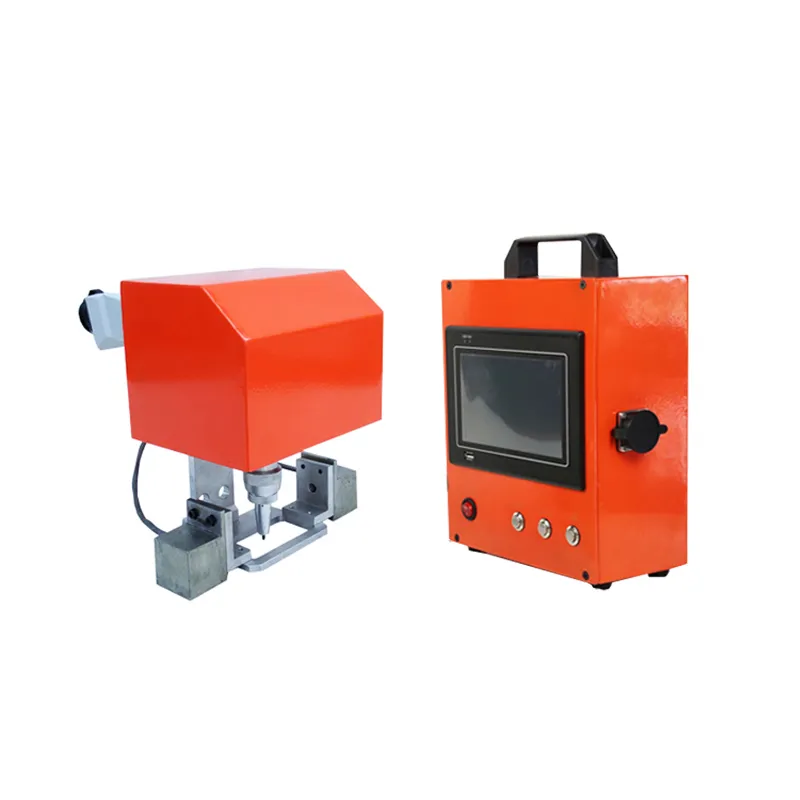
3D Laser Marking Machine
3D laser marking machines use dynamic focusing or 3D scanning technology to maintain the laser focus when marking curved, tilted, stepped and multi-level surfaces.
If your product is flat, a standard 2D fiber laser may already be enough. A 3D system becomes useful when the surface height changes across the marking area and you need the mark to stay consistent.
Typical configurations: 20W / 30W / 50W / 100W Fiber or MOPA laser source + dynamic focus / 3D scanning system.
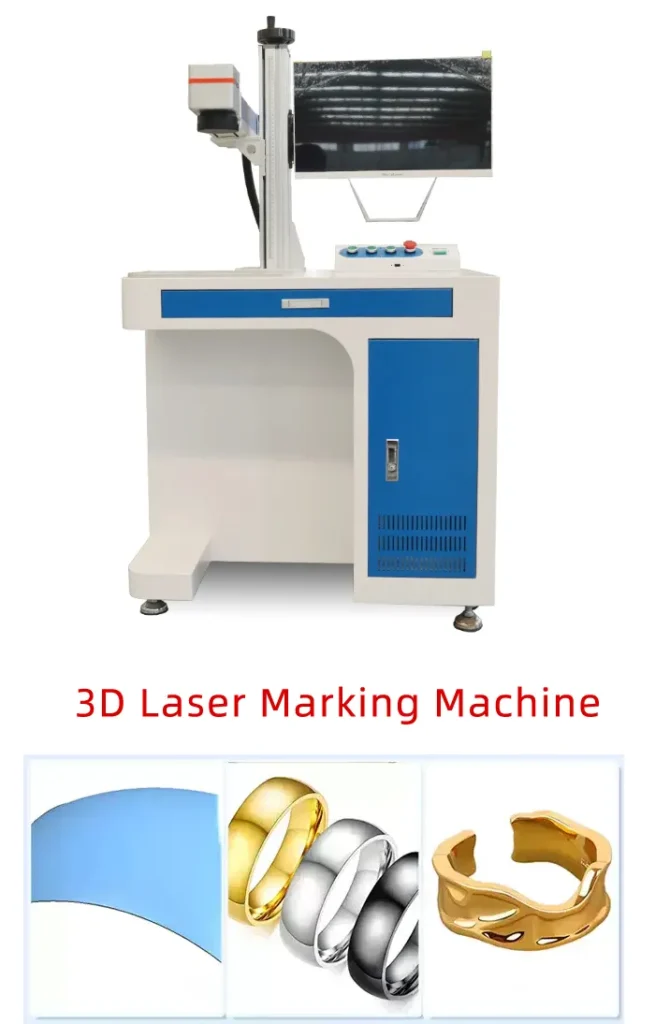
Typical 3D Laser Marking Machine Price
Typical FOB reference ranges for common 3D fiber configurations. Not a fixed JQ Laser quotation.
Price depends on laser power and source, dynamic focus head, 3D marking area, Z-range, software, rotary axis, enclosure, automation and shipping terms.
Price ranges are market/typical FOB references for comparison. Final price depends on the confirmed machine configuration.
What Makes a Laser Marking Machine “3D”?
Not every machine with a Z-axis is a true 3D laser marking system. The optical configuration matters.
2D Laser
The laser focus is calibrated for a relatively flat working surface. The machine is ideal for ordinary logos, serial numbers, QR codes and graphics on flat parts.
Best for: Flat surfaces2.5D / Z-Control
A motorized Z-axis or software-controlled depth function can handle stepped heights and some relief/deep-engraving jobs.
Best for: Stepped / relief workTrue 3D Dynamic Focus
A dynamic-focus system continuously changes the focal position to follow a curved or three-dimensional surface.
Best for: Curved / irregular surfacesA practical buying rule: If your part is flat, do not pay for a 3D system just because the specification sounds more advanced. If your part has a continuous curve or large height variation, ask the supplier whether the machine uses a real dynamic-focus head and request a sample on the actual part.
What Makes a Laser Marking Machine “3D”?
Not every machine with a Z-axis is a true 3D laser marking system. The optical configuration matters.
2D Laser
The laser focus is calibrated for a relatively flat working surface. The machine is ideal for ordinary logos, serial numbers, QR codes and graphics on flat parts.
Best for: Flat surfaces2.5D / Z-Control
A motorized Z-axis or software-controlled depth function can handle stepped heights and some relief/deep-engraving jobs.
Best for: Stepped / relief workTrue 3D Dynamic Focus
A dynamic-focus system continuously changes the focal position to follow a curved or three-dimensional surface.
Best for: Curved / irregular surfacesA practical buying rule: If your part is flat, do not pay for a 3D system just because the specification sounds more advanced. If your part has a continuous curve or large height variation, ask the supplier whether the machine uses a real dynamic-focus head and request a sample on the actual part.
Typical 3D Laser Marking Machine Specifications
The figures below are typical industry configurations used as a reference. Exact specifications depend on the selected laser source, dynamic-focus head, lens and 3D system.
| Parameter | Typical Configuration | Buyer Should Confirm |
|---|---|---|
| Laser Type | Fiber / MOPA Fiber | Exact laser source model |
| Laser Power | 20W / 30W / 50W / 100W | Rated output power |
| Wavelength | 1064 nm for common fiber systems | Actual source wavelength |
| Standard Flat Field | 150×150 / 200×200 / 300×300 mm | F-theta lens and actual field |
| 3D Field | Approx. 300×300 / 400×400 / 600×600 mm | Effective 3D field |
| Z Range | Often ±50 mm / ±100 mm class | Exact effective Z range |
| Maximum Scanning Speed | About 7,000–12,000 mm/s* | Actual process speed |
| Minimum Line Width | About 0.02 mm from* | Actual sample result |
| Minimum Character | About 0.2 mm from* | Material and curvature |
| 3D Module | Dynamic focus / 3D scanning head | Exact head model |
* Speed, line width and character size are reference values. They should not be treated as guaranteed production values on curved surfaces. Sample testing is recommended.
What’s Included in the Standard Configuration?
Before comparing laser marking machine prices, make sure you are comparing the same configuration.
| Item | Standard | Optional / Confirm Before Order |
|---|---|---|
| Laser Source | Selected fiber laser source | Brand and exact model |
| Galvo Scanner | Configured scanner | Brand / aperture / speed |
| F-Theta Lens | Selected marking field | 110 / 150 / 175 / 200 mm or other |
| Control System | Laser marking software + controller | Software version / interface |
| Rotary Axis | Not included unless specified | Chuck / roller / diameter range |
| Enclosure | Depends on configuration | Full enclosure / safety interlock |
Which 3D Laser Power Should You Buy?
The correct power depends on the material, required depth, marking area, cycle time and surface geometry.
3D Entry
Suitable for smaller curved parts, light marking and some relief applications where deep material removal is not the main requirement.
Typical reference: USD 4,000–7,000General Industrial
A practical middle option for automotive components, tooling, curved logos and general industrial 3D marking.
Typical reference: USD 5,000–9,000Deep & Faster
More suitable when deeper engraving, relief work or higher throughput becomes important.
Typical reference: USD 7,000–13,000Industrial Production
Better suited to high material removal, deep engraving, large parts and production environments.
Typical reference: USD 10,000–25,000+Our practical recommendation: Do not choose 100W simply because it is faster on paper. If the customer only needs curved logos or traceability marks, 30W or 50W may be enough. If the project involves deep engraving, large-area relief or high production volume, higher power becomes more meaningful.
3D Laser Marking Machine Buying Information
Before placing an order, confirm the configuration, price basis, lead time and sample-testing requirements.
| Purchasing Item | What We Specify | What Buyer Should Confirm |
|---|---|---|
| Configuration |
20W / 30W / 50W / 100W Fiber or MOPA + 3D Dynamic Focus | Laser source + 3D head + lens + field + Z range |
| Typical Price | USD 4,000–25,000+ | Final configuration and shipping terms |
| MOQ | 1 set for standard machine | Customized automation may require project review |
| Lead Time | Confirmed after configuration | Production starts after order/deposit and specification confirmation |
| Sample Testing | Available | Send actual material and workpiece where possible |
| Shipping | EXW / FOB / CIF subject to quotation | Destination + shipping terms |
Important: The price shown on this page is a typical reference range, not a fixed quotation. The final price depends on the laser source, dynamic-focus system, 3D field, Z range, rotary axis, enclosure, automation and shipping terms.
When Does 3D Laser Marking Actually Make Sense?
Problem 1: Curved Surface
With a conventional 2D system, the focal point is normally calibrated to a specific plane. On a strongly curved part, different areas can move away from the ideal focus.
3D solution: dynamically adjust the focal position.
Problem 2: Multi-Level Surface
A component may contain several different heights. Manually adjusting the Z-axis for every level slows production.
3D solution: software-controlled focus/depth handling.
Problem 3: Large Curved Parts
Large components may exceed the useful focus range of a conventional small-field lens.
3D solution: larger dynamic field with controlled Z range.
Problem 4: Relief & Deep Engraving
Some customers need a three-dimensional engraving effect rather than a simple surface mark.
3D solution: depth-controlled marking strategies.
3D Laser Marking Applications
The machine is most useful when the product geometry itself creates a marking problem.
Automotive Parts
Mark curved housings, engine components, cast parts, gears and other traceability surfaces.
Molds & Tooling
Deep engraving, serial numbers, logos, cavity identification and relief-style processing.
Curved Metal Parts
Mark cylindrical, tilted or irregular metal components without treating the whole surface as a flat plane.
Rings & Jewelry
Mark curved rings and small contoured products when a rotary axis alone does not solve the focal-height problem.
Medals & Coins
Relief logos, textures, lettering and depth-controlled engraving on suitable metal products.
Large Irregular Components
Useful when the workpiece has significant height variation across the marking area.
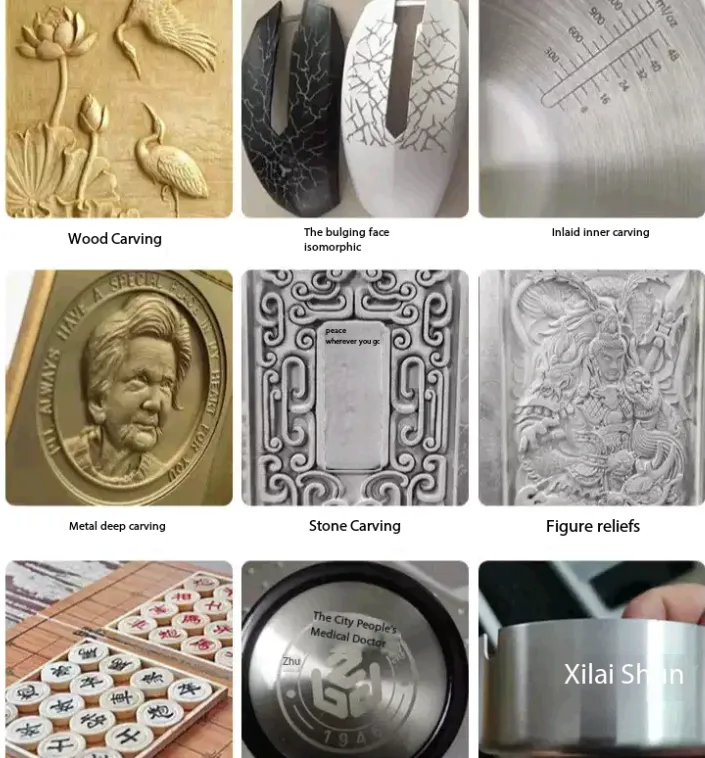
3D Marking Area Is Not the Same as Z Range
This is one of the specifications buyers should ask about before ordering a 3D laser marking machine.
3D Marking Field
This describes the effective X-Y working area of the 3D optical system.
Z Working Range
This describes how much surface-height variation the dynamic focus system can accommodate.
Do not accept a quotation that only says: “600×600 mm 3D marking.”Ask the supplier to specify the actual 3D field, effective Z range, dynamic-focus head and lens/optical configuration.
Why Does a 3D Laser Marking Machine Cost More?
The extra cost is not simply the laser wattage.
| Component | What It Does | Why It Affects Price |
|---|---|---|
| Dynamic Focus Head | Moves the focus position dynamically | Optical complexity and performance |
| 3D Control Software | Maps the marking geometry and focus | Software and controller compatibility |
| Larger 3D Field | Covers larger workpieces | Optical design and scan-head requirements |
| Z Range | Accommodates height changes | Depends on the dynamic system |
| Automation | Fixtures, rotary, vision and PLC | System integration cost |
As a reference, the supplied market research estimates a 3D dynamic-focus module itself can add roughly USD 2,000–10,000+, depending on the scan head, Z range, software, field size and automation level.
3D Laser Marking Machine Buying Checklist
Before comparing quotations, ask every supplier for the same technical fields.
Brand, complete model, wavelength, output power, frequency/pulse specifications and warranty.
Exact dynamic-focus or 3D scanning head model.
Actual 2D marking field and lens configuration.
Actual effective 3D marking area.
Effective Z working range for the actual selected configuration.
Software name, version, 3D capability and license.
If cylindrical parts are involved, confirm rotary type, diameter range and synchronization.
Require testing on the actual curved or irregular workpiece.
3D Laser Marking Machine Buying Checklist
Before comparing quotations, ask every supplier for the same technical fields.
Brand, complete model, wavelength, output power, frequency/pulse specifications and warranty.
Exact dynamic-focus or 3D scanning head model.
Actual 2D marking field and lens configuration.
Actual effective 3D marking area.
Effective Z working range for the actual selected configuration.
Software name, version, 3D capability and license.
If cylindrical parts are involved, confirm rotary type, diameter range and synchronization.
Require testing on the actual curved or irregular workpiece.
Have a Curved or Irregular Part?
Send us the actual workpiece or a clear photo with the marking area identified. We can first determine whether you need a standard 2D system, 2.5D configuration or true 3D dynamic focus.
Recommended information: material + part dimensions + surface curvature + marking size + desired depth + production volume.
Explore Related Laser Marking Solutions
The best laser marking machine depends on your material, surface shape, marking depth and production requirements. Use the related pages below to compare different solutions.
Fiber Laser Marking Machine
A standard fiber laser marking solution for stainless steel, aluminum, brass, copper and other suitable metals.
View Fiber Laser Marking Machine →MOPA Fiber Laser Marking Machine
Consider MOPA when you need more control over pulse parameters, black marking, fine processing or certain plastic applications.
View MOPA Fiber Laser →50W Fiber Laser Marking Machine
A higher-power option for customers who need deeper engraving, faster processing or higher production throughput.
View 50W Fiber Laser →Fiber Laser Marking Machine for Metal
Learn how fiber laser systems are used for metal identification, serial numbers, QR codes, logos and industrial marking.
Explore Metal Marking →Fiber Laser for Stainless Steel
Compare marking methods for stainless steel products, including logos, serial numbers, QR codes and identification marks.
View Stainless Steel Solution →Automatic Laser Marking Machine
For production lines that require fixtures, conveyors, vision inspection, automatic positioning or PLC integration.
View Automatic Laser Marking →Not sure which system you need? If your workpiece is flat metal, start with a standard fiber laser marking machine .If you need more pulse control or special marking effects, compare a MOPA fiber laser .If your surface is curved, tilted or has significant height variation, a 3D laser marking system may be the better configuration.
Explore Materials & Applications
Popular Materials
Stainless Steel • Aluminum • Copper • Brass • Titanium
Common Applications
Automotive • Electronics • Medical • Jewelry • Hardware
3D Laser Marking Machine FAQ
What is a 3D laser marking machine?
A 3D laser marking machine uses dynamic focusing or a 3D scanning system to control the laser focus across surfaces with height or geometry changes. It is commonly used for curved, tilted, multi-level and irregular parts.
Is a motorized Z-axis the same as a true 3D laser?
No. A motorized Z-axis mainly changes the machine or focus height. A true 3D dynamic-focus system changes the focal position according to the surface geometry during the marking process.
What materials can a 3D fiber laser mark?
Typical fiber-laser applications include stainless steel, aluminum, carbon steel, titanium, brass, copper and other suitable metals. The actual result depends on material grade, surface condition, laser source and process settings.
What is the typical 3D marking area?
Common reference configurations include approximately 300×300 mm, 400×400 mm and 600×600 mm 3D fields. The effective field depends on the dynamic-focus head and optical design.
What is the Z range of a 3D laser marking machine?
Typical industry references include ±50 mm and ±100 mm class ranges, but the actual usable range must be confirmed for the selected 3D head and optical configuration.
How much does a 3D laser marking machine cost?
Typical FOB reference ranges in the supplied market research are about USD 4,000–7,000 for 20W, USD 5,000–9,000 for 30W, USD 7,000–13,000 for 50W and USD 10,000–25,000+ for 100W. Actual pricing depends on the complete configuration.
Do I need a 3D laser if my products are flat?
Usually not. If the workpieces are consistently flat, a standard 2D fiber laser is often more economical. A 3D system becomes more valuable when surface height changes affect focus or marking quality.
Can you test our curved product before we buy?
Yes. For curved and irregular products, sample testing is strongly recommended because the final result depends on the actual geometry, material, marking size and required depth.
Technical Notes & Data Sources
The technical information on this page is based on publicly available laser-source, galvo, 3D scanning and laser-marking equipment documentation, together with the supplied market research for 3D fiber laser marking systems.
The typical configurations referenced on this page include 20W, 30W, 50W and 100W fiber or MOPA fiber sources, commonly paired with dynamic-focus or 3D scanning systems.
3D marking field, effective Z range, minimum line width and production speed depend on the actual optical system and workpiece geometry. These values should therefore be verified through sample testing before purchase.
Price ranges shown on this page are typical market/FOB reference ranges rather than guaranteed JQ Laser quotations.
- JPT Laser — 3D Laser Marking technical explanation
- JCZ / EZCAD — Galvo and laser control system documentation
- Laserax — 3D laser marking and curved-surface applications
- Public laser equipment market references supplied for this page
Choose the 3D System Based on Your Part — Not Just the Wattage
If you are not sure whether your application needs 2D, 2.5D or true 3D dynamic focus, send us your part information first. We can evaluate the surface geometry, marking area and required result before recommending a configuration.