MOPA Fiber Laser Color Engraving Machine
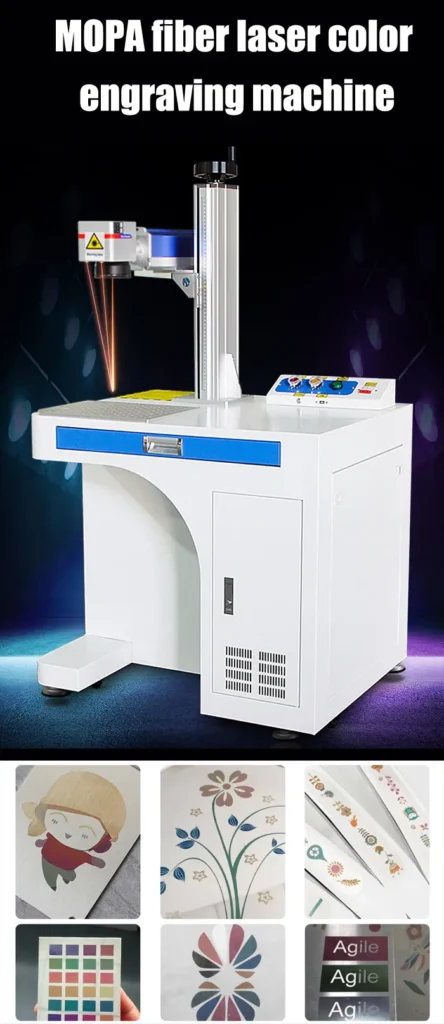
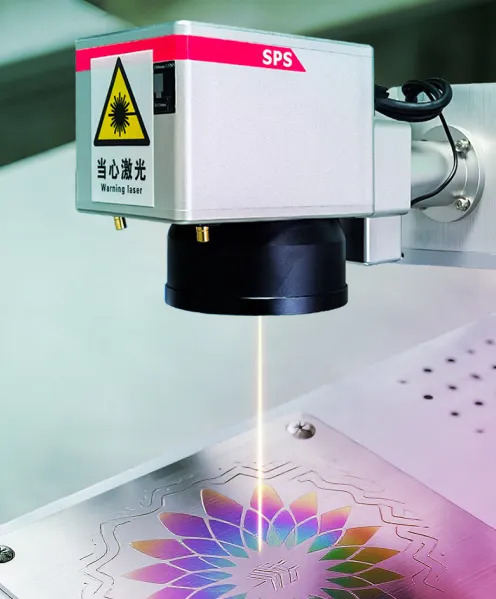
Flexible MOPA fiber laser system for stainless steel color marking, black marking on anodized aluminum, high-contrast plastic marking and fine metal engraving. Adjustable pulse duration gives you more control over heat input and marking appearance than a conventional fixed-pulse fiber laser.
Color results depend on material alloy, surface condition, laser parameters and process setup.
What Makes a MOPA Fiber Laser Different?
A conventional fiber laser gives you control over parameters such as power and marking frequency, but a MOPA fiber laser also provides greater control over pulse duration. This additional parameter can change how laser energy interacts with the material surface.
For applications such as stainless steel color marking, black marking on anodized aluminum, fine metal processing and selected plastic applications, this additional control can make it easier to develop a suitable process window.
MOPA is therefore not simply a “more powerful fiber laser.” Its main advantage is process flexibility. The correct choice still depends on the material, marking objective, production volume and required appearance.
How Does MOPA Laser Color Marking Work?
MOPA color marking on stainless steel is generally achieved through controlled laser annealing rather than adding colored ink or coating to the metal. The laser changes the surface condition and optical appearance of the material through controlled heating.
Pulse duration, frequency, power, scanning speed, line spacing, focus position and the material itself all influence the final result. Changing the pulse width can produce different visual colors under suitable conditions.
Do not evaluate a MOPA machine only by looking at a color sample from another supplier. Stainless steel alloys, surface finish and laser parameters can change the final color. Always request a sample test using your actual material.
What Colors Can a MOPA Laser Produce?
MOPA laser color marking can create different visual colors on suitable stainless steel surfaces by changing laser parameters. The available color range is material- and parameter-dependent rather than a fixed “paint palette.”
High-contrast industrial marking
Decorative and product identification applications
Decorative metal marking applications
Possible under suitable material and parameter conditions
Actual color results must be verified on the customer’s material and alloy.
MOPA Fiber Laser vs Standard Fiber Laser
| Feature | Standard Fiber Laser | MOPA Fiber Laser |
|---|---|---|
| Wavelength | Typically 1064nm | Typically 1064nm |
| Pulse Duration | More limited | Adjustable over a wider range depending on source |
| Standard Metal Marking | Excellent | Excellent |
| Stainless Steel Color Marking | Limited | Suitable under controlled conditions |
| Black Anodized Aluminum | Possible depending on process | Strong application advantage |
| Plastic Processing | Material dependent | More parameter flexibility |
MOPA Fiber Laser Color Engraving Applications
MOPA technology is particularly useful when standard fiber laser marking does not provide enough control over color, contrast, heat input or surface appearance.
Stainless Steel Color Marking
Create controlled color effects and decorative markings on suitable stainless steel alloys.
Anodized Aluminum
Produce high-contrast black markings on selected anodized aluminum surfaces.
Electronics
Fine identification, serial numbers, QR codes and component marking where controlled heat input is important.
Automotive Components
Permanent identification, part numbers, logos and traceability codes on metal components.
Medical Devices
Fine and permanent marking applications on suitable metal components and instruments.
Consumer Products
Decorative logos, names, graphics and customized markings on suitable metal products.
MOPA Laser Color Marking on Stainless Steel
Stainless steel is one of the best-known applications for MOPA color marking. By controlling pulse duration and other process parameters, the laser can create different surface appearances on suitable stainless steel alloys.
However, color marking should always be treated as an application-development process. Stainless steel is not a single material specification. Alloy composition, surface finish, polishing condition and previous processing can all influence the result.
Why sample testing matters
- The same nominal stainless-steel grade may have different surface conditions.
- Different alloys can produce different color responses.
- Pulse width and frequency affect the final appearance.
- Scanning speed and power also influence heat input.
- Production settings should be validated on the actual material.
Black Marking on Anodized Aluminum
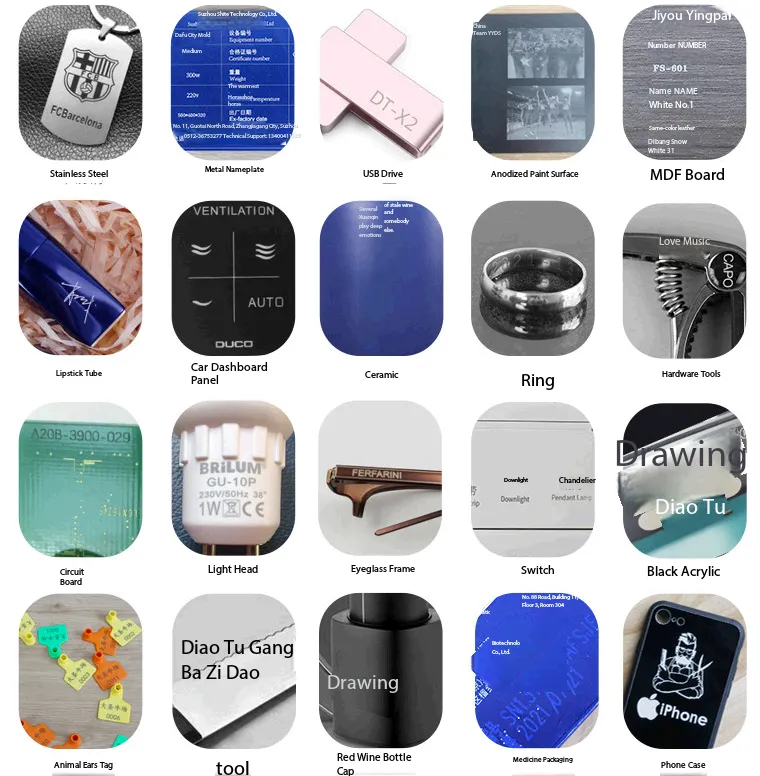
MOPA fiber lasers can also be used for high-contrast black marking on suitable anodized aluminum surfaces. This is useful for logos, text, serial numbers, QR codes and product identification where a dark, readable mark is required.
The exact result depends on the anodizing layer, aluminum surface, laser parameters and desired contrast. Parameter development should therefore be performed using the actual product rather than relying only on a generic sample.
MOPA Fiber Laser Color Engraving Machine Specifications
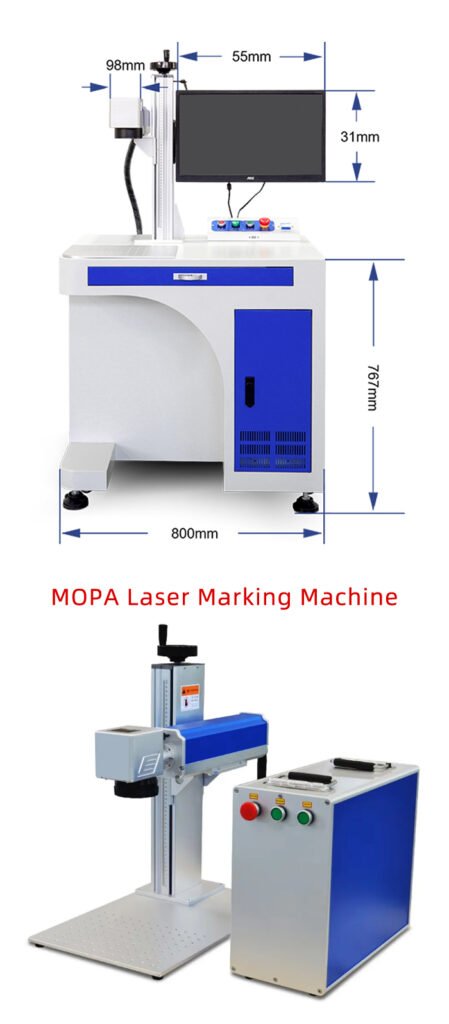
Specifications below represent a reference MOPA configuration. Final parameters may vary according to laser source, lens, power, marking field, software and application requirements.
| Laser Type | MOPA Pulsed Fiber Laser |
|---|---|
| Wavelength | 1064nm |
| Laser Power | 20W / 30W / 50W / 60W / 100W |
| Pulse Width | Approx. 1–350ns depending on source configuration |
| Frequency | Up to approximately 4000kHz depending on laser source |
| Reference Marking Speed | Up to approximately 10,000mm/s |
| Positioning Accuracy | Approx. ±0.005mm reference |
| Cooling | Air Cooling |
| Marking Field | 110 × 110mm standard reference; other lenses available |
| Software | EZCAD-compatible configuration |
| Typical Applications | Color marking, black marking, fine marking, serial numbers, QR codes and logos |
How Much Does a MOPA Fiber Laser Color Engraving Machine Cost?
MOPA systems usually cost more than basic fiber laser marking machines because the laser source provides additional pulse-control capability and is designed for more demanding applications.
The final machine price depends on laser power, laser source brand, marking field, enclosure, rotary axis, exhaust system, vision system, software configuration and other automation requirements.
- Material and material grade
- Product dimensions
- Required marking size
- Color or contrast requirement
- Production quantity
- Whether QR codes or serial numbers are required
- Whether rotary or automation is required
Test Your Material Before You Buy
MOPA color marking is highly application-dependent. Instead of promising a color based only on a catalogue photograph, we recommend testing your actual material and marking requirements before selecting the final configuration.
Send Your Sample
Provide your actual stainless steel, aluminum, plastic or other material.
Define the Target
Tell us whether you need color, black marking, contrast, logo or identification.
Develop Parameters
Test pulse width, frequency, speed and power combinations.
Evaluate the Result
Check color, contrast, readability, heat effect and production suitability.
How We Develop MOPA Laser Marking Parameters
There is no universal MOPA parameter that produces the same result on every product. Parameter development normally starts with the material and target result, followed by controlled adjustment of laser settings.
Identify alloy, coating, anodizing layer or plastic formulation where possible.
Define color, black contrast, surface finish or engraving depth.
Adjust pulse duration to change the interaction between laser energy and material.
Fine-tune energy distribution and marking response.
Adjust scanning speed, line spacing and filling strategy.
Confirm that the selected parameters remain stable across repeated production cycles.
MOPA vs Fiber vs UV Laser Marking
| Requirement | Standard Fiber | MOPA Fiber | UV Laser |
|---|---|---|---|
| General Metal Marking | Excellent | Excellent | Possible |
| Stainless Steel Color | Limited | Strong application fit | Application dependent |
| Black Anodized Aluminum | Possible | Strong application fit | Possible |
| Sensitive Plastics | Material dependent | More pulse-control flexibility | Often preferred for fine applications |
| Fine / Cold Marking | Good | Very flexible | Excellent for suitable materials |
| Main Advantage | Cost-effective metal marking | Pulse control & application flexibility | Shorter wavelength and fine material interaction |
Is a MOPA Fiber Laser Right for Your Application?
Choose MOPA if:
- You need stainless steel color marking.
- You need black marking on anodized aluminum.
- You work with heat-sensitive or difficult plastics.
- You need more control over pulse duration.
- You need fine and controlled metal marking.
- You have several different marking requirements.
A standard fiber may be enough if:
- You mainly mark ordinary stainless steel.
- You only need serial numbers and QR codes.
- You do not require color effects.
- Your material is easy to process.
- Purchase cost is the main priority.
JQ Laser MOPA Fiber Laser Configuration
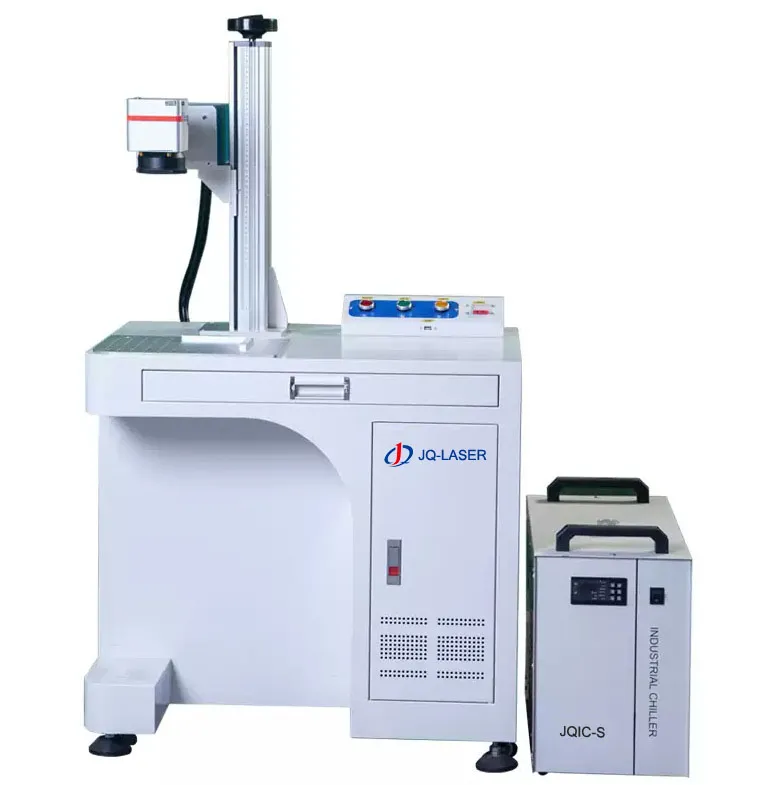
JQ Laser configures MOPA fiber laser marking systems according to the actual application. The goal is not simply to select a higher laser power, but to match the laser source, pulse parameters, marking lens, workholding method and software settings to the product.
20W–100W reference configurations depending on application.
High-speed scanning system selected according to marking field and process.
Different marking fields can be configured according to product size.
Suitable for text, graphics, serial numbers and QR/Data Matrix marking.
Optional for rings, shafts, tubes and other cylindrical workpieces.
Optional enclosed configuration according to application and safety requirements.
How We Test a MOPA Fiber Laser Before Delivery
MOPA applications are parameter-sensitive, so a machine should not be evaluated only by whether the laser turns on. For customer projects, the marking result, repeatability and machine operation should be checked together.
01. Laser Test
Check laser source operation and stability.
02. Sample Marking
Test the customer’s material and marking requirement where available.
03. Parameter Verification
Check pulse width, frequency, speed and power settings.
04. Marking Repeatability
Run repeated samples to check consistency.
05. Software Test
Verify marking files, variable data and operating functions.
06. Final Inspection
Inspect the complete system before packing and shipment.
Frequently Asked Questions About MOPA Fiber Laser Color Engraving
Can a MOPA laser engrave in color?
MOPA lasers can produce color marking on suitable stainless steel surfaces under controlled conditions. The effect is generally created through laser-induced surface changes rather than adding colored ink. Results depend on alloy and laser parameters.
What materials can a MOPA laser mark?
Typical applications include stainless steel, aluminum, anodized aluminum, selected plastics and other metal materials. Plastic results are highly dependent on the material formulation and should be tested.
Can MOPA create different colors on stainless steel?
Yes, different colors can be produced under suitable conditions by changing laser parameters such as pulse width. However, the result varies with stainless steel alloy, surface condition and process settings.
Is MOPA better than a standard fiber laser?
Not for every application. A standard fiber laser is often sufficient for general metal marking. MOPA becomes more attractive when pulse control, color marking, high-contrast marking or more demanding material processing is required.
Can MOPA mark anodized aluminum black?
Yes. Black marking on suitable anodized aluminum is a common MOPA application, although the final result depends on the anodizing layer and laser parameters.
Can MOPA mark plastic?
Yes, selected plastics can be marked with MOPA. Because polymer composition, additives and color affect laser response, sample testing is recommended.
Does MOPA require water cooling?
The reference JQ Laser MOPA configurations are air-cooled. Final cooling requirements depend on the selected laser source and system configuration.
Can the MOPA machine mark QR codes and serial numbers?
Yes. MOPA systems can be configured for text, logos, serial numbers, QR codes, Data Matrix codes and other common industrial marking content.
Can you test our stainless steel before we buy?
Yes. Providing the actual material and marking requirements is strongly recommended, especially for color marking applications.

LEO — Sales Engineer, JQ Laser
LEO has more than 10 years of experience in laser marking and has worked with applications across multiple industries, including automation marking project design and implementation.
Need Color Marking on Your Stainless Steel?
Send us your material, product photo and marking requirements. We can help determine whether MOPA is the right laser technology and develop a suitable marking process for your application.