Stainless steel is one of the most widely used materials in modern manufacturing due to its excellent corrosion resistance, mechanical strength, durability, and attractive appearance. It is commonly found in automotive components, industrial equipment, medical devices, electronic products, hardware tools, kitchen equipment, and high-value consumer products.
For manufacturers that require permanent identification, fiber laser marking has become one of the most reliable technologies for stainless steel processing.
A fiber laser marking machine can create:
- Logos
- Serial numbers
- QR codes
- Barcodes
- Product traceability information
- Decorative patterns
- Deep engraving marks
on stainless steel surfaces with high precision and excellent durability.
However, one of the most common technical questions from manufacturers is:
How can the laser marking depth be adjusted when engraving stainless steel?
The answer depends on multiple laser parameters, including:
- Laser power
- Marking speed
- Frequency
- Pulse width
- Hatch distance
- Number of passes
- Focus position
- Material characteristics
Adjusting these parameters correctly allows manufacturers to achieve different marking requirements, from shallow surface identification to deep engraving applications.
For example:
- Product serial number marking requires only a shallow surface mark.
- Automotive parts may require deeper engraving for long-term traceability.
- Mold and tooling industries may require deep engraving that can withstand repeated wear.
This guide explains how to adjust fiber laser marking depth for stainless steel, how each parameter affects engraving performance, and how manufacturers can optimize laser settings for different industrial applications.
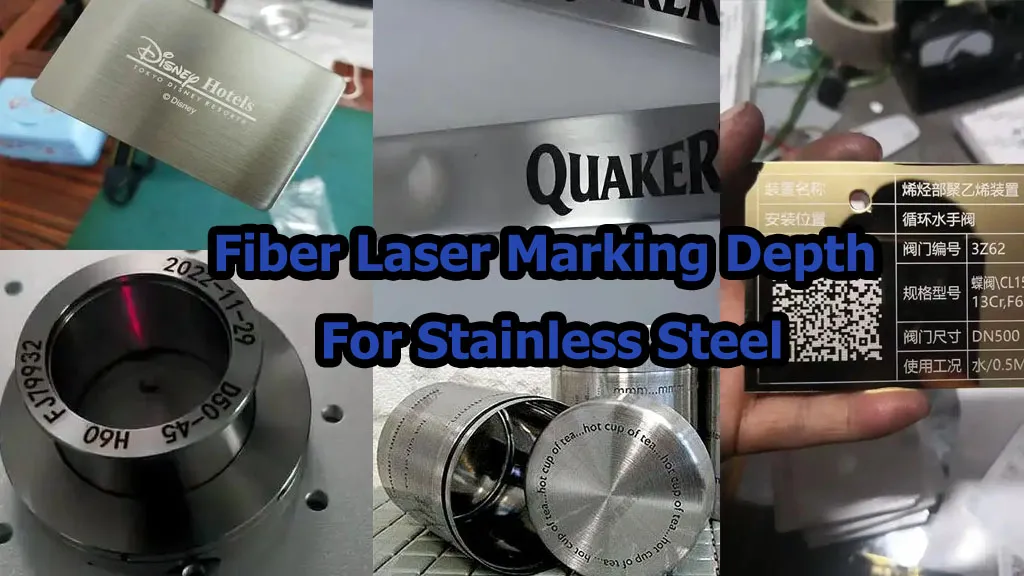
Table of Contents
What Determines Fiber Laser Marking Depth On Stainless Steel?
The engraving depth produced by a fiber laser marking machine is not controlled by a single parameter.
Instead, it is the result of interaction between laser energy density and material response.
The basic principle is:
Higher laser energy delivered to a smaller area creates deeper material removal.
A fiber laser marking system controls energy delivery through several adjustable parameters.
The main factors include:
- Laser power
- Marking speed
- Frequency
- Pulse duration
- Hatch spacing
- Number of marking passes
- Focus position
- Material composition
Understanding Fiber Laser Technology For Stainless Steel
How Fiber Laser Interacts With Stainless Steel
Most industrial fiber laser marking machines use a wavelength around:1064 nm
This wavelength provides excellent absorption characteristics for metals.
When the laser beam contacts stainless steel, the concentrated energy creates rapid heating of the surface.
Depending on the parameter settings, different results can occur:
Surface Marking
The laser modifies the surface color without significant material removal.
Typical applications:
- Logos
- Text
- Serial numbers
Annealing Marking
The laser creates controlled oxidation changes inside the stainless steel surface.
Advantages:
- Smooth surface
- No material removal
- Suitable for medical components
Common industries:
- Medical devices
- Food equipment
- Precision components
Engraving
Higher laser energy removes material from the stainless steel surface.
Applications:
- Industrial parts
- Mechanical components
- Tools
Deep Engraving
Multiple passes with optimized parameters remove a larger amount of material.
Applications:
- Molds
- Automotive components
- Heavy-duty parts
Stainless Steel Types And Laser Marking Behavior
Different stainless steel grades may react differently during laser processing.
Common stainless steel materials include:
304 Stainless Steel
One of the most widely used stainless steel grades.
Applications:
- Kitchen equipment
- Machinery parts
- Industrial products
Laser characteristics:
- Good marking quality
- High contrast
- Stable engraving performance
316 Stainless Steel
Common in:
- Medical equipment
- Marine applications
- Chemical environments
Characteristics:
- Higher corrosion resistance
- Requires optimized parameters for consistent marking
201 Stainless Steel
Used for:
- Hardware products
- Consumer products
- Decorative parts
Laser performance:
- Generally easy to mark
- Parameter adjustment required for color consistency

Difference Between Laser Marking Depth And Laser Engraving Depth
Many users confuse laser marking and laser engraving.
Although both use laser technology, they have different objectives.
| Process | Material Removal | Typical Depth | Purpose |
|---|---|---|---|
| Laser Marking | Low or none | Micron level | Identification |
| Laser Engraving | Yes | 0.01-1mm+ | Permanent depth |
| Deep Engraving | High | Multiple layers | Wear resistance |
For stainless steel:
A normal fiber laser marking application may require only:0.001-0.01 mm
while industrial engraving may require:0.05-0.5 mm
or deeper depending on machine configuration.
Key Parameters For Adjusting Stainless Steel Laser Marking Depth
1. Laser Power Adjustment
Laser power is one of the most important factors affecting engraving depth.
Common fiber laser powers:
- 20W
- 30W
- 50W
- 60W
- 100W
Higher power provides:
- More laser energy
- Faster material removal
- Deeper engraving capability
For example:
A 20W fiber laser is suitable for:
- Nameplates
- Serial numbers
- Product identification
A 50W or 100W fiber laser is more suitable for:
- Deep engraving
- Industrial parts
- Heavy-duty components
However, increasing power alone is not always the best solution.
Excessive power may cause:
- Surface overheating
- Uneven marking
- Reduced edge quality
The optimal result requires balancing power with speed and frequency.
2. Marking Speed Adjustment And Its Effect On Stainless Steel Depth
Marking speed is one of the most important parameters when adjusting fiber laser marking depth.
In simple terms:
The slower the laser moves, the longer the laser stays on each point, and the more energy is transferred into the stainless steel surface.
Therefore:
- Lower speed → Higher energy density → Deeper engraving
- Higher speed → Lower energy density → Shallower marking
However, speed should not be reduced excessively.
An extremely slow marking speed may cause:
- Excessive heat accumulation
- Rough engraving edges
- Surface discoloration
- Reduced production efficiency
For industrial stainless steel engraving, the correct approach is to balance:
- Laser power
- Speed
- Frequency
- Number of passes
Example Of Speed Adjustment
Assume a 50W fiber laser marking machine is engraving stainless steel.
Setting A:
Laser Power:
50%
Speed:
5000 mm/s
Result:
- Fast processing
- Light surface marking
- Suitable for logos and serial numbers
Setting B:
Laser Power:
80%
Speed:
1500 mm/s
Result:
- Higher energy density
- Visible material removal
- Suitable for industrial engraving
Setting C:
Laser Power:
90%
Speed:
500 mm/s
Multiple passes:
Result:
- Deep engraving
- Suitable for wear-resistant marks
3. Frequency Adjustment For Stainless Steel Laser Engraving
Laser frequency, also called pulse repetition rate, determines how many laser pulses are generated per second.
Common frequency ranges:
- 20 kHz
- 30 kHz
- 50 kHz
- 100 kHz
Frequency directly affects:
- Pulse energy
- Surface heat
- Marking texture
- Engraving efficiency
Lower Frequency
Lower frequency means:
- Fewer pulses per second
- Higher energy per pulse
Advantages:
- Stronger material removal
- Deeper engraving capability
Suitable for:
- Stainless steel engraving
- Tool marking
- Industrial components
Example:
20-40 kHz
Higher Frequency
Higher frequency means:
- More pulses
- Lower energy per pulse
Advantages:
- Smoother surface
- Better fine marking
Suitable for:
- Small text
- High-resolution graphics
- Decorative marking
Example:
60-100 kHz
Recommended Frequency Selection
| Application | Frequency Range |
|---|---|
| Surface marking | 50-100 kHz |
| Black marking on stainless steel | 40-80 kHz |
| Deep engraving | 20-50 kHz |
| Heavy industrial parts | 20-40 kHz |
4. Hatch Distance Adjustment
Hatch distance refers to the spacing between each laser scanning line.
It is one of the most important parameters affecting engraving depth.
A smaller hatch distance means:
- More laser lines
- Higher energy overlap
- More material removal
Example
Hatch Distance:
0.05 mm
Result:
- Dense laser coverage
- Smooth surface
- Higher depth
Hatch Distance:
0.15 mm
Result:
- Faster processing
- Lower energy density
- Shallower engraving
Recommended Hatch Settings For Stainless Steel
| Application | Hatch Distance |
|---|---|
| Fine marking | 0.08-0.12 mm |
| Standard engraving | 0.05-0.10 mm |
| Deep engraving | 0.03-0.08 mm |
5. Number Of Passes And Depth Control
Multiple passes are commonly used when manufacturers need deeper engraving.
A single pass removes only a limited amount of material.
By repeating the same marking path:
- More material is removed
- Engraving depth increases gradually
Single Pass Marking
Suitable for:
- Product identification
- Logos
- Serial numbers
Advantages:
- Faster production
- Lower heat generation
Multiple Pass Engraving
Suitable for:
- Automotive components
- Industrial tools
- Metal molds
Example:
Pass:
1-3
Result:
Surface engraving
Pass:
5-20
Result:
Deep engraving
Important Consideration
Increasing passes does not always produce proportional depth increase.
After several passes:
- Heat accumulation increases
- Material removal efficiency decreases
Therefore, professional parameter optimization is required.
6. Focus Position Adjustment
The laser focus position significantly affects marking quality and depth.
A fiber laser marking machine produces the highest energy density at the focus point.
Normally:
The focus point should be located exactly on the stainless steel surface.
Standard Focus
Best for:
- High-quality marking
- Small text
- Precise graphics
Defocused Marking
Moving the focus slightly above or below the surface can change the laser spot size.
Effects:
Larger spot:
- Lower energy density
- Wider engraving area
Smaller spot:
- Higher energy density
- More precise marking
Focus Offset For Deep Engraving
For deep engraving applications, some manufacturers adjust focus position gradually during multiple passes.
This helps maintain:
- Better energy delivery
- More uniform depth
- Improved side wall quality
7. Pulse Width Adjustment (For MOPA Fiber Laser)
For MOPA fiber laser systems, pulse width provides additional control.
This is especially useful for stainless steel.
Different pulse widths create different marking effects.
Short Pulse Width
Advantages:
- Higher peak power
- Better fine marking
- Reduced heat influence
Applications:
- Electronics
- Precision parts
Long Pulse Width
Advantages:
- More thermal energy
- Stronger engraving ability
Applications:
- Deep stainless steel engraving
- Industrial parts
Stainless Steel Laser Marking Parameter Reference Table
The following parameters are general references only. Actual settings depend on:
- Laser source brand
- Lens size
- Material grade
- Surface condition
- Machine configuration
| Application | Power | Speed | Frequency | Pass |
|---|---|---|---|---|
| Black marking | 30-60% | 3000-6000mm/s | 40-80kHz | 1 |
| Logo marking | 40-70% | 2000-5000mm/s | 30-60kHz | 1-2 |
| Standard engraving | 70-90% | 800-3000mm/s | 20-50kHz | 2-5 |
| Deep engraving | 80-100% | 300-1500mm/s | 20-40kHz | 5-20 |
How To Optimize Fiber Laser Parameters For Different Stainless Steel Applications
Application 1: Stainless Steel Nameplates
Requirements:
- Clear text
- High contrast
- Fast production
Recommended:
- Medium power
- Higher speed
- Single pass
Application 2: Automotive Stainless Steel Parts
Requirements:
- Permanent identification
- Long-term durability
Recommended:
- Higher power
- Lower speed
- Multiple passes
Application 3: Medical Stainless Steel Instruments
Requirements:
- No surface damage
- Corrosion resistance
Recommended:
- Annealing marking
- Controlled energy
- Minimal material removal
Application 4: Stainless Steel Tools
Requirements:
- Wear-resistant marks
Recommended:
- Deep engraving
- Lower frequency
- Multiple passes
Common Mistakes When Adjusting Stainless Steel Laser Depth
Mistake 1: Increasing Power Only
Many operators believe:
“More power always means deeper engraving.”
This is incorrect.
Depth depends on:
Power × Speed × Frequency × Hatch × Passes
A balanced parameter combination produces better results.
Mistake 2: Using Excessive Low Speed
Very low speed may create:
- Burn marks
- Rough edges
- Heat deformation
The goal is not the slowest speed, but the highest energy efficiency.
Mistake 3: Incorrect Focus Position
Incorrect focus causes:
- Weak marking
- Uneven depth
- Blurred edges
Always calibrate focus before parameter testing.
Mistake 4: Ignoring Stainless Steel Grade
Different grades have different compositions.
304, 316, 201 stainless steel may require different parameters.
Professional Method For Adjusting Fiber Laser Marking Depth On Stainless Steel
In industrial manufacturing, adjusting fiber laser marking depth is not simply a process of increasing laser power or reducing marking speed. Professional laser engineers usually optimize parameters through a systematic testing process.
A correct adjustment method can improve:
- Engraving quality
- Production efficiency
- Machine lifetime
- Product consistency
- Processing reliability
The following workflow is commonly used by professional manufacturers when setting up a fiber laser marking machine for stainless steel applications.
Step 1: Identify The Required Marking Result
Before adjusting parameters, manufacturers should first determine the final marking requirement.
Different applications require different depths.
Surface Identification Marking
Purpose:
- Product labels
- Serial numbers
- QR codes
- Logos
Requirement:
- High contrast
- Fast processing
- Minimal material removal
Recommended process:
Laser marking or annealing marking.
Standard Industrial Engraving
Purpose:
- Machine parts
- Hardware products
- Tools
- Components
Requirement:
- Permanent identification
- Resistance to wear
- Visible depth
Recommended process:
Controlled laser engraving.
Deep Engraving
Purpose:
- Molds
- Automotive parts
- Industrial tools
- High-wear components
Requirement:
- Long-term durability
- Physical depth
- Strong resistance
Recommended process:
Multiple-pass deep engraving.
Step 2: Select The Appropriate Fiber Laser Power
Laser power selection directly influences marking capability.
Common industrial fiber laser configurations:
| Laser Power | Typical Application |
|---|---|
| 20W | Basic marking, small metal products |
| 30W | General industrial marking |
| 50W | Medium engraving and faster production |
| 60W | Industrial applications requiring efficiency |
| 100W | Deep engraving and heavy production |
20W Fiber Laser Marking Machine For Stainless Steel
Suitable for:
- Nameplates
- Electronic parts
- Small hardware
- Jewelry components
Advantages:
- Lower investment
- High precision
- Compact design
Limitations:
- Lower engraving depth
- Slower deep engraving speed
30W-50W Fiber Laser Marking Machine
This is the most common industrial configuration.
Suitable for:
- Stainless steel hardware
- Automotive parts
- Tools
- Industrial components
Advantages:
- Balanced speed and depth
- Excellent cost-performance ratio
- Wide material compatibility
60W-100W Fiber Laser Marking Machine
Designed for:
- Heavy industrial engraving
- Deep metal engraving
- Large production lines
Advantages:
- Higher productivity
- Faster material removal
- Deeper engraving capability
Step 3: Perform Parameter Testing
Professional manufacturers rarely use one parameter immediately.
Instead, they create a test matrix.
For example:
Power Test
Test:
30%
50%
70%
90%
Observe:
- Marking contrast
- Surface quality
- Depth
Speed Test
Test:
1000 mm/s
2000 mm/s
3000 mm/s
5000 mm/s
Observe:
- Processing efficiency
- Engraving depth
Frequency Test
Test:
20kHz
40kHz
60kHz
80kHz
Observe:
- Surface condition
- Material removal
Example Parameter Optimization Process
Material:
304 Stainless Steel
Machine:
50W Fiber Laser Marking Machine
Initial setting:
Power:
40%
Speed:
5000mm/s
Frequency:
80kHz
Result:
Light surface marking.
Adjustment:
Power:
80%
Speed:
1500mm/s
Frequency:
40kHz
Pass:
5
Result:
Clear engraving with visible depth.
Further adjustment:
Power:
90%
Speed:
800mm/s
Frequency:
30kHz
Pass:
10
Result:
Deep engraving suitable for industrial components.
Stainless Steel Laser Engraving Quality Evaluation
After adjusting parameters, manufacturers should evaluate several aspects.
1. Depth Consistency
A high-quality engraving should have:
- Uniform depth
- Smooth edges
- No uneven areas
2. Edge Quality
Poor parameters may create:
- Rough edges
- Excessive melting
- Material deformation
Professional settings produce:
- Sharp characters
- Clean graphics
- Clear details
3. Heat Affected Area
For stainless steel products, excessive heat may cause:
- Color changes
- Surface deformation
- Reduced appearance quality
Especially important for:
- Medical components
- Decorative products
- Precision parts
4. Contrast And Readability
The final mark should remain clear under:
- Different lighting conditions
- Industrial environments
- Long-term use
Fiber Laser Marking Stainless Steel Case Studies
Case 1: Stainless Steel Hardware Manufacturer
Customer Requirement
A hardware manufacturer needed permanent identification on stainless steel fasteners.
Requirements:
- Product code marking
- High-speed production
- Long-lasting identification
Challenge
Traditional printing methods had problems:
- Ink fading
- Poor durability
- Additional consumable costs
Laser Solution
A 50W fiber laser marking machine was selected.
Optimized parameters:
- Medium laser power
- High-speed marking
- Multiple-pass engraving
Result
The customer achieved:
- Permanent marks
- Improved production efficiency
- Reduced maintenance cost
Case 2: Stainless Steel Medical Components
Customer Requirement
A medical component manufacturer needed traceability marking.
Requirements:
- High precision
- No material damage
- Corrosion resistance
Laser Solution
The process used:
- Controlled fiber laser parameters
- Annealing marking technology
- Low thermal impact settings
Result
The parts maintained:
- Surface integrity
- Clear identification
- Long-term traceability
Case 3: Stainless Steel Tools
Customer Requirement
A tool manufacturer required marks that could survive:
- Mechanical friction
- Oil exposure
- Industrial environments
Laser Solution
Deep engraving parameters:
- Higher power
- Lower frequency
- Multiple passes
Result
The engraved marks remained readable throughout product lifetime.
How To Improve Fiber Laser Engraving Efficiency On Stainless Steel
Depth is important, but industrial manufacturers must also consider productivity.
A professional solution should balance:
Depth
Speed
Quality
Operating Cost
Use The Correct Lens Size
Different marking fields influence energy density.
Common lenses:
| Lens Size | Application |
|---|---|
| 70×70mm | Fine precision marking |
| 110×110mm | Standard industrial marking |
| 175×175mm | Medium-size components |
| 300×300mm | Large-area marking |
A smaller marking field generally provides:
- Smaller spot size
- Higher energy density
- Better engraving ability
Use Rotary Axis For Cylindrical Stainless Steel Parts
Many stainless steel products are cylindrical:
Examples:
- Pipes
- Rings
- Bearings
- Shafts
A rotary attachment allows:
- 360-degree marking
- Accurate positioning
- Automated processing
Combine Laser Marking With Automation
For mass production, fiber laser marking machines can integrate with:
- Conveyor systems
- Robot arms
- Automatic feeding systems
- Production line control
Benefits:
- Higher efficiency
- Lower labor cost
- Stable quality
How To Choose The Right Fiber Laser Marking Machine For Stainless Steel?
When selecting equipment, manufacturers should consider:
1. Required Engraving Depth
For normal identification:
20W-30W
For industrial engraving:
50W
For deep engraving:
60W-100W
2. Production Volume
Small batch:
Desktop fiber laser marking machine
Mass production:
Industrial integrated laser marking system
3. Product Size
Consider:
- Marking area
- Fixture requirements
- Automation needs
4. Material Characteristics
Different stainless steel grades may require different laser parameters.
Professional suppliers should provide:
- Sample testing
- Parameter recommendations
- Application support
Why Choose JQ Laser For Stainless Steel Laser Marking Solutions?
JQ Laser specializes in industrial laser marking solutions for manufacturers worldwide.
Our fiber laser marking machines are designed for:
- Stainless steel marking
- Metal engraving
- Product traceability
- Industrial identification
Professional Application Support
Every material and application has different requirements.
JQ Laser provides:
- Material testing
- Parameter optimization
- Machine configuration recommendations
Reliable Industrial Performance
Our laser marking solutions focus on:
- Stable operation
- High marking accuracy
- Long service life
- Low maintenance requirements
Solutions For Multiple Industries
Our stainless steel laser marking solutions are used in:
- Hardware manufacturing
- Automotive components
- Electronics
- Medical devices
- Aerospace
- Machinery
Troubleshooting Common Fiber Laser Marking Depth Problems On Stainless Steel
Even with a high-quality fiber laser marking machine, incorrect parameter settings or unsuitable configurations may result in poor engraving depth, uneven marking, or inconsistent quality.
Understanding common problems helps manufacturers quickly optimize their laser marking process.
Problem 1: Marking Depth Is Too Shallow
Possible Causes
1. Insufficient Laser Power
If the laser energy delivered to the stainless steel surface is too low, the laser cannot remove enough material.
Solution:
Increase:
- Laser power percentage
- Number of passes
2. Marking Speed Is Too Fast
When the laser moves too quickly, the energy exposure time is reduced.
Solution:
Reduce marking speed gradually.
Example:
Before:
5000 mm/sAfter:
2000-3000 mm/s3. Incorrect Hatch Distance
A large hatch distance creates gaps between laser scanning lines.
Solution:
Reduce hatch spacing.
Example:
Before:
0.15mmAfter:
0.05-0.08mm4. Wrong Focus Position
If the workpiece is outside the correct focal distance, laser energy density decreases.
Solution:
Recalibrate the focus position.
Problem 2: Stainless Steel Surface Becomes Too Dark Or Burned
Possible Causes
Excessive Energy Input
Too much laser energy may cause excessive heating.
Symptoms:
- Dark burned areas
- Rough surface
- Uneven appearance
Solutions:
Adjust:
- Reduce power
- Increase speed
- Increase frequency
- Reduce passes
Problem 3: Uneven Engraving Depth
Possible Causes
Uneven Material Surface
Stainless steel parts with irregular surfaces may cause inconsistent focus.
Solution:
- Improve fixture positioning
- Use autofocus systems
Incorrect Laser Calibration
The optical system may require adjustment.
Solution:
Check:
- Lens cleanliness
- Focus calibration
- Laser alignment
Problem 4: Poor Edge Quality
Possible Causes
Excessive Heat Accumulation
When laser energy overlaps too much, edges may become rough.
Solution:
Optimize:
- Frequency
- Speed
- Hatch distance
Incorrect Parameter Combination
High power combined with slow speed may create unnecessary melting.
Solution:
Balance:
Power + Speed + Frequency
Recommended Maintenance For Consistent Stainless Steel Laser Engraving
Maintaining the laser marking machine is essential for stable engraving depth.
1. Clean The F-Theta Lens Regularly
The lens directly affects:
- Laser focus
- Energy transmission
- Marking quality
Dust or contamination may reduce laser performance.
Recommended:
Regular inspection according to operating environment.
2. Keep The Working Area Clean
Metal dust and particles may affect:
- Product positioning
- Marking consistency
3. Check Focus Calibration
Before important production batches:
Verify:
- Correct focal distance
- Stable fixture position
4. Maintain Laser Source Conditions
A quality fiber laser source requires minimal maintenance, but manufacturers should ensure:
- Proper operating temperature
- Stable power supply
- Clean environment
Fiber Laser Marking Depth Adjustment Checklist
Before production, operators can use the following checklist.
| Item | Check |
|---|---|
| Material type confirmed | ✓ |
| Stainless steel grade identified | ✓ |
| Correct laser power selected | ✓ |
| Focus position calibrated | ✓ |
| Speed optimized | ✓ |
| Frequency adjusted | ✓ |
| Hatch distance tested | ✓ |
| Pass number confirmed | ✓ |
| Final sample approved | ✓ |