We have previously discussed many laser application scenarios, but there is one more fundamental question that has never been systematically addressed: how does one determine whether a laser is actually good or not?
Many people buying lasers focus solely on power—how many watts or how much energy it delivers. However, power is merely a ‘nominal value’, much like the top speed displayed on a car’s dashboard; it does not indicate whether the car drives smoothly or is fuel-efficient in practice. What truly measures the quality of a laser is a set of interrelated parameters.
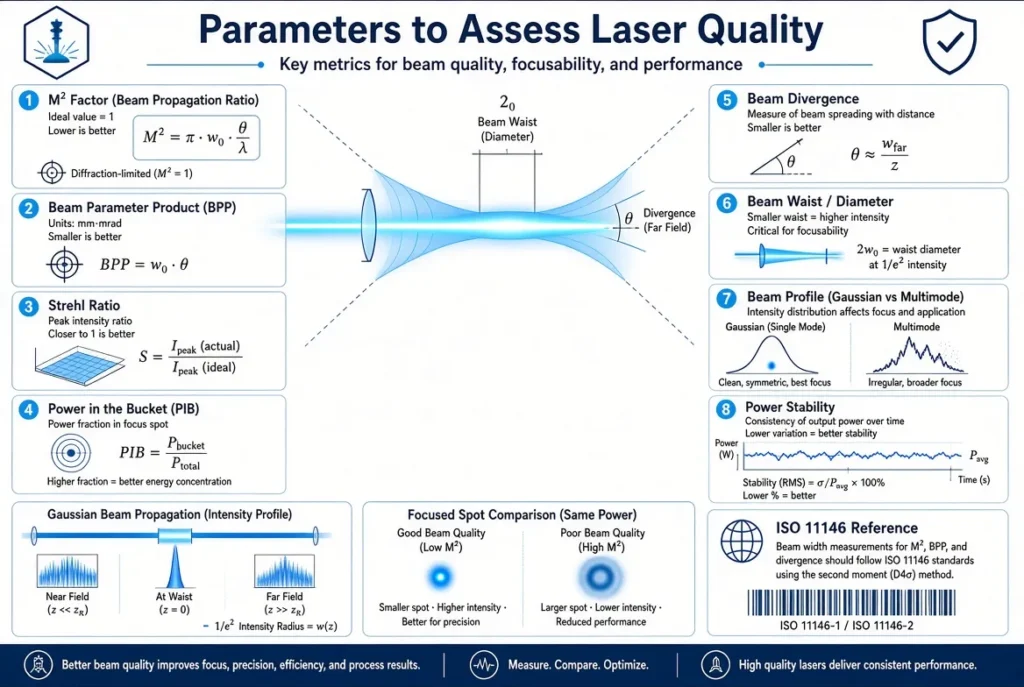
Table of Contents
1. Power Stability: The ‘Heartbeat’ of a Laser
This is the single most important parameter for assessing laser quality.
A laser may have a nominal output of 100 W, but in actual operation, this power may fluctuate constantly. The smaller the fluctuations, the better the consistency of the machining. In the industry, this is typically measured by power instability, expressed as a percentage.
Standards require this to be within the range of ±1 per cent to ±2 per cent. For example, for a 100 W fibre laser, if the output power fluctuates between 98 W and 102 W, the instability is ±2 per cent. Research indicates that high-quality lasers can maintain power instability within ±0.98 per cent during eight hours of continuous operation. Precision-grade single-frequency fibre lasers can achieve power fluctuations of less than 0.75 per cent RMS over a three-hour period.
What does poor power stability mean? It means that even with identical welding parameters, a weld that is sound today may result in a cold weld tomorrow. In applications such as power batteries and aerospace—where 100 per cent consistency is required—power instability is unacceptable.
2. Beam Quality
Beam Quality: Determines Whether the Laser Can ‘Hit the Target Accurately’
If power stability determines whether a laser is ‘reliable’, then beam quality determines whether it is ‘accurate’.
Beam quality is measured using the M² factor or BPP (beam parameter product). An ideal Gaussian beam has an M² of 1; the closer the M² of an actual beam is to 1, the better the beam quality, the more concentrated the energy, the smaller the focused spot, and the higher the energy density.
Specific standards: For single-mode fibre lasers, the M² typically ranges from 1.05 to 1.3; for high-power multimode lasers, the M² may reach 10 or even higher. With regard to BPP, the theoretical limit for a single-mode 1080 nm fibre laser is 0.344 mm·mrad.
Poor beam quality means the laser is ‘divergent’. For the same power output of 100 W, a laser with an M² of 1.1 may produce a focused spot diameter of 0.1 mm, whilst one with an M² of 10 may produce a spot exceeding 1 mm. No matter how high the power, it is of no use if the beam cannot be aimed accurately.
3. Electro-optical Conversion Efficiency
Electro-optical Conversion Efficiency: Determining ‘Affordability’
Electro-optical conversion efficiency refers to the efficiency with which a laser converts electrical energy into laser energy. The higher the efficiency, the greater the energy savings and the less heat generated.
The electro-optical conversion efficiency of fibre lasers is typically above 30 per cent, with high-performance models exceeding 35 per cent. By comparison, the efficiency of traditional YAG solid-state lasers is only around 3 per cent—more than ten times lower.
Low electro-optical conversion efficiency means that a significant amount of electrical energy is converted into heat, requiring a massive water-cooling system to dissipate it. This not only increases electricity bills but also adds to the investment in cooling equipment and the associated operational and maintenance costs. A laser with 30 per cent efficiency and one with 3 per cent efficiency, both producing the same output power, will result in a tenfold difference in electricity costs.
4. Reliability: MTBF and Service Life
MTBF stands for Mean Time Between Failures and is measured in hours. The longer the MTBF, the more reliable the laser.
The MTBF of pump sources for industrial-grade fibre lasers typically exceeds 100,000 hours. Research indicates that laser diodes, when properly assembled and subjected to ageing screening, can achieve an average failure time of 1.87 million hours. The MTBF of high-power pump modules typically exceeds 10,000 hours. However, it should be noted that MTBF is measured under specific operating conditions; in actual use, it is significantly affected by heat dissipation, load and ambient temperature.
Complementary to MTBF is power decay. As a laser is used over time, its output power gradually decreases. In a high-quality laser, power decay is almost negligible after 3,000 hours of operation; in a poor-quality one, it may decline by more than 10 per cent after just 2,000 hours.
5. Spectral Characteristics: Determining ‘Where It Is Used’
Spectral characteristics include centre wavelength, spectral linewidth and wavelength stability.
The centre wavelength determines which materials the laser can be absorbed by. For example, a 1064 nm fibre laser is suitable for metal processing, 532 nm green light is suitable for copper welding, and 355 nm ultraviolet light is suitable for precision machining.
Spectral linewidth and wavelength stability, in turn, determine the ‘purity’ of the laser. Lasers with narrow linewidths are crucial in spectral analysis, fibre sensing and coherent communications. Research indicates that high-quality external-cavity semiconductor lasers can achieve a linewidth of less than 69 kHz. In terms of wavelength stability, the centre wavelength shift must be controlled to within 0.5 nm (taking 1064 nm as an example).
6. Pulse Parameters
Pulse Parameters: The ‘Distinctive Metrics’ of Pulsed Lasers
The above primarily concerns continuous-wave lasers. For pulsed lasers, there are several additional parameters specific to this type:
Pulse energy instability: Measures the consistency of energy across each pulse. Standards require that energy instability be less than 2 per cent during 140 seconds of continuous operation. Pulse width: Determines the timescale over which the laser interacts with the material, ranging from nanoseconds to femtoseconds. Peak power: This determines the laser’s ‘burst power’.
Summary
When assessing the quality of a laser, the key lies in examining six dimensions:
Power stability indicates ‘consistency’; beam quality indicates ‘accuracy’; electro-optical conversion efficiency indicates ‘efficiency’; reliability indicates ‘durability’; spectral characteristics indicate ‘purity’; and pulse parameters indicate ‘consistency’.
A good laser is not necessarily the one with the highest power rating, but rather one in which every parameter you require is stable, consistent and predictable.
When selecting a laser, do not focus solely on ‘how many watts’; instead, ask the supplier about the parameters listed above. Only a product that can provide all these figures comprehensively and accurately is truly a product of substance.