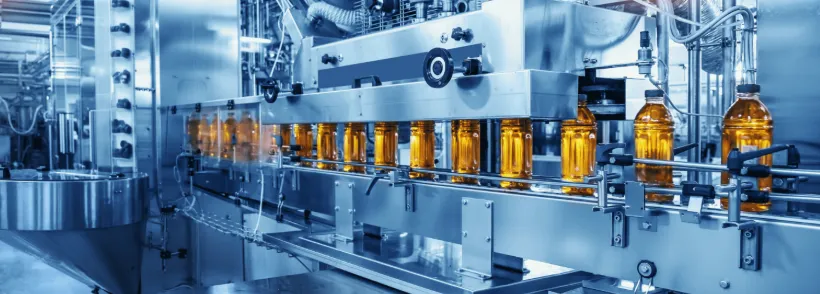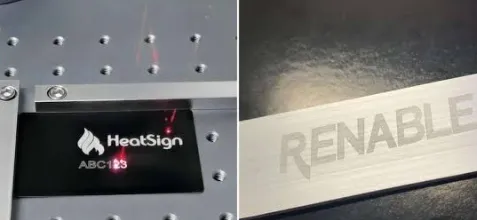
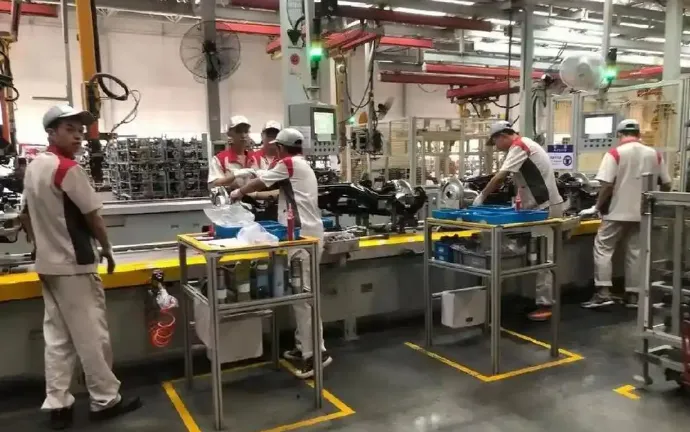
In 2025, a Philippine automotive component manufacturer introduced a JQ LASER 50W Fiber Laser Marking Machine to improve the efficiency, consistency, and traceability of its production line.
The company specializes in the design and manufacture of automotive wiring harness protection products, new energy battery protection components, and air and fluid pipe systems. Its product range includes corrugated tubes, cable ties, guide channels, and other protective components used in automotive and new energy applications.
As production volumes increased, the company needed a more reliable marking solution capable of producing permanent and readable identification marks while maintaining stable performance in continuous production.
After introducing the JQ LASER 50W fiber laser marking system, the company reported a 30% improvement in marking efficiency, while product marking quality and stability improved significantly. The reported product defect rate was also reduced by approximately 50%.
Table of Contents
1. About the Customer
The Philippine customer is an industrial manufacturer serving the automotive and new energy sectors.
Its main products include:
- Automotive wiring harness protection components
- New energy battery protection parts
- Corrugated protective tubes
- Cable ties and fastening components
- Guide channels
- Air and fluid pipe system components
The company operates in a manufacturing environment where product identification, process consistency, and production efficiency are important.
Its products are used in applications where components may need to be identified by part numbers, specifications, production information, or traceability codes.
As production requirements became more demanding, conventional marking methods became less attractive for applications requiring permanent, consistent, and highly readable marks.
2. The Marking Challenge
Before upgrading the marking process, the customer faced several practical production requirements.
High Production Efficiency
Automotive components are often produced in relatively high volumes. Marking therefore needs to keep pace with the production line rather than becoming a bottleneck.
For this type of application, the laser marking system needs to provide:
- Fast marking cycles
- Stable operation during continuous production
- Consistent marking quality
- Easy parameter adjustment
- Low routine maintenance requirements
Permanent Product Identification
Automotive and new energy components may require permanent identification during their service life.
Depending on the component, marking information can include:
- Product identification
- Part numbers
- Specifications
- Serial numbers
- Batch information
- QR codes
- Company logos
Unlike labels or printed ink, laser marking creates an identification mark directly on the material surface.
Consistent Marking Quality
For industrial production, a readable mark is not enough. The marking result also needs to remain consistent from batch to batch.
Inconsistent contrast, incorrect parameters, excessive heat input, or unstable positioning can increase the risk of defective products.
The customer therefore needed a marking system capable of maintaining stable results during continuous operation.
3. Why a 50W Fiber Laser Marking Machine?
For industrial metal marking applications, a 50W fiber laser provides a useful balance between marking speed, marking capability, and production efficiency.
Compared with lower-power systems, a 50W configuration can provide additional processing capacity when the production line requires faster marking cycles or more demanding marking operations.
Typical applications can include:
- Stainless steel marking
- Carbon steel marking
- Aluminum marking
- Copper and brass marking
- Metal component identification
- QR code marking
- Serial number marking
- Logo marking
- Deeper engraving applications
The actual marking result depends on the material, surface condition, marking content, lens configuration, focal position, laser parameters, and required cycle time.
For this reason, choosing laser power based only on wattage is not recommended. A production test should be performed before final equipment selection.
4. JQ LASER 50W Fiber Laser Marking Machine
The customer selected a JQ LASER 50W Fiber Laser Marking Machine as the production marking solution.
The system is designed for industrial applications where manufacturers need permanent identification with high repeatability.
Key Advantages
50W Laser Power
Provides additional processing capacity for demanding industrial marking applications and higher-throughput production environments.
Non-Contact Marking
The laser marks the workpiece without mechanical contact with the surface. This helps eliminate tool wear associated with traditional mechanical marking methods.
Permanent Identification
Laser marking can produce durable identification marks suitable for industrial components when the correct laser wavelength and process parameters are selected.
High Repeatability
Once the marking parameters are properly established, the same marking file can be repeatedly applied to production batches.
Low Routine Maintenance
Compared with mechanical marking equipment, fiber laser marking systems have fewer consumable mechanical components in the marking process.
Flexible Marking Content
The system can be used for different types of identification, including text, numbers, logos, barcodes, QR codes, and other graphic elements.
5. Application in Automotive Component Manufacturing
For an automotive component manufacturer, laser marking is not simply a cosmetic process.
It can become part of the company’s product identification and traceability workflow.
For example, a component can be marked with a part number or production code before it moves to the next manufacturing stage.
This allows operators and quality-control personnel to identify products more easily and can support internal production management.
Example Marking Workflow
A typical workflow can be:
Component Production → Positioning → Laser Marking → Inspection → Assembly → Final Product
The laser marking stage can be integrated into either a manual workstation or an automated production line depending on production volume and product geometry.
6. Results After Introducing the 50W Fiber Laser
According to the customer case information provided, the introduction of the JQ LASER 50W fiber laser marking machine produced measurable improvements.
| Performance Indicator | Reported Result |
|---|---|
| Marking efficiency | Increased by approximately 30% |
| Product defect rate | Reduced by approximately 50% |
| Marking clarity | Significantly improved |
| Marking stability | Significantly improved |
| Production suitability | Suitable for fast production-line marking |
The most important result was not simply a faster marking speed.
The combination of marking efficiency, consistency, and quality control helped the customer improve the overall production process.
7. Why Marking Stability Matters
In high-volume manufacturing, a small marking inconsistency can become a significant production problem when thousands of components are processed.
For example, unstable marking parameters can lead to:
- Low contrast
- Excessive surface damage
- Incomplete characters
- Inconsistent QR codes
- Different marking depths between batches
- Increased inspection workload
- Higher rejection rates
A stable laser marking process helps manufacturers reduce these risks.
However, stability does not come from laser power alone.
It depends on the complete process, including:
Laser Source + Galvanometer Scanner + F-Theta Lens + Software + Fixture + Material + Marking Parameters
This is why professional application testing is important before purchasing a laser marking machine.
8. Practical Purchasing Considerations for Automotive Manufacturers
If you are purchasing a fiber laser marking machine for automotive components, several factors should be evaluated before comparing prices.
1. Material
Identify the actual material that needs to be marked.
Different metals and engineered materials respond differently to laser energy.
2. Marking Content
Determine whether you need:
- Text
- Numbers
- Logos
- QR codes
- Barcodes
- Serial numbers
- Data matrix codes
3. Required Cycle Time
The required production output should be calculated before selecting laser power.
For example:
Required daily production ÷ available production time = required production rate
The marking cycle must fit within this production requirement.
4. Marking Size
The required marking area affects the selection of the scanning lens.
Common marking-field configurations can vary depending on the application.
5. Marking Depth
Surface identification and deep engraving are different applications.
If the customer requires deep engraving, the laser configuration and processing parameters need to be evaluated accordingly.
6. Automation Requirements
For high-volume production, manufacturers should consider whether the laser should be integrated with:
- Conveyor systems
- Pneumatic fixtures
- Rotary devices
- Automatic loading systems
- Vision inspection
- PLC control
- Production-line communication
A manually operated machine may be sufficient for small-batch production, while automated laser marking can provide greater efficiency for high-volume manufacturing.
9. What Makes This Case Valuable for Other Manufacturers?
The Philippine customer case demonstrates an important point:
The value of a laser marking machine should not be evaluated only by its purchase price.
For industrial manufacturers, the real cost of marking also includes:
- Operator labor
- Production cycle time
- Rejected products
- Consumables
- Maintenance
- Inspection time
- Production downtime
A machine with a slightly higher initial purchase price may provide a better return if it significantly reduces production time and defective products.
This is particularly important for automotive and new energy component manufacturers where production volumes can be high.
10. JQ LASER’s Approach to Industrial Laser Marking
At JQ LASER, we focus on providing laser marking equipment based on the customer’s actual production requirements rather than recommending the same configuration for every application.
Before selecting a machine, we recommend evaluating:
Material → Marking Content → Marking Size → Required Depth → Cycle Time → Production Volume → Automation Level
This process helps determine whether a 20W, 30W, 50W, or higher-power fiber laser marking machine is appropriate for the application.
For customers with demanding production requirements, application testing can also be used to verify marking quality and processing speed before equipment selection.
11. Frequently Asked Questions
Is a 50W fiber laser marking machine suitable for automotive parts?
Yes. A 50W fiber laser can be suitable for many metal automotive components, especially applications requiring permanent identification, logos, serial numbers, barcodes, or QR codes. The exact suitability depends on the material and required marking result.
Is 50W better than 30W for laser marking?
Not necessarily.
A higher-power laser can provide additional processing capacity, but the correct power depends on the material, marking speed, marking depth, and production requirements.
For simple surface marking, a lower-power system may already be sufficient. For higher throughput or deeper engraving, 50W can provide more processing capability.
Can a fiber laser mark QR codes?
Yes. Fiber laser marking machines can mark QR codes, Data Matrix codes, barcodes, serial numbers, and other identification information on suitable materials.
Can the machine be integrated into an automotive production line?
Yes. Fiber laser marking systems can be configured for integration with production-line equipment, fixtures, conveyors, rotary devices, PLC systems, and other automation equipment depending on the customer’s requirements.
How should I choose between 20W, 30W and 50W?
The decision should be based on the actual application rather than laser power alone.
Consider:
Material + Marking Content + Marking Area + Required Speed + Required Depth + Production Volume
For high-throughput industrial applications, a 50W configuration may provide additional processing capacity.
12. Conclusion
The Philippine customer case shows how a properly selected fiber laser marking system can contribute to manufacturing efficiency and quality control.
After introducing the JQ LASER 50W Fiber Laser Marking Machine, the customer reported approximately 30% higher marking efficiency and a 50% reduction in product defect rate, together with improved marking clarity and stability.
For automotive, new energy, electronics, hardware, and other industrial manufacturers, laser marking is increasingly becoming more than a simple identification process. It can become an important part of product traceability, quality control, production efficiency, and manufacturing automation.
If you are evaluating a fiber laser marking machine for your production line, the best starting point is not simply asking, “How much does a 50W laser marking machine cost?”
Instead, start with:
What material are you marking?
What information needs to be marked?
How fast does the production line need to run?
How deep does the mark need to be?
How many parts do you need to process per day?
Do you need manual operation or automatic integration?
Once these requirements are clear, the appropriate laser configuration can be selected based on the actual production process.
JQ LASER — Fiber Laser Marking Machine Manufacturer & Industrial Laser Marking Solutions Supplier
For application testing, machine configuration, and production-line marking solutions, contact JQ LASER with your material, marking sample, marking size, and required production volume.