How to Evaluate Chinese Laser Marking Machine Manufacturers: 10 Questions Buyers Should Ask
If you are buying a laser marking machine from China, do not choose the supplier only because it has a low price, a large factory, or a famous laser source. Ask ten practical questions: who actually builds the machine, what components are installed, can they test your real material, how is the machine inspected, what happens if something fails after delivery, and what exactly is included in the quotation? A good supplier should be able to show configuration details, marking samples, QC procedures, lead time, spare-parts support and clear answers about OEM and MOQ. For industrial buyers, the sample test and technical specification sheet are usually more useful than a sales presentation.

I have worked with laser marking applications for more than 10 years, including metal marking, industrial identification, automation marking and application testing. When a customer asks me which laser to buy, I normally start with the material, marking result, production volume and actual part—not the machine price.
Table of Contents
What Actually Makes a Chinese Laser Marking Manufacturer Reliable?
After working with overseas buyers, I have found that the biggest purchasing mistake is treating a laser marking machine as a single product.
It is not.
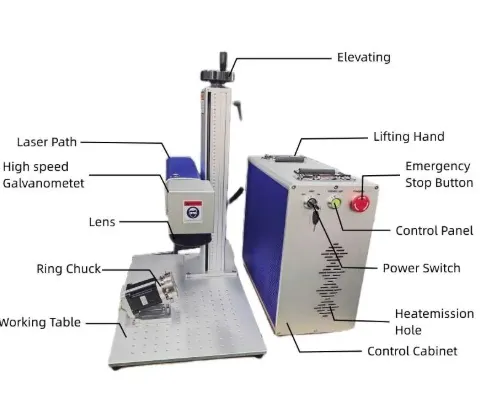
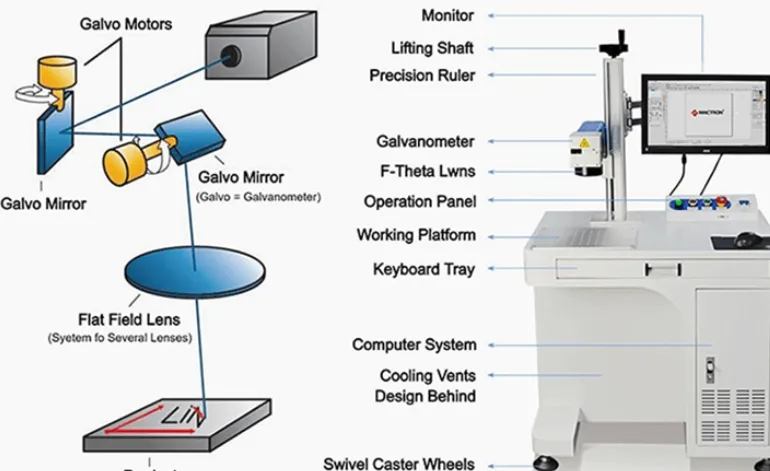
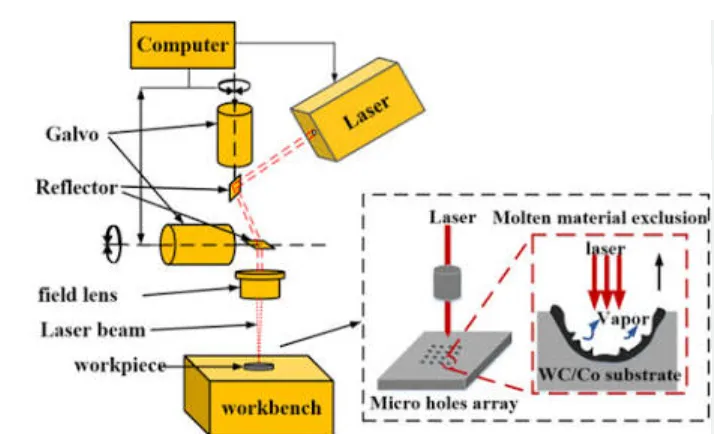
A fiber laser marking machine is a system made up of the laser source, galvanometer scanner, F-theta lens, controller, software, electrical components, mechanical structure, focusing system and application parameters. Two machines can both be advertised as “50W fiber laser marking machines” and still produce different marking depth, contrast, line quality, positioning accuracy and cycle time.
So when I evaluate another supplier, I don’t start with “How cheap is the machine?” I start with:
- Can they explain exactly what is inside the machine?
- Can they test my actual material?
- Can they explain why they recommend a particular laser power?
- Can they provide a real configuration sheet?
- Can they explain what happens after the machine arrives?
Those questions tell you much more about a manufacturer than a polished factory video.
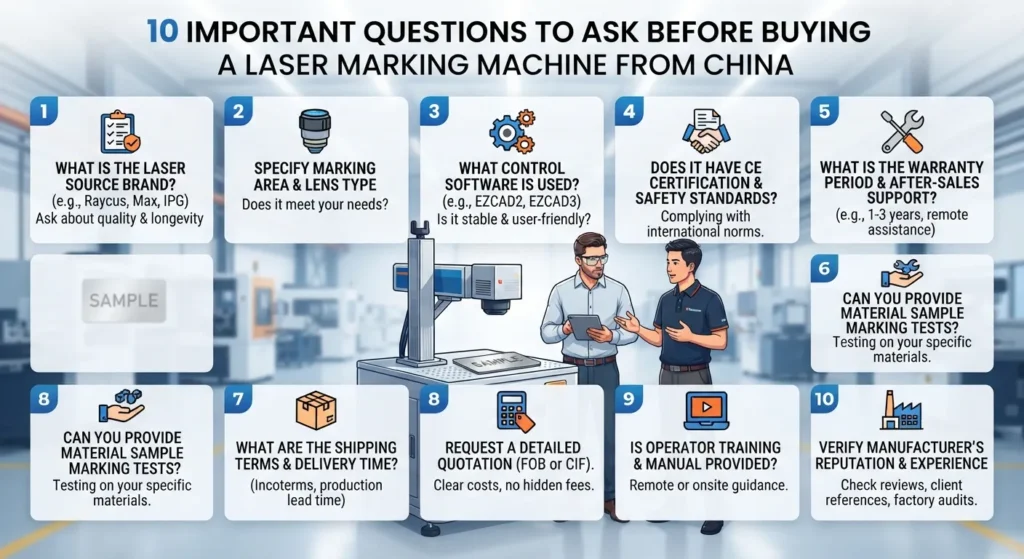
10 Questions to Ask Before Buying a Laser Marking Machine From China
| # | Question | Why It Matters |
|---|---|---|
| 1 | Are you actually the manufacturer? | You need to know who assembles, tests and supports the machine. |
| 2 | What exactly is inside the machine? | Laser power alone does not define machine performance. |
| 3 | Can you test my actual workpiece? | Material and surface condition can change the marking result significantly. |
| 4 | What is the real production speed? | 7,000 mm/s scanner speed is not the same as finished parts per hour. |
| 5 | How do you perform QC before shipment? | Factory testing reduces avoidable commissioning problems. |
| 6 | What technical support do you provide? | Remote troubleshooting and parameter support matter after installation. |
| 7 | What are the MOQ and lead time? | Important for distributors, first-time buyers and customized machines. |
| 8 | Can you provide OEM/ODM customization? | Important if you want your own brand or application-specific equipment. |
| 9 | What spare parts are available? | A small replacement part can otherwise stop production. |
| 10 | What exactly is included in the quotation? | A low machine price may exclude the items you actually need. |
1. Are You Actually a Laser Marking Machine Manufacturer?
This is the first question I would ask.
But don’t simply ask, “Are you a factory?” Almost every supplier will answer yes.
Ask them to show you what they actually do.
Ask for These Five Things
- Machine assembly area
- Laser testing or application testing area
- Engineers or technical team
- Quality inspection process
- Real machines being prepared for delivery
A company does not need to manufacture the laser source, galvanometer or control card itself to be a legitimate machine manufacturer. Most laser machine builders integrate specialist components from different suppliers.
What matters is whether the company can take those components and build, align, configure, test and support a complete machine.
JQ Laser, for example, states that its team handles machine assembly, laser testing, application testing, OEM/ODM and after-sales technical support. Customers can also send actual samples for testing before final configuration.
2. What Exactly Is Inside the Laser Marking Machine?
Don’t buy a machine based only on “20W”, “30W” or “50W”.
Ask for the complete configuration.
Example: Typical JQ Fiber Laser Configuration
| Component | Typical Configuration | What the Buyer Should Confirm |
|---|---|---|
| Laser | 20W / 30W / 50W / 100W fiber | Brand, exact model, wavelength, pulse characteristics |
| Wavelength | 1064nm typical | Confirm according to material |
| Galvo | Digital galvanometer scanner | Brand, speed, repeatability |
| F-Theta Lens | 110×110mm typical field | Required marking area and working distance |
| Controller | BJJCZ / JCZ-compatible configuration | Software compatibility and replacement availability |
| Software | EZCAD2 commonly used | Version and functions included |
| Cooling | Air cooling is common | Actual source requirements |
| Power Supply | 110V / 220V, 50/60Hz | Destination-country electrical standard |
These are reference configurations, not a promise that every machine from every supplier will use exactly the same components. Your quotation should list the actual components you are paying for.
3. Can the Manufacturer Test Your Actual Material?
This is probably the most important question after configuration.
If you are marking stainless steel, aluminum, brass, copper, titanium, coated metal, engineering plastic or another special material, don’t accept a random sample from the supplier as proof.
Send your own workpieces.
Why Your Actual Workpiece Matters
Two stainless-steel parts can behave differently because of alloy composition, surface finish, heat treatment, coating, polishing and geometry.
The same problem occurs with plastics. A laser parameter that produces a clean black mark on one engineering plastic may create excessive heat or poor contrast on another formulation.
Recommended Sample Test
- Send actual production material.
- Provide the marking artwork.
- Explain the required contrast or depth.
- Tell the supplier your target cycle time.
- Ask for several parameter combinations.
- Ask for photographs and, preferably, physical samples.
- Keep the final parameter as part of the project record.
4. What Is the Real Production Speed?
Be careful when a supplier tells you: “Our machine can mark at 7,000 mm/s.”
That can be a valid scanner specification, but it is not the same thing as production throughput.
Actual cycle time includes:
- Laser processing time
- Text and graphic complexity
- QR/Data Matrix content
- Hatch density
- Number of passes
- Workpiece positioning
- Fixture loading
- Rotary movement
- Conveyor movement
- Inspection or vision processing
- Loading and unloading
For example, a 50W fiber configuration may have a reference scanning speed of up to approximately 7,000 mm/s, but your actual parts-per-hour number needs to be tested with the real marking file and workpiece.
5. How Does the Factory Perform Quality Control Before Shipment?
A good QC process should not begin five minutes before loading the machine into a truck.
At Minimum, Ask About These Checks
| QC Stage | What Should Be Checked? |
|---|---|
| Incoming Components | Laser source, scanner, controller, power supply and other key components |
| Mechanical Assembly | Machine structure, movement and fixture installation |
| Optical System | Lens, beam path and marking alignment |
| Software | Controller, marking software and basic functions |
| Marking Test | Actual marking quality and required application |
| Final Inspection | Configuration, accessories and customer requirements |
For customized machines, I strongly recommend asking the supplier to record the final configuration before shipment. That gives both sides a reference if there is a problem later.
6. What Happens When the Machine Arrives at Your Factory?
Buying a machine is not the end of the project.
Especially for a first-time importer, installation and parameter adjustment can become frustrating if there is no technical support.
Ask the Supplier:
- Is an English manual included?
- Is remote installation support available?
- Can engineers help with software setup?
- Can they help optimize marking parameters?
- What happens if marking quality changes?
- Can spare parts be shipped separately?
- How quickly does the technical team normally respond?
For industrial applications, technical support should include more than “restart the machine.”
A useful support process should identify whether the problem is caused by software, parameter settings, material variation, optics, the laser source, scanner or another component.
7. What Are the MOQ and Lead Time?
This is particularly important if you are a distributor or are buying your first machine.
MOQ
For standard machines, MOQ and OEM MOQ can be completely different.
A supplier may be willing to sell one standard machine but require a different quantity for customized branding, packaging or special production arrangements.
Do not accept a vague answer such as “MOQ depends.” Ask what exactly changes the MOQ:
- Standard machine or OEM?
- Private-label branding?
- Custom enclosure?
- Special packaging?
- Special electronics?
- Automation integration?
Lead Time
Current JQ reference information lists approximately 5–7 working days for common 30W/50W fiber laser production after order confirmation, while customized systems may require additional time.
The important question is not simply “How many days?” Ask:
When does the lead time start, what is included in that period, and will the machine be tested before shipment?
8. Can the Manufacturer Provide OEM or ODM?
If you are buying one machine for your own factory, OEM may not matter much.
If you are a distributor, importer or building your own laser equipment brand, it becomes much more important.
Possible OEM / ODM Items
- Your company logo
- Machine appearance
- Laser source configuration
- Marking field
- Rotary axis
- CCD vision
- Automatic loading/unloading
- Packaging
- User manuals
- Product labels and documentation
The important point is that customization should be documented.
Before production, confirm the final machine configuration, appearance, logo, accessories, software and packaging.
JQ Laser’s published OEM/ODM process specifically states that MOQ depends on customization level, machine configuration, packaging and production requirements, and recommends testing the actual machine configuration before shipment.
9. What Spare Parts Can You Get After the Sale?
This question is often ignored because the machine works perfectly when it is new.
Six months or two years later, the situation can be different.
Ask the supplier which parts are considered consumables or replacement parts.
Useful Spare Parts to Ask About
- Protective optical components where applicable
- Focusing or lens components
- Power supply components
- Control card
- Cooling fans
- Foot switch
- Cables and connectors
- Emergency-stop components
- Other application-specific parts
You do not need to buy every spare part in advance. But you should know the supplier’s replacement process and whether commonly required parts can be sourced quickly.
10. What Exactly Is Included in the Quotation?
This is where many “cheap” quotations become expensive.
Two suppliers may quote completely different systems while using the same product name.
Ask for a Line-by-Line Quotation
| Item | Confirm Before Ordering |
|---|---|
| Laser source | Brand + exact model + power |
| Lens | Marking field + working distance |
| Galvo | Brand / model if specified |
| Controller | Controller type and software compatibility |
| Rotary | Included or optional |
| CCD Vision | Included or optional |
| Enclosure | Open / enclosed / safety configuration |
| Software | Version and functions |
| Training | Online / onsite / documentation |
| Warranty | Coverage and exclusions |
| Shipping | EXW / FOB / other agreed terms |
Example: What a Real 50W Fiber Laser Configuration Can Look Like
Here is a useful example from an actual project configuration. It is not presented as the only correct 50W configuration; it shows the level of detail I recommend buyers request.
| Parameter | Reference Configuration |
|---|---|
| Laser type | Pulsed fiber laser |
| Rated power | 50W |
| Wavelength | 1064nm |
| Cooling | Forced air cooling |
| Power supply | AC 220V ±10%, 50/60Hz, single phase |
| Power consumption | ≤600–800W reference |
| Main marking field | 110 × 110mm |
| Additional lens | 150 × 150mm |
| Scanning speed | ≥7,000–8,000mm/s reference |
| Control | JCZ-compatible control configuration |
| Software | EZCAD2 / EZCAD3 |
| Positioning | Red-light positioning |
This table is a project reference rather than a universal specification. The final configuration should always be confirmed on the quotation and sample-test record.
What Does This Look Like in a Real Factory?
Scenario 1: Automotive Parts
Suppose you produce steel or aluminum automotive components and need serial numbers, QR codes and traceability information.
I would not immediately recommend a 100W machine.
First I would ask:
- How many parts per day?
- What is the marking size?
- Is the code visually readable or machine-verifiable?
- Do you need deep engraving?
- Is the surface oily, coated or heat-treated?
- Will the machine eventually connect to a PLC or MES?
For many general metal identification applications, 30W or 50W may be a more sensible starting point than simply buying the highest available power.
Automotive Parts Laser Marking →
Scenario 2: CNC Machined Parts
If the customer needs permanent serial numbers and Data Matrix codes on machined metal components, the important issue is often not extreme engraving depth.
Fixture consistency, code readability and production cycle time may matter more.
In this situation, spending the budget on a good fixture or automated positioning system can sometimes produce more value than increasing laser power.
Scenario 3: Deep Metal Engraving
If the customer needs actual material removal rather than surface marking, power becomes more important.
A 50W fiber laser can be a practical choice for deeper engraving and higher production capacity, but the required depth should be verified through sample testing.
See the deep engraving solution →
Scenario 4: Distributor Buying 5–20 Machines
Here the questions change.
You need to evaluate not only machine quality but also:
- OEM capability
- Branding consistency
- Packaging
- Documentation
- Spare parts
- Lead-time stability
- Technical support
- Replacement policy
A supplier who can build one good machine is not automatically capable of supporting a distributor’s product line.
What Factory Capabilities Should You Verify?
Machine Assembly
Can the company assemble and configure complete laser marking systems?
Laser Testing
Is marking performance checked before delivery?
Application Testing
Can the factory test customer materials and workpieces?
Automation
Can the supplier integrate rotary, conveyor, PLC or vision systems?
OEM / ODM
Can the supplier support private-label and customized machines?
After-Sales
Can technical issues be diagnosed remotely after delivery?
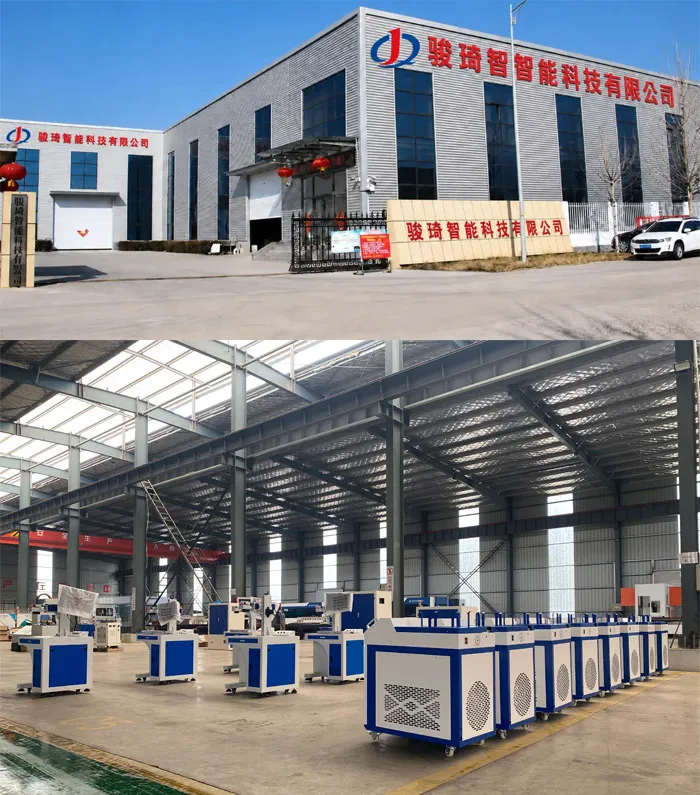
Jining Junqi Intelligent Technology Co., Ltd. states that it was established in 2011 in Qufu, Jining, Shandong, and that its team handles machine assembly, laser testing, sample testing, OEM/ODM and technical support.
JQ Laser Factory, OEM, MOQ, Lead Time and QC — What Buyers Should Know
| Item | Reference Information | Buyer Note |
|---|---|---|
| Factory | Jining Junqi Intelligent Technology Co., Ltd., Qufu, Jining, Shandong, China | Verify current project capability and configuration |
| Established | 2011 | Company history should still be checked against current project capability |
| OEM / ODM | Available for machine configuration, branding, appearance, accessories, automation and documentation | Customization requirements should be agreed before production |
| MOQ | Project dependent | Depends on customization, packaging and production arrangement |
| Fiber Lead Time | Approximately 5–7 working days for common configurations | Customized systems may take longer |
| Sample Testing | Actual customer material can be tested | Strongly recommended before final configuration |
| QC | Configuration, laser marking, software and final requirements checked | Ask for final test records |
| After-Sales | Remote technical support, software guidance, troubleshooting and spare parts | Confirm response and replacement process before ordering |
How Should You Compare Chinese Laser Marking Machine Prices?
Don’t compare the final price until the configurations are comparable.
For example, a basic 50W fiber laser marking machine and a 50W production system with a larger marking field, rotary axis, CCD camera, enclosure and automation are not the same product.
Price Comparison Checklist
- Laser source
- Laser power
- Galvo scanner
- F-theta lens
- Marking field
- Controller
- Software
- Rotary axis
- CCD vision
- Enclosure
- Fixture
- Automation
- Shipping terms
- Warranty and technical support
A low quotation is not necessarily bad. A high quotation is not necessarily good. The important thing is whether you can explain the difference between them.
Chinese Laser Marking Machine Supplier Evaluation Checklist
| Evaluation Area | Score 1–5 | Evidence |
|---|---|---|
| Factory capability | ___ / 5 | Factory / assembly / testing evidence |
| Laser configuration | ___ / 5 | Brand / model / datasheet |
| Sample testing | ___ / 5 | Actual workpiece test |
| Technical knowledge | ___ / 5 | Technical answers |
| QC process | ___ / 5 | Inspection records |
| After-sales support | ___ / 5 | Support procedure |
| Spare parts | ___ / 5 | Replacement process |
| OEM / ODM | ___ / 5 | Customization capability |
| Lead time | ___ / 5 | Written production schedule |
| Quotation transparency | ___ / 5 | Line-by-line quotation |
FAQ: Buying a Laser Marking Machine From China
Is buying a laser marking machine from China risky?
It can be risky if the supplier is selected only by price. The risk becomes much lower when you verify the machine configuration, test your actual material, confirm QC, document the final specification and understand the after-sales process before ordering.
How can I tell whether a Chinese laser supplier is a real manufacturer?
Ask about machine assembly, application testing, engineering capability, QC and after-sales support. A company does not necessarily need to manufacture every component itself. The important issue is whether it can integrate, test and support the complete system.
Should I choose a 20W, 30W or 50W fiber laser?
It depends on the material, marking depth, production volume, marking content and required cycle time. 20W is often sufficient for standard surface marking. 30W is a practical general-purpose option. 50W becomes more attractive when faster production or deeper engraving is required.
Is 7,000mm/s the actual production speed?
No. It is normally a reference scanning speed. Actual cycle time depends on the marking artwork, material, hatch settings, number of passes, fixture, positioning and automation process.
Should I test my own material before buying?
Yes. For industrial applications, testing the actual workpiece is one of the most useful steps you can take before purchasing.
Can Chinese laser marking manufacturers provide OEM?
Many can, but you should verify the exact customization capability. OEM may include branding, appearance, packaging and documentation, while ODM may involve more significant configuration or application development.
What should I prepare when requesting a quotation?
Provide material, workpiece dimensions, marking content, marking size, required contrast, required depth if applicable, production quantity, cycle-time target, power supply and whether automation or rotary marking is required.
What if I don’t know which laser type I need?
Send the supplier your actual workpiece and marking requirements. A professional supplier should be able to compare fiber, UV, CO2 or MOPA based on the material and required result rather than simply recommending the most expensive machine.
Related Laser Marking Resources
- Fiber Laser Marking Machine
- 20W Fiber Laser Marking Machine
- 30W Fiber Laser Marking Machine
- 50W Fiber Laser Marking Machine
- MOPA Laser Marking Machine
- UV Laser Marking Machine
- Automatic Laser Marking Machine
- Deep Engraving Laser Solution
- Laser Marking Machine OEM & ODM
- Shipping & Delivery
- After-Sales Support
- Fiber Laser Maintenance
- Laser Marking Customer Cases