When to Choose a 50W Fiber Laser for Deep Metal Engraving
Choose a 50W fiber laser when your metal-marking job has a real reason to need more processing capacity: deeper engraving, more material removal, shorter cycle times or repeated industrial production. If you only need serial numbers, QR codes, logos or normal surface marking, a 20W or 30W machine may already be enough. A 50W system does not guarantee a specific engraving depth because material type, hardness, pulse characteristics, scan speed, hatch strategy, number of passes and focus all affect the result. The right way to buy 50W is to test your actual part, measure the required depth and compare cycle time—not simply buy the highest wattage.

LEO, JQ Laser sales engineer, with 10+ years in laser marking, cross-industry application experience, automation marking project design/implementation.
When Does a 50W Fiber Laser Actually Make Sense?
In practical terms, I would recommend a 50W fiber laser when a 20W or 30W machine is becoming limited by engraving depth, material removal rate or production cycle time. For a simple serial number or QR code, I would not automatically push you toward 50W. That can be unnecessary spending. The situation changes when you need repeated deep engraving on steel, stainless steel, hardened components, tools, molds, automotive parts or industrial nameplates, or when the same job is running hundreds or thousands of times per day. In those cases, the additional power can provide more processing headroom. But the final decision should come from an actual sample test, measured depth and real cycle-time comparison.
50W Fiber Laser: Current JQ Reference Configuration
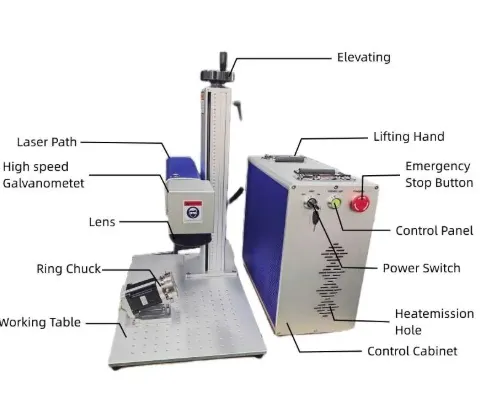
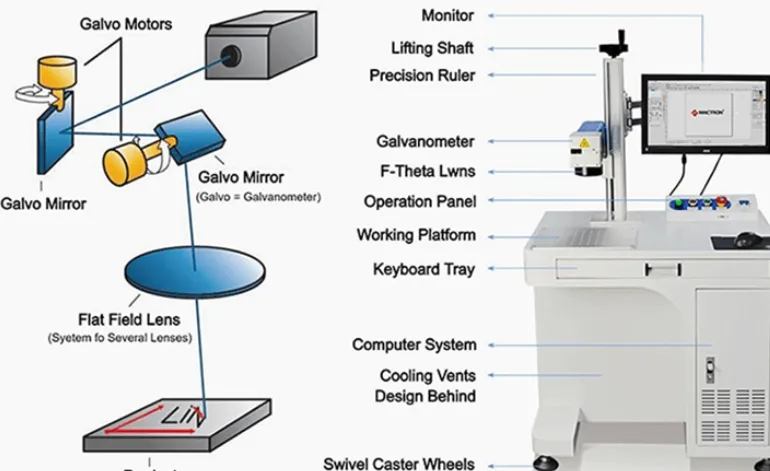
These are reference specifications for JQ Laser’s current 50W fiber marking configuration. The final machine should be confirmed against the quotation because optics, source, scanner, marking field, enclosure and automation can change the configuration.
| Parameter | JQ Reference | Procurement Meaning |
|---|---|---|
| Laser Type | Pulsed Fiber Laser | Main platform for industrial metal marking and engraving |
| Rated Power | 50W | More processing capacity than standard 20W / 30W systems |
| Wavelength | 1064 nm | Standard fiber-laser wavelength for many metal applications |
| Reference Marking Speed | Up to approximately 7,000 mm/s* | Scanner capability, not guaranteed production cycle time |
| Standard Marking Field | 110 × 110 mm | Suitable for many small and medium identification areas |
| Larger Lens Options | 150 / 175 / 200 / 300 mm and other configurations | Larger marking area usually trades off with spot size and energy density |
| Cooling | Air cooling | Common configuration for JQ’s pulsed fiber systems |
| Power Supply | 110V / 220V | Destination-dependent electrical configuration |
*Published maximum/reference speed is not the same as actual engraving speed. Deep engraving normally requires different parameters and multiple passes.
How Much Does a 50W Fiber Laser Marking Machine Cost?
Typical public-market reference for a standard 50W configuration / FOB reference. This is not a fixed JQ Laser quotation.
When comparing 50W quotations, I would not compare the total price before comparing the configuration. A USD 1,700 machine and a USD 3,000 machine may both be called “50W fiber laser”, but the laser source, scanner, F-theta lens, marking field, enclosure, rotary axis, vision system, software and automation can be completely different.
What can increase the price?
- Higher-end laser source
- Larger or multiple F-theta lenses
- Higher-performance galvo scanner
- Enclosed Class 1 machine structure
- Rotary axis or custom fixture
- CCD / vision positioning
- Motorized Z-axis or autofocus
- Production-line PLC integration
- Fume extraction
- Custom OEM / ODM configuration
20W vs 30W vs 50W: Which One Should You Buy?
The easiest way to make the wrong purchase is to start with wattage. Start with your actual production problem instead.
| Buying Requirement | 20W | 30W | 50W |
|---|---|---|---|
| Serial numbers / QR codes | Excellent | Excellent | Usually more than necessary |
| General metal marking | Good | Very Good | Very Good |
| Light engraving | Good | Good | Good |
| Deep engraving | Limited / slower | Possible | Stronger candidate |
| High material removal | Less suitable | Moderate | Better suited |
| Large production batches | Depends on cycle time | Good balance | Better processing headroom |
| Investment | Lowest | Moderate | Higher |
If your job is mainly identification, start by testing 20W or 30W. If your production problem is material removal, engraving depth or cycle time, then 50W becomes much easier to justify.
What Does “Deep Metal Engraving” Actually Mean?
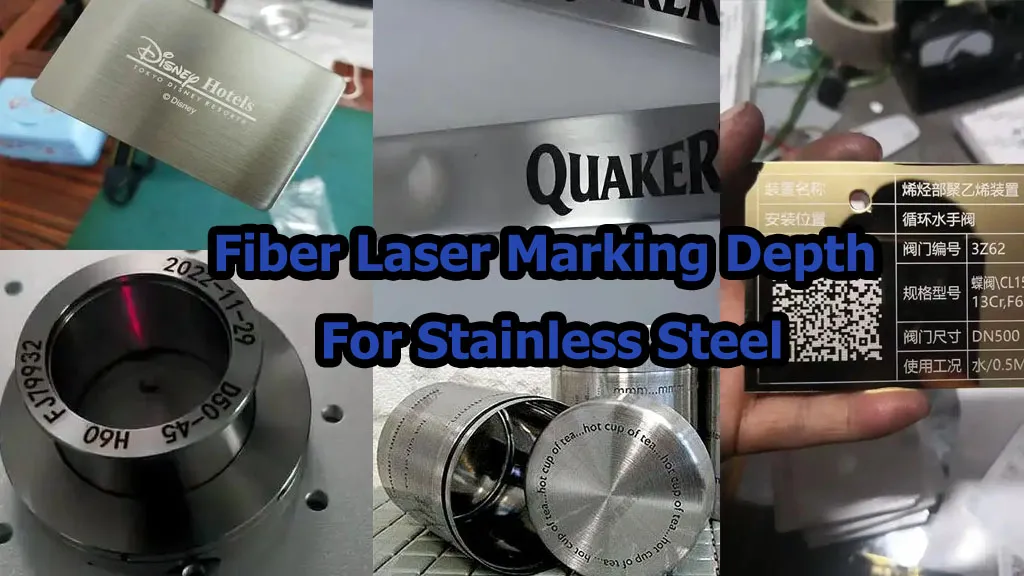
This is an important distinction when comparing machines. A dark black mark is not necessarily a deep engraving. Annealing changes the appearance of the surface, while engraving removes material. If you need a mark that remains visible after polishing, coating, wear or later processing, you may need actual material removal rather than a surface-color change.
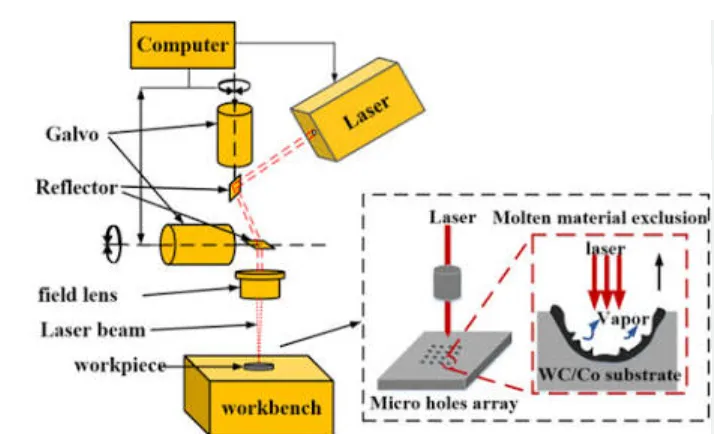
Deep engraving is normally a multi-pass process. The laser removes a small amount of material, the process repeats, and the resulting cavity becomes deeper. As the cavity becomes deeper, focus, debris removal, hatch direction and heat management become increasingly important.
Surface Marking
Changes the surface appearance without significant material removal. Common for serial numbers, logos and general identification.
Etching / Engraving
Removes some material to create a permanent physical mark.
Deep Engraving
Uses repeated material removal to create a measurable cavity or relief where durability or later processing requires more than a surface mark.
How 50W Fiber Laser Deep Engraving Is Actually Done
Clean and fixture the part
Focus the marking area
Select initial parameters
Run multiple passes
Remove debris / inspect
Measure depth and quality
Why multiple passes matter
If you try to remove too much material in one pass, you can increase heat accumulation, redeposition and edge damage. A controlled multi-pass process usually gives the engineer more control over the final cavity. The best number of passes is application-specific and should be established during sample testing.
Materials and Workpieces Commonly Considered for 50W Deep Engraving
| Material / Workpiece | Typical Requirement | Why 50W May Help | Main Risk / Test Point |
|---|---|---|---|
| Stainless Steel | Deep identification, tooling, durable industrial marks | Higher processing capacity for material removal | Heat, burrs, redeposition and corrosion protection after material removal |
| Carbon / Alloy Steel | Part identification, tools, molds, automotive parts | Faster material removal than lower-power configurations in suitable jobs | Hardness, heat treatment and required depth |
| Hardened Steel | Tools, dies and wear-resistant components | Additional power can reduce processing time for suitable engraving jobs | Heat input, surface condition and material response |
| Aluminum | Nameplates, housings and industrial components | Can provide additional processing capacity where deeper removal is required | Aluminum alloy and heat dissipation can change the result |
| Brass / Copper | Electrical components, hardware and industrial parts | Higher power can be useful in demanding processing applications | Reflectivity and alloy composition require testing |
Typical 50W Deep Engraving Workpieces
Metal Tools
Deep identification, specifications, logos and tamper-resistant marks on industrial tools.
Molds & Dies
Part numbers, cavity identification, revision information and durable reference marks.
Automotive Parts
Engine, transmission, brake and other components requiring permanent identification or deeper marks.
Industrial Nameplates
Durable identification where surface marking may not be sufficient for the expected service environment.
Cutting Tools
Product specifications, model numbers and permanent identification on metal tools.
Machine Components
Identification of gears, shafts, brackets, fixtures and industrial components.
Metal Tags
Deeper text or graphics where the identification must remain visible after handling or further processing.
Security / Tamper Marks
Physical material removal can make identification more difficult to remove compared with a simple surface mark.
Real Production Situations Where 50W Makes More Sense
Scenario 1 — Your 30W Mark Looks Good, But Takes Too Long
This is one of the clearest reasons to test 50W. If the existing mark already meets your quality requirements but the cycle time is too long, increasing available power may allow a more productive process. The correct decision should be based on measured cycle time, not the advertised scanner speed.
Scenario 2 — You Need a Physical Cavity
If your requirement is actual material removal rather than a color change, 50W becomes more attractive. Tools, molds and industrial components are common examples where a physical cavity may provide better durability.
Scenario 3 — You Are Marking the Same Part All Day
Even a small reduction in cycle time can matter when a machine processes thousands of parts. In this situation, compare the total production cycle, including loading and unloading—not only the laser-on time.
Scenario 4 — You Need More Future Capacity
If today’s job only needs light marking but your factory expects deeper engraving or higher production volume later, 50W can provide more processing headroom. But this only makes financial sense if the expected future work is realistic.
When I Would NOT Recommend Buying 50W
As a sales engineer, this is just as important as knowing when to recommend 50W. More power is not automatically better.
You Only Need Serial Numbers
If the marking is shallow and the production cycle already works with 20W or 30W, 50W may add cost without adding useful value.
Your Part Is Heat-Sensitive
Higher average power can increase heat input. A higher-power laser is not automatically the right answer when thermal impact is the main problem.
Your Mark Is Extremely Fine
Optical configuration, pulse characteristics and spot size may matter more than simply increasing wattage.
Your Production Volume Is Low
If the machine only runs occasionally, the productivity advantage of 50W may never recover the additional investment.
Don’t Compare 50W by Laser Speed Alone
This is one of the most common purchasing mistakes I see. A supplier may quote a maximum scanner speed such as 7,000 mm/s, but that number does not tell you how long it takes to engrave your actual part.
| Production Step | Included in Real Cycle Time? |
|---|---|
| Part loading | Yes |
| Positioning / fixture clamping | Yes |
| Laser processing | Yes |
| Multiple engraving passes | Yes |
| Inspection / code verification | Yes |
| Part unloading | Yes |
A better comparison method
Ask the supplier to mark your actual part with 30W and 50W, then record: required depth, number of passes, laser processing time, complete cycle time, mark quality and code readability. That gives you a real basis for deciding whether the additional investment pays back.
Which Parameters Affect Deep Engraving?
A 50W source is only one part of the process. When we test a deep engraving application, we normally look at the complete parameter set rather than changing power alone.
Laser Power
Determines available average processing power and affects material removal capability.
Pulse Characteristics
Pulse behavior affects energy delivery, heat input and the processing window.
Scan Speed
Slower processing can increase energy delivered to an area, but it does not guarantee a better result.
Hatch Spacing
Line spacing affects overlap, material removal and surface finish.
Hatch Direction
Alternating hatch directions can help control the shape and consistency of deeper cavities.
Focus
As engraving becomes deeper, maintaining effective focus becomes increasingly important.
Do You Need 3-Axis or Dynamic Focus for Deep Engraving?
Not every 50W project needs 3-axis control. If the marking surface is flat and the engraving area is relatively shallow, a conventional 2D setup may be sufficient. The situation changes when the part has significant height variation, curved geometry or when the engraving depth itself creates a focal-distance problem.
For complex components, 3-axis dynamic focus can help maintain the intended focal position as the Z height changes. This is one reason advanced industrial systems combine higher laser power with focal control rather than treating wattage as the only performance factor.
Practical buying rule
If your part is flat, start with a conventional 50W system and test it. If the part is curved, stepped, deeply recessed or has significant height variation, ask the supplier to demonstrate the actual geometry before purchasing.
Our 50W Deep Engraving Sample Test Process
If you are serious about buying a 50W machine for deep engraving, I strongly recommend testing the actual workpiece before final configuration.
Send actual material
Confirm target depth
Test 30W / 50W when useful
Measure depth and quality
Confirm cycle time
What We Record During Testing
- Material and surface condition
- Required engraving depth
- Number of passes
- Laser processing time
- Complete cycle time
- Edge quality
- Heat effect
- Debris / redeposition
- Surface finish
- Dimensional consistency
How We Keep the 50W Recommendation Traceable
A useful quotation should allow the buyer to understand why 50W was recommended. We do not want the recommendation to be based on “50W is more powerful.” The application information should be recorded together with the test result.
| Item | What Should Be Recorded? |
|---|---|
| Workpiece | Material, dimensions and surface condition |
| Marking requirement | Content, size, depth, appearance and durability requirement |
| Laser configuration | Power, source, lens, scanner and control system |
| Process | Speed, passes, hatch strategy and focus method |
| Result | Depth, contrast, edge quality, thermal effect and readability |
| Production | Actual cycle time and expected production quantity |
JQ Laser Factory Capability for 50W Projects
Jining Junqi Intelligent Technology Co., Ltd. (JQ Laser) was established in 2011 in Qufu, Jining, Shandong, China. We handle machine assembly, laser testing, application testing, OEM/ODM projects and customized marking systems. For application-specific projects, we prefer to start from the customer’s actual material and marking requirement rather than selecting a machine from wattage alone.
Machine Assembly
Machines are assembled by our team and configured according to the agreed laser, optics, control and structural requirements.
Laser Testing
Laser marking performance and machine operation are checked before delivery.
Application Testing
Customers can send actual material or products for sample testing before final configuration.
Customized Engineering
Rotary systems, fixtures, automation and CCD vision can be considered for suitable projects.
OEM & ODM for 50W Fiber Laser Systems
If you are a distributor, importer, automation company or industrial manufacturer, the 50W system can also be configured as an OEM or ODM project. The important point is that customization should be based on a confirmed application instead of simply changing the machine label.
Possible OEM Requirements
- Customer brand and logo
- Machine appearance
- Private-label packaging
- Documentation
- Selected configuration
Possible ODM Requirements
- Application-specific laser configuration
- Customized marking field
- Rotary or positioning system
- Automation integration
- Special-purpose marking solution
OEM/ODM MOQ is not a universal fixed number. It depends on customization level, machine configuration, packaging requirements and production arrangement.
50W Production Lead Time and Shipping
Working days typical production time for 50W fiber configurations
Current standard trade terms
Countries covered by current international service and shipping arrangements
Production time starts after the order and configuration are confirmed. Customized automation, special structures and unusual components may require a separately confirmed lead time. International delivery time is separate from production time and depends on the shipping route, customs and destination.
What Should Be Checked Before a 50W Machine Ships?
Confirm laser source, power, scanner, lens, controller and agreed accessories.
Verify the agreed sample result when application testing is part of the project.
Check marking software operation and the agreed workflow.
Confirm rotary axis, fixtures, enclosure and other agreed components.
Confirm the machine is prepared for the destination voltage configuration.
Confirm the machine operates according to the agreed configuration before packing.
Spare Parts, Training and After-Sales Support
A deep-engraving machine is a production tool, so the purchase should not end when the crate leaves China. Before ordering, ask what happens if the marking result changes, the software has a problem, or a replaceable component needs attention.
| Support Area | JQ Reference Support |
|---|---|
| Machine Setup | Installation guidance and initial production testing |
| Operator Training | Basic operation, marking files, parameters and daily maintenance |
| Parameter Support | Starting-point guidance based on material and marking requirement |
| Troubleshooting | Remote diagnosis using photos, videos, screenshots and marking samples |
| Spare Parts | Spare-part identification and replacement guidance according to machine configuration |
50W Fiber Laser Buying Checklist
Before paying for a 50W machine, I recommend asking the supplier these questions.
- What is the exact laser source brand and model?
- Is the rated output actually 50W?
- What scanner is included?
- What F-theta lens and marking field are included?
- What is the actual required depth on my material?
- How many passes are needed?
- What is the complete cycle time?
- Can you test my actual part?
- Will you provide the sample test result?
- Does the quotation include rotary equipment or fixtures if required?
- Is vision inspection included or optional?
- What software and controller are included?
- What voltage configuration will be supplied?
- What is the production lead time?
- What are the shipping terms?
- Which spare parts are available?
- What technical support is provided after delivery?
- What is the actual warranty scope?
7 Mistakes Buyers Make When Choosing a 50W Fiber Laser
1. Buying 50W Because It Sounds Better
If 20W already meets the required quality and cycle time, 50W may not provide a useful return.
2. Believing the Maximum Speed
7,000 mm/s is a machine reference, not a promise that your deep engraving job will run at that speed.
3. Asking “How Deep Can It Engrave?” Without Giving the Material
Depth depends heavily on material, hardness, geometry and processing parameters.
4. Testing on the Wrong Sample
A test on ordinary steel does not prove the result on your hardened, coated or heat-treated production part.
5. Ignoring Optics
A larger marking field can change the optical conditions. Select the lens around the actual marking area and required resolution.
6. Forgetting Debris and Heat
Deep material removal creates debris and heat. The production setup needs to handle both.
7. Comparing Machines Only by Price
Compare the laser source, scanner, lens, controller, fixture, enclosure, software, testing and support together.
50W Fiber Laser Deep Engraving FAQ
When should I choose a 50W fiber laser?
Choose 50W when you have a real requirement for deeper engraving, greater material removal, shorter cycle time or higher production capacity. For ordinary serial numbers and QR codes, 20W or 30W may already be sufficient.
Can a 50W fiber laser deeply engrave stainless steel?
Yes, a 50W pulsed fiber laser can be evaluated for deep engraving stainless steel. The achievable depth and processing time depend on the alloy, surface condition, parameters, number of passes and required result. Actual sample testing is recommended.
How deep can a 50W fiber laser engrave?
There is no single reliable depth specification that applies to every material and application. Depth depends on material, hardness, laser configuration, scan strategy, passes, focus and processing time. A supplier should test your actual part before promising a production result.
Is 50W much better than 30W?
Not for every job. 50W becomes more useful when the application requires deeper material removal, shorter processing time or higher production capacity. For normal surface marking, the difference may not justify the additional cost.
Can a 50W fiber laser engrave hardened steel?
It can be considered for suitable hardened-steel applications. Hardness, alloy composition, required depth and heat effects should be tested on the actual component before final machine selection.
Can 50W mark aluminum?
Yes. A 50W fiber laser can process many aluminum applications, including identification and engraving. The exact result depends on the aluminum alloy, surface finish and desired marking effect.
Does deep engraving require multiple passes?
Deep engraving commonly uses multiple passes to progressively remove material. The exact number of passes depends on the target depth, material and desired surface quality.
Do I need a 3-axis fiber laser for deep engraving?
Not necessarily. A flat workpiece may work well with a conventional 2D system. 3-axis or dynamic-focus technology becomes more useful when the part has significant height variation, curved geometry or difficult focal conditions.
Can you compare 30W and 50W on my actual sample?
Yes. JQ Laser can evaluate customer materials and marking requirements. Where useful, different power configurations can be compared to determine whether the additional 50W capacity provides a meaningful improvement in depth or cycle time.
What information should I send for a 50W quotation?
Send the material, part dimensions, photos or drawings, marking artwork, target depth, marking area, production quantity, expected cycle time and whether you need a fixture, rotary axis, enclosure or automation.
Related JQ Laser Resources
View the current 50W machine configuration and buying information.
Fiber Laser Marking MachineCompare 20W, 30W, 50W and 100W fiber laser configurations.
30W Fiber Laser Marking MachineSee whether 30W is sufficient before moving to 50W.
Deep Engraving SolutionExplore industrial fiber laser deep engraving applications.
Automatic Rotary Laser MarkingFor cylindrical, round and difficult-to-position workpieces.
Automation Marking SolutionFor higher-volume production and factory integration.
OEM & ODMCustomized 50W machines, branding, configuration and automation.
After-Sales SupportTechnical support, troubleshooting and spare-parts guidance.
Fiber Laser MaintenanceMaintenance, troubleshooting and long-term machine support.
Not Sure Whether You Need 30W or 50W?
Send us your actual metal part, marking file, target engraving depth and production requirement. Instead of telling you that 50W is automatically better, we can evaluate the application and compare the configuration around the result you actually need.
Request a Sample Test Get a 50W Quote