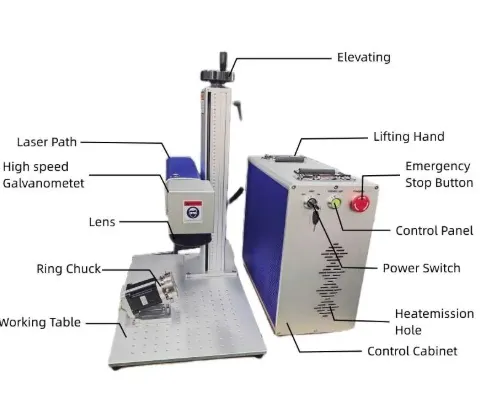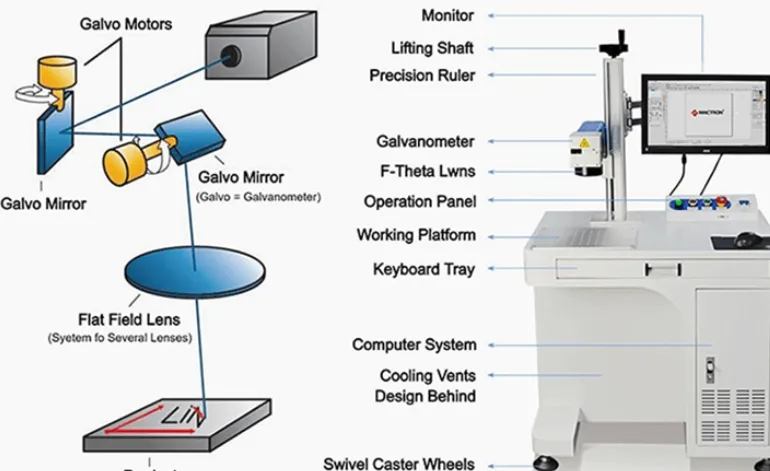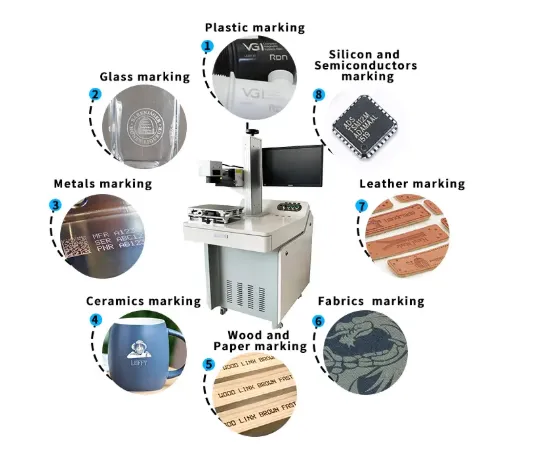
If you are asking “What laser is best for engraving plastic?”, the short answer is: there is no single laser that is best for every type of plastic.
For many industrial plastic-marking applications, a 355 nm UV laser is an excellent starting point because it can produce fine, high-contrast marks with relatively low thermal impact. However, CO₂ lasers can be highly effective for materials such as acrylic, plastics, films and packaging, while 1064 nm fiber or MOPA lasers can work very well on certain engineered plastics and laser-markable polymers.
The correct choice depends on the actual plastic, its color and additives, the required marking appearance, engraving depth, production speed, part geometry, and whether heat-related deformation is acceptable.
Quick Answer
For fine, high-contrast marking on many heat-sensitive plastics, evaluate a 355 nm UV laser first. For deeper or faster engraving of acrylic, wood-like plastics, films and some packaging materials, a CO₂ laser may be more appropriate. For selected engineering plastics and applications requiring dark marking or carbonization, 1064 nm fiber or MOPA lasers can also be effective.
The safest buying rule is simple: test your actual plastic before purchasing the machine.
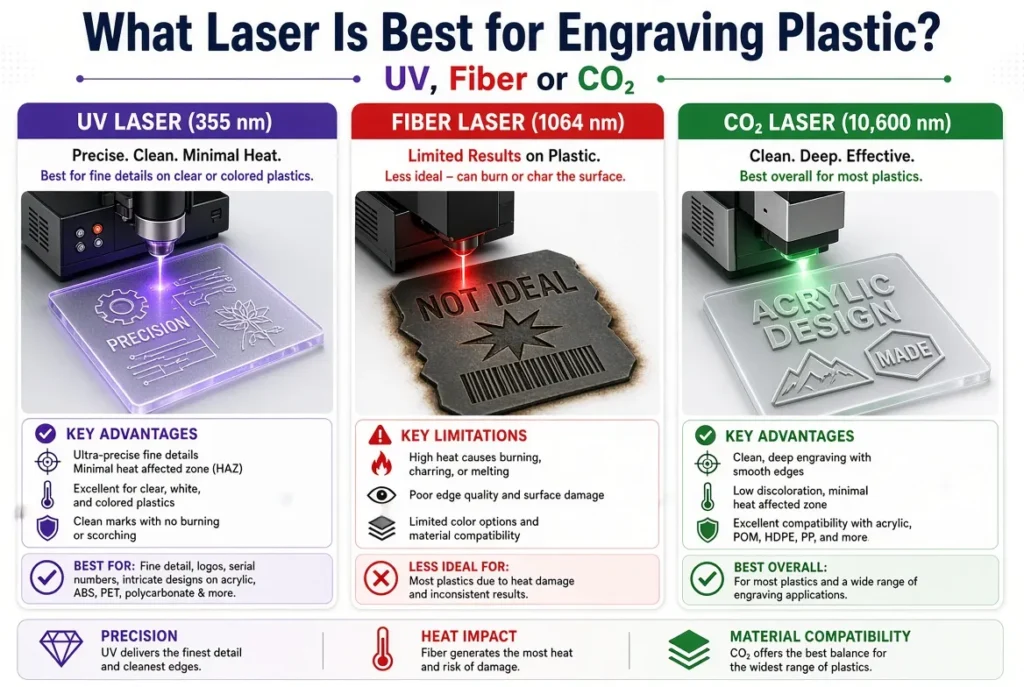
Table of Contents
Which Laser Is Best for Plastic Engraving?
| Laser Type | Typical Wavelength | Plastic Applications | Main Advantage | Main Concern |
|---|---|---|---|---|
| UV Laser | 355 nm | ABS, PC, selected PVC, electronics, medical plastics, packaging and sensitive plastics | Fine marking and relatively low thermal impact | Higher equipment cost and application-specific testing |
| Fiber Laser | 1064 nm | Selected engineering plastics, laser-markable polymers and filled plastics | High efficiency and strong industrial capability | Thermal effects can be significant on unsuitable plastics |
| MOPA Fiber | 1064 nm | Selected plastics requiring controlled pulse conditions and contrast | More flexible pulse control | Not every plastic responds well |
| CO₂ Laser | 10.6 μm | Acrylic, plastics, films, packaging and larger-area engraving | Strong absorption in many organic materials and fast material removal | Thermal effects can cause melting, discoloration or deformation |
Public application references support this general division. KEYENCE identifies UV, hybrid and CO₂ systems as important technologies for plastic engraving, while noting that plastic composition strongly affects the result.
1. Why Is UV Laser Often Recommended for Plastic?
UV laser marking is commonly associated with plastic because the 355 nm wavelength can be strongly absorbed by many materials.
Unlike conventional thermal processing, UV marking can produce a photochemical interaction with suitable polymers. The laser energy can directly affect molecular bonds, allowing certain plastics to be marked with less heat transfer to the surrounding material.
For this reason, UV lasers are often considered when the application requires:
- high contrast;
- fine text;
- small graphics;
- small Data Matrix or QR codes;
- minimal deformation;
- low thermal impact;
- marking on sensitive plastic components.
Coherent describes 355 nm UV marking as a photochemical process that can change the color of suitable plastics without relying primarily on thermal damage. Its published examples include ABS, polyurethane, transparent plastics and packaging applications.
This is one of the main reasons UV laser technology is widely considered for electronics, medical plastics, pharmaceutical packaging and other precision applications.
2. Is UV Always the Best Laser for Plastic?
No.
This is an important distinction.
UV is often an excellent choice for precision plastic marking, but the word plastic covers hundreds of different formulations.
Two parts that look almost identical may behave very differently under the same laser parameters because of differences in:
- polymer type;
- pigments;
- fillers;
- glass fiber;
- flame retardants;
- UV stabilizers;
- surface coatings;
- color;
- surface texture;
- manufacturing process.
KEYENCE also notes that plastics vary significantly in their chemical composition and may respond differently to laser marking and engraving processes.
Therefore, “UV is best for plastic” is useful as a starting point, but it should not be treated as a universal production rule.
3. What About a 1064 nm Fiber Laser?
Fiber lasers are normally associated with metal marking, but that does not mean they cannot process plastics.
Some plastics and laser-markable polymers can produce excellent results with 1064 nm fiber lasers.
The process can involve mechanisms such as carbonization, foaming, color change, or modification of pigments within the polymer.
Trotec, for example, describes fiber-laser marking of plastics where the process can create dark marks through carbonization or lighter marks through foaming, depending on the material and application.
Coherent has also documented a plastic-marking application in which a 40W, 1064 nm laser was selected to achieve the required combination of speed, contrast and legibility on white plastic.
This demonstrates an important purchasing lesson:
A fiber laser should not be rejected simply because the target material is plastic.
Instead, the specific plastic should be tested.
4. When Does MOPA Fiber Make Sense for Plastic?
MOPA fiber lasers are a specialized form of pulsed fiber laser that can provide greater flexibility in pulse parameters than many conventional Q-switched fiber systems.
This can be useful when the plastic requires tighter control over the interaction between laser energy and the surface.
Potential applications include:
- dark marking on selected engineering plastics;
- high-contrast identification;
- fine text and graphics;
- electronic components;
- automotive plastic components;
- laser-markable polymers;
- applications where conventional fiber marking produces excessive heat.
However, MOPA does not automatically solve every plastic-marking problem.
The material formulation remains critical.
A MOPA laser may give you a wider process window, but it cannot make an unsuitable plastic formulation automatically laser-compatible.
5. When Is a CO₂ Laser Better for Plastic?
CO₂ lasers operate at a much longer wavelength, commonly around 10.6 μm.
This wavelength is strongly absorbed by many organic materials and plastics, making CO₂ lasers widely used for engraving and processing acrylic, plastics, films, packaging, wood, leather and similar materials.
KEYENCE notes that CO₂ laser markers use thermal processing to create marks on plastics and can provide rapid engraving depth on suitable materials.
CO₂ can therefore be attractive when the application requires:
- larger-area engraving;
- deeper material removal;
- high-speed processing;
- acrylic engraving;
- plastic sheets;
- films;
- packaging;
- large text or graphics.
The trade-off is heat.
Because CO₂ processing relies strongly on thermal interaction, some plastics may melt, discolor, deform or produce unwanted edge effects if the parameters are not properly controlled.
6. UV vs Fiber vs CO₂ for Plastic
| Factor | UV 355 nm | Fiber/MOPA 1064 nm | CO₂ 10.6 μm |
|---|---|---|---|
| Fine marking | Excellent | Good to excellent depending on plastic | Good |
| Low thermal impact | Excellent | Application dependent | Lower than UV in this comparison |
| Engineering plastics | Excellent candidate | Application dependent | Application dependent |
| Acrylic | Good | Application dependent | Excellent candidate |
| Large-area engraving | Good | Good | Strong candidate |
| Deep material removal | Application dependent | Good | Strong candidate |
| Heat-sensitive parts | Strong candidate | Requires testing | Requires careful testing |
| Plastic electronics | Strong candidate | Application dependent | Application dependent |
| General metal + plastic production | Specialized | Strong candidate | Material dependent |
The table should be treated as an engineering starting point, not a guarantee. Actual plastic formulations can produce significantly different results.
7. Which Laser Is Best for ABS Plastic?
ABS is one of the most common engineering plastics used in consumer products, electronics, automotive components and industrial parts.
For ABS, UV laser marking is often a strong option when high contrast and low thermal impact are important.
However, 1064 nm fiber or MOPA systems can also work on selected ABS formulations.
Coherent specifically documents UV marking of ABS formulations containing titanium dioxide, where UV processing can create dark, high-contrast marks on white material.
Therefore, the correct approach is not to ask only:
“Can UV mark ABS?”
Instead ask:
“Which laser produces the required contrast, durability and cycle time on my exact ABS formulation?”
8. Which Laser Is Best for PC Plastic?
Polycarbonate can be challenging because the final result depends strongly on the specific formulation, color and additives.
For precision marking where surface damage and thermal deformation must be minimized, UV is often worth evaluating first.
Fiber or MOPA may also be suitable for specific laser-markable PC formulations.
The most reliable selection method is to test:
- white PC;
- black PC;
- colored PC;
- filled PC;
- the actual production grade.
Do not assume that a successful test on one PC grade proves compatibility with another.
9. Which Laser Is Best for PVC?
PVC requires special attention during laser processing because its formulation and additives can affect both marking performance and process safety.
Before using a laser on PVC, manufacturers should confirm the material composition and follow appropriate safety and exhaust requirements.
For precision identification, UV may be worth evaluating because of its lower thermal interaction with suitable materials.
However, the actual formulation must be tested before production.
10. Which Laser Is Best for Acrylic?
For acrylic sheets and many large-area acrylic engraving applications, CO₂ lasers are commonly considered because the 10.6 μm wavelength is strongly absorbed by the material.
CO₂ can provide fast material removal and is commonly used for:
- signage;
- acrylic panels;
- display products;
- decorative parts;
- letters;
- logos;
- custom graphics.
If the application instead requires very fine identification marks rather than deep engraving, a UV system may also be worth testing.
The best choice therefore depends on whether the goal is fine marking or high-volume material removal.
How to Test a Laser Before Buying It
If you are purchasing a plastic laser engraving machine for production, send the supplier your actual parts.
Do not rely only on a demonstration using a generic piece of plastic.
A proper application test should include:
- Actual production material.
- Exact material grade if available.
- Actual color.
- Actual surface finish.
- Actual marking artwork.
- Required marking dimensions.
- Required contrast.
- Required depth.
- Target cycle time.
- Required readability.
Ask the supplier to provide:
- laser wavelength;
- laser power;
- speed;
- frequency;
- pulse width where applicable;
- hatch spacing;
- number of passes;
- lens;
- marking field;
- actual cycle time.
This creates a much more useful comparison between suppliers.
JQ Laser’s Approach to Plastic Laser Marking
At JQ Laser, we do not recommend choosing a plastic laser only by asking which wavelength is “best.” The correct configuration depends on the material, application and required production result.
Our UV laser marking systems use a 355 nm wavelength and are available in multiple power configurations for applications involving plastics, electronics, glass, PCB and other materials where fine marking and controlled thermal interaction are important.
For manufacturers working with both metals and selected plastics, fiber and MOPA systems may also be worth evaluating depending on the plastic formulation and required marking result.
For a broader overview of material compatibility, see our Laser Marking Material Compatibility Chart.
If your application is mainly plastic, you can also review our UV Laser Marking Machine solutions and compare them with fiber and MOPA technologies.
Final Answer: What Laser Is Best for Engraving Plastic?
If you need one practical starting point, 355 nm UV is often the first technology I would evaluate for precision plastic marking, especially when high contrast and low thermal impact are important.
But that does not make UV the universal winner.
CO₂ can be a better fit for acrylic, plastic sheets, films and larger-area engraving.
Fiber or MOPA can be effective for selected engineering plastics and laser-markable polymers, particularly when dark marking, productivity or integration with metal marking is important.
The best laser is ultimately determined by the actual plastic formulation and the production result you need.
So before buying a plastic laser engraving machine, ask these five questions:
- What exact plastic am I marking?
- What color and additives does it contain?
- Do I need marking or actual material removal?
- How much heat can the part tolerate?
- What cycle time and contrast do I need?
Then test the actual material.
That is usually more reliable than choosing a laser based only on its wavelength, power or price.
Frequently Asked Questions
What laser is best for engraving plastic?
A 355 nm UV laser is often a strong choice for precision plastic marking because it can provide high contrast with relatively low thermal impact. However, CO₂, fiber and MOPA lasers can also be suitable for specific plastics and applications.
Is UV laser better than fiber laser for plastic?
Not universally. UV is often advantageous for heat-sensitive plastics and fine, high-contrast marking, while fiber or MOPA can work well on selected laser-markable engineering plastics.
Can a fiber laser engrave plastic?
Yes. Some plastics can be marked or engraved with 1064 nm fiber lasers. The result depends strongly on polymer formulation, pigments, fillers, color and laser parameters.
Can a MOPA laser engrave plastic?
Yes, selected plastics can be processed with MOPA fiber lasers. The greater flexibility in pulse parameters can be useful for controlling contrast and thermal effects, but the actual plastic must be tested.
Is CO₂ laser good for plastic engraving?
Yes. CO₂ lasers are widely used for acrylic, plastic sheets, films and other organic materials. They can be particularly useful when fast or deeper material removal is required.
What laser is best for ABS plastic?
UV is often worth evaluating first for ABS when high contrast and low thermal impact are important. Fiber or MOPA can also work on suitable ABS formulations.
What laser is best for acrylic?
CO₂ is commonly considered a strong option for acrylic engraving because the 10.6 μm wavelength is strongly absorbed by the material. UV may also be suitable when fine precision marking is required.
Can a UV laser mark black plastic?
Yes, UV lasers can mark various dark plastics, but the exact result depends on the polymer, pigments and surface formulation. Actual sample testing is recommended.
Can a laser engrave transparent plastic?
Yes, certain transparent plastics can be laser marked, particularly with UV systems. The specific polymer and additives determine the achievable contrast and quality.
How do I choose a plastic laser marking machine?
Start with the exact plastic, color, additives, required marking appearance, depth, thermal tolerance and cycle time. Then test the actual production material with the proposed laser before purchasing.