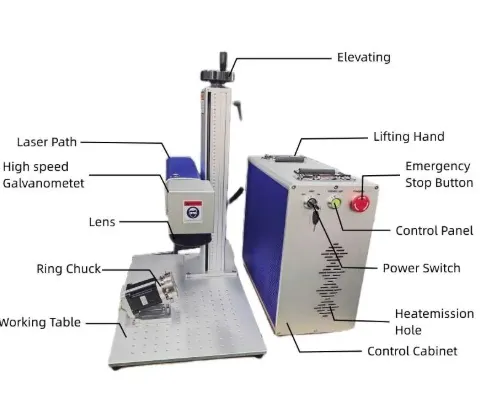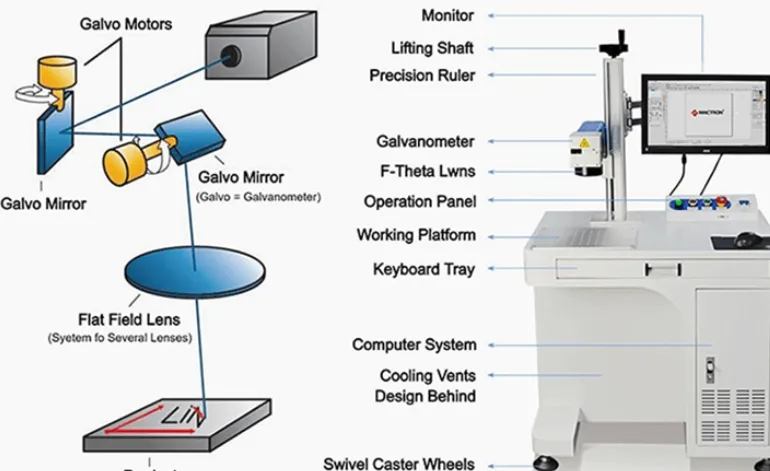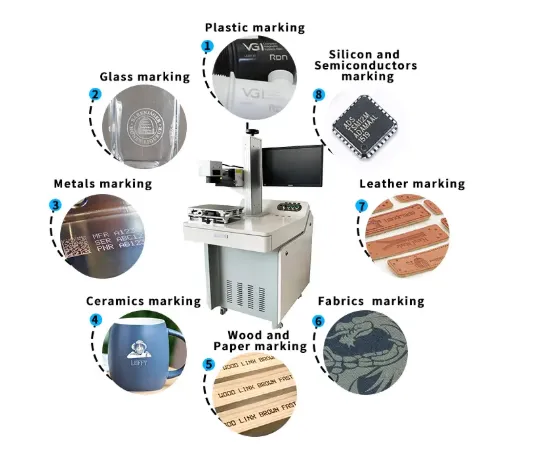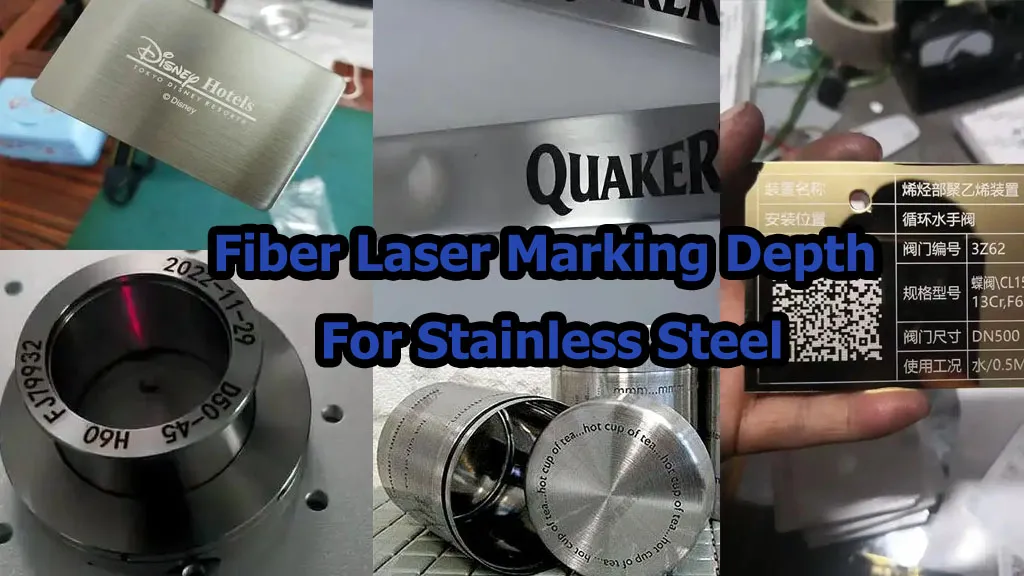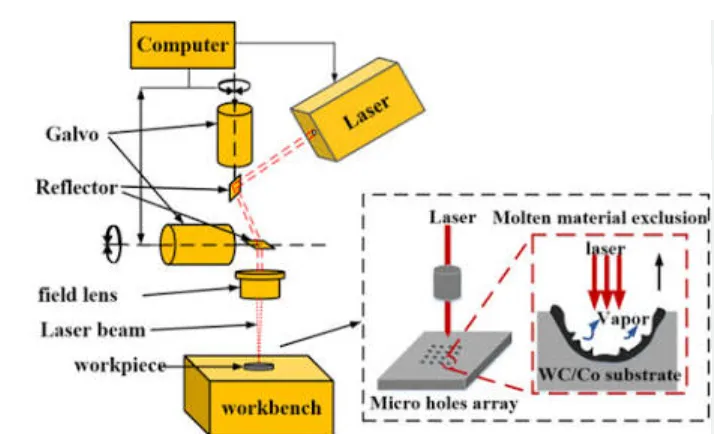
Fiber laser marking machines are mainly used to create permanent identification, traceability, logos, serial numbers, barcodes, QR codes, specifications and decorative marks on metals and selected plastics. They are widely used in automotive parts, electronics, hardware and tools, medical devices, batteries, aerospace components, jewelry, packaging and general industrial manufacturing.
Unlike a traditional printer or label, a laser mark can be created directly on the surface of a component without using ink, labels or consumable marking chemicals. Depending on the material and process parameters, a fiber laser can produce surface color changes, annealing marks, coating removal, engraving and other permanent identification effects.
The exact application depends on the material, laser source, power, lens, marking speed, pulse parameters, focus and required production result. Therefore, the best way to select a fiber laser marking machine is to start with the product and marking requirement rather than simply choosing a higher laser wattage.
1. What Are Fiber Laser Marking Machines Used For?
The most common use of a fiber laser marking machine is to permanently mark information directly onto a product or component.
Typical marking content includes company logos, model numbers, serial numbers, part numbers, production codes, dates, QR codes, Data Matrix codes, barcodes, technical specifications and customized graphics.
| Application | Typical Marking Content | Common Materials |
|---|---|---|
| Product Identification | Logo, model number, product name | Stainless steel, aluminum, steel, brass |
| Traceability | Serial number, QR code, Data Matrix | Metal, coated metal, selected plastics |
| Part Number Marking | Part number, specification, batch code | Automotive and industrial metals |
| Logo Marking | Company logo, brand identification | Metal and selected plastics |
| Decorative Marking | Patterns, graphics, personalized designs | Stainless steel, aluminum, jewelry metals |
| Serial Number Marking | Sequential numbers and variable data | Metal and engineering plastics |
| Barcode & QR Marking | 1D barcode, QR code, Data Matrix | Metal, plastic and coated surfaces |
| Deep Engraving | Text, logos, grooves and cavities | Steel, stainless steel, aluminum and other metals |
For industrial production, the value of fiber laser marking is not simply that it can “write” on a product. The more important advantage is the ability to create durable and machine-readable identification directly on the component.
Fiber Laser Marking vs. Laser Engraving
The terms laser marking and laser engraving are often used interchangeably, but they can describe different processes.
Laser marking generally refers to changing the appearance or characteristics of the material surface without necessarily removing a large amount of material.
Laser engraving usually involves controlled material removal to create a visible depression.
A fiber laser marking machine can perform different processes depending on the material and laser configuration, including surface marking, coating removal, annealing and deeper engraving.
2. Fiber Laser Marking Machine Uses by Material
Fiber lasers are particularly well matched to many metal-marking applications because their approximately 1 μm wavelength is efficiently absorbed by a wide range of metals.
Typical materials include stainless steel, carbon steel, aluminum, copper, brass, titanium, nickel and precious metals. However, not every material behaves in exactly the same way, and some plastics are better processed with MOPA or UV laser systems.
| Material | Typical Fiber Laser Applications | Common Marking Result |
|---|---|---|
| Stainless Steel | Logo, serial number, QR code, technical information | Black marking, annealing, engraving |
| Aluminum | Product identification, industrial parts, nameplates | High-contrast surface marking, coating removal |
| Carbon Steel | Part numbers, industrial components, tools | Engraving and surface marking |
| Copper | Electrical components, connectors, industrial parts | Surface identification and selected engraving applications |
| Brass | Hardware, fittings, decorative components | Logo and specification marking |
| Titanium | Medical, aerospace and industrial components | Identification and surface marking |
| Gold | Jewelry and personalized products | Logo, text and decorative marking |
| Silver | Jewelry and identification | Text, logo and decorative marking |
| Coated Metal | Nameplates, tools, electronic components | Coating removal and contrast marking |
Can Fiber Lasers Mark Plastic?
Yes, but the answer depends strongly on the type of plastic.
Some engineering plastics and laser-sensitive plastics can be marked effectively with fiber lasers, while other plastics may require a MOPA fiber laser or UV laser to obtain better contrast and lower thermal impact.
For example, MOPA fiber lasers provide more flexibility in pulse-width and frequency adjustment than conventional Q-switched fiber sources and can therefore be useful for applications involving certain plastics and specialized color-marking requirements.
For highly sensitive plastics, transparent plastics, medical plastics and applications where heat-affected areas need to be minimized, UV laser marking may be a better technical choice.
For a broader material comparison, see our Laser Marking Material Compatibility Chart.
3. Fiber Laser Marking Machine Applications by Industry
Fiber laser marking is used across many manufacturing industries because industrial components often need permanent identification throughout their service life.
The following industries represent some of the most common application areas.
Automotive Industry
Automotive components often require permanent identification for manufacturing control, assembly, quality management and traceability.
Fiber laser marking machines can be used on metal automotive components such as engine parts, transmission components, brackets, gears, shafts, fasteners and other industrial parts.
Typical marking content includes:
- Part numbers
- Serial numbers
- Production codes
- Batch numbers
- Logos
- QR codes
- Data Matrix codes
- Technical specifications
For automotive suppliers, the key requirement is often not simply visual appearance but whether the mark remains readable after handling, cleaning or normal industrial use.
Electronics Industry
Electronics manufacturers use laser marking for component identification, traceability and permanent product information.
Typical applications include:
- Electronic housings
- Connectors
- Metal components
- Aluminum housings
- Electrical terminals
- Switches
- Industrial electronics
- Selected plastic components
Small characters and machine-readable codes can be important in electronics production. The required optical configuration should therefore be selected according to the smallest character size and marking area rather than only the maximum marking field.
Hardware and Tools Industry
Hardware manufacturers are one of the most common users of fiber laser marking machines.
Applications include:
- Cutting tools
- Saw blades
- Drills
- End mills
- Wrenches
- Pliers
- Metal hand tools
- Fasteners
- Bearings
- Industrial hardware
Marking may include a company logo, product specification, size, model number, grade or other identification information.
For example, a fiber laser can mark product specifications directly onto a metal saw blade without requiring a printed label.
Medical Device Industry
Medical device manufacturers often need durable identification that remains associated with the product throughout processing and use.
Applications can include selected stainless steel instruments, surgical components, implants and other metal medical devices, depending on the required surface properties and applicable regulatory requirements.
Typical information can include:
- UDI-related identification
- Serial numbers
- Product codes
- Lot or batch information
- Manufacturer identification
- Data Matrix codes
For sensitive medical plastics, UV laser marking can sometimes provide a more suitable process because UV processing can reduce the thermal impact on appropriate polymer materials.
Battery Industry
Laser marking is increasingly used in battery and energy-storage manufacturing for identification and traceability.
Depending on the battery design and production process, applications may include cylindrical cells, prismatic cells, pouch cells, modules and packs.
Typical marking information can include:
- Serial numbers
- Production codes
- QR codes
- Data Matrix codes
- Model information
- Traceability information
The marking process must be developed according to the battery material, coating, cell construction and manufacturer’s safety requirements. A supplier should therefore test the actual battery component before recommending final parameters.
Aerospace Industry
Aerospace components require reliable identification because parts may need to remain traceable throughout manufacturing, maintenance and service.
Fiber laser marking can be used on selected aerospace metals and components for:
- Part identification
- Serial numbers
- Data Matrix codes
- Manufacturing information
- Inspection identification
- Traceability codes
For aerospace applications, the marking method must be evaluated not only for readability but also for the effect of the process on the material surface.
Jewelry Industry
Fiber laser marking machines are also used for jewelry personalization and identification.
Applications include:
- Names
- Dates
- Initials
- Logos
- Serial numbers
- Patterns
- Decorative graphics
- Product identification
Gold, silver and other jewelry metals can be processed with appropriately configured fiber laser systems. Small marking fields and suitable optical configurations are particularly useful for detailed jewelry work.
Packaging and Product Identification
Fiber laser marking can also be used for selected metal packaging and industrial product identification applications.
However, buyers should not assume that fiber is the best laser for every packaging material.
For paper, cardboard, wood and many organic packaging materials, CO₂ lasers are often more suitable. For certain plastics, UV or MOPA systems may provide better results.
4. What Types of Information Can a Fiber Laser Mark?
A major reason fiber laser marking machines are popular in industrial production is their ability to mark both fixed and variable information.
| Marking Type | Example | Typical Purpose |
|---|---|---|
| Logo | Company or product logo | Brand identification |
| Text | Model, specification, instructions | Product information |
| Serial Number | SN20260913001 | Individual traceability |
| QR Code | Variable QR code | Digital product identification |
| Data Matrix | 2D industrial code | Traceability |
| Barcode | 1D product code | Inventory and identification |
| Date Code | 2026-09-13 | Production identification |
| Batch Number | B26091301 | Manufacturing traceability |
| Graphics | Patterns and symbols | Decoration and identification |
Variable Data Marking
One of the important industrial uses of laser marking is variable-data marking.
Instead of marking exactly the same information on every part, the software can generate different serial numbers, QR codes, barcodes or production codes for individual products.
This makes laser marking particularly useful for manufacturing traceability.
5. What Makes Fiber Laser Marking Suitable for Industrial Production?
Fiber laser marking is widely used in manufacturing because the process can be integrated into both standalone workstations and automated production lines.
Permanent Identification
Laser marks are created directly on the product surface, so there is no separate label that can simply fall off or become detached.
Low Consumable Requirement
Unlike traditional ink-based marking systems, laser marking does not require marking ink for the laser process itself.
High Repeatability
Once suitable marking parameters have been developed, the same digital marking file can be reproduced across production batches.
Digital Workflow
Logos, text, serial numbers, QR codes and other variable information can be controlled digitally.
Automation Compatibility
Laser marking systems can be integrated with fixtures, sensors, conveyors, rotary devices, cameras and production-line control systems depending on the machine configuration.
Non-Contact Processing
The laser does not need to physically touch the workpiece during the marking process. This can be useful for products where mechanical contact could cause scratches or deformation.
6. Fiber Laser Marking vs. Other Laser Technologies
One of the most common purchasing mistakes is assuming that a fiber laser is the best solution for every material.
It is better to select the laser wavelength and source type according to the material and required marking result.
| Laser Type | Typical Wavelength | Strong Application Areas |
|---|---|---|
| Fiber Laser | Approximately 1064 nm | Metals, industrial parts, tools, automotive components |
| MOPA Fiber Laser | Approximately 1064 nm | Metals, specialized plastic marking, color effects, fine control |
| UV Laser | 355 nm | Plastics, glass, PCB, electronics, sensitive materials |
| CO₂ Laser | Approximately 10.6 μm | Wood, acrylic, paper, leather and many organic materials |
Fiber lasers are generally a strong choice when the majority of the application involves metal.
UV lasers may be more appropriate when the main requirement involves sensitive plastics, transparent materials or applications where reduced thermal impact is important.
CO₂ lasers are commonly selected for organic materials such as wood, acrylic, paper and leather.
Therefore, “What material are you marking?” should be one of the first questions asked before choosing a laser marking machine.
7. How to Choose the Right Fiber Laser Marking Machine for Your Application
Choosing a fiber laser marking machine should start with the production requirement rather than the machine catalog.
| Buyer Requirement | What to Evaluate |
|---|---|
| Material | Stainless steel, aluminum, copper, steel, plastic, etc. |
| Marking Content | Text, logo, QR code, barcode, serial number |
| Marking Size | Required marking area and smallest feature |
| Marking Depth | Surface mark or material removal |
| Cycle Time | Required seconds per product |
| Production Volume | Number of parts per hour/day |
| Laser Power | 20W, 30W, 50W, 60W, 100W or application-specific configuration |
| Laser Source | Standard fiber or MOPA depending on application |
| Lens | Field size, focal length and required resolution |
| Automation | Manual, rotary, conveyor, sensor, camera or production-line integration |
20W Fiber Laser
A 20W fiber laser marking machine is commonly considered for general-purpose identification applications such as logos, serial numbers, QR codes and text on metal components.
It can be a practical choice for small and medium production environments where extremely deep engraving or very high throughput is not the primary requirement.
30W Fiber Laser
A 30W machine can provide additional processing capability for manufacturers who need higher productivity or more material removal than a basic 20W system.
It is often considered for industrial parts, tools, stainless steel components and general manufacturing applications.
50W Fiber Laser
A 50W fiber laser can be attractive for applications requiring higher throughput or deeper engraving capability.
For example, JQ Laser has used a 50W fiber laser configuration for metal saw-blade marking applications where the customer’s requirement included product logos and specifications with a reported marking cycle of approximately one second per blade.
However, the one-second result should not be interpreted as a universal 50W performance figure. Actual cycle time depends on the marking content, material, lens, focus, parameters and required quality.
100W Fiber Laser
Higher-power fiber lasers are generally considered when production requirements involve greater material removal, deeper engraving or higher throughput.
The correct configuration still needs to be determined through application testing because increasing laser power does not automatically make every marking process faster or better.
8. What Are the Most Common Real-World Uses?
For a manufacturer considering a fiber laser marking machine, the following examples represent common production tasks:
| Product | Typical Use |
|---|---|
| Metal Saw Blades | Logo, size, teeth specification |
| Automotive Parts | Part number, serial number, Data Matrix |
| Bearings | Brand, model and identification code |
| Metal Tools | Logo, size, product model |
| Electronic Housings | Logo, serial number and specification |
| Connectors | Product identification |
| Stainless Steel Instruments | Identification and traceability |
| Jewelry | Names, logos, dates and decorative designs |
| Metal Nameplates | Text, logo, specifications and serial numbers |
| Industrial Components | Permanent product identification |
9. When Should You NOT Choose a Fiber Laser?
A professional laser supplier should also explain when a fiber laser may not be the best option.
You should carefully evaluate other laser technologies when your primary material is:
- Wood
- Paper
- Cardboard
- Leather
- Many acrylic applications
- Highly sensitive plastics
- Transparent plastics
- Glass
For these applications, a CO₂ or UV laser may provide a better processing solution depending on the exact material and required result.
Similarly, if your application involves specialized plastic marking, a MOPA fiber laser may be worth evaluating instead of a conventional Q-switched fiber laser.
The right question is not “Which laser is the most powerful?” but “Which laser process produces the required result on my material at the required production cost?”
10. Final Answer: What Are the Uses of Fiber Laser Marking Machines?
Fiber laser marking machines are primarily used for permanent product identification, traceability, logos, serial numbers, QR codes, Data Matrix codes, barcodes, specifications and engraving.
They are particularly suitable for metal products and are widely used in automotive, electronics, hardware, tools, medical, battery, aerospace, jewelry and general industrial manufacturing.
The final laser configuration should be selected according to the material, marking content, required depth, marking area, cycle time and production volume.
If you are comparing different laser marking technologies, start with the material and application requirement. A fiber laser is an excellent industrial marking solution for many metals, but MOPA, UV or CO₂ technology may be more appropriate for specific materials and processing requirements.
For a complete material-by-material comparison, see our Laser Marking Material Compatibility Chart.
You can also learn more about our Fiber Laser Marking Machine configurations for industrial applications.
Frequently Asked Questions
What are fiber laser marking machines mainly used for?
Fiber laser marking machines are mainly used for permanent logos, serial numbers, part numbers, QR codes, Data Matrix codes, barcodes, specifications, traceability information and engraving on metals and selected plastics.
What materials can a fiber laser marking machine mark?
Fiber lasers are widely used on stainless steel, carbon steel, aluminum, brass, copper, titanium, nickel and many other metals. Some plastics can also be marked, depending on the material formulation and laser configuration.
Can a fiber laser mark stainless steel?
Yes. Stainless steel is one of the most common materials for fiber laser marking. Applications include logos, serial numbers, QR codes, specifications, annealing and engraving.
Can a fiber laser mark aluminum?
Yes. Fiber lasers are commonly used for marking anodized and bare aluminum components, including housings, nameplates, industrial parts and electronic components.
Can fiber lasers mark plastic?
Some plastics can be marked with fiber lasers. However, MOPA or UV laser systems may provide better results for certain plastic materials and specialized applications.
Can a fiber laser engrave metal?
Yes. With suitable power and processing parameters, fiber lasers can remove material from many metals for engraving. Deeper engraving generally requires more energy, slower processing, multiple passes or a higher-power configuration.
Are fiber laser marking machines suitable for QR codes?
Yes. Fiber laser marking machines are widely used for permanent QR codes and Data Matrix codes on metal components and other compatible materials.
What industries use fiber laser marking machines?
Common industries include automotive, electronics, hardware, tools, medical devices, batteries, aerospace, jewelry, machinery and general manufacturing.
Is a 50W fiber laser always better than a 20W machine?
No. Higher power can be useful for certain high-throughput or deeper engraving applications, but the correct power depends on the material, marking content, cycle time and required result.
How do I choose the right fiber laser marking machine?
Start with the material, marking content, marking area, required depth, cycle time and production volume. Then select the appropriate laser source, power, scanner and lens configuration.