If you are searching for “50W fiber laser marking machine price in Pakistan”, you will probably find a surprisingly wide range of prices.
Some sellers advertise a 50W machine for around PKR 400,000–700,000. Others quote close to or above PKR 1 million. Imported online machines can be even more expensive once shipping and customs charges are added.
So which price is actually reasonable?
As someone selling and configuring fiber laser marking machines, I would not answer this question with one number.
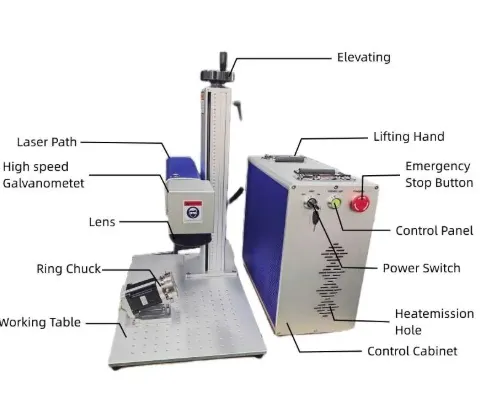
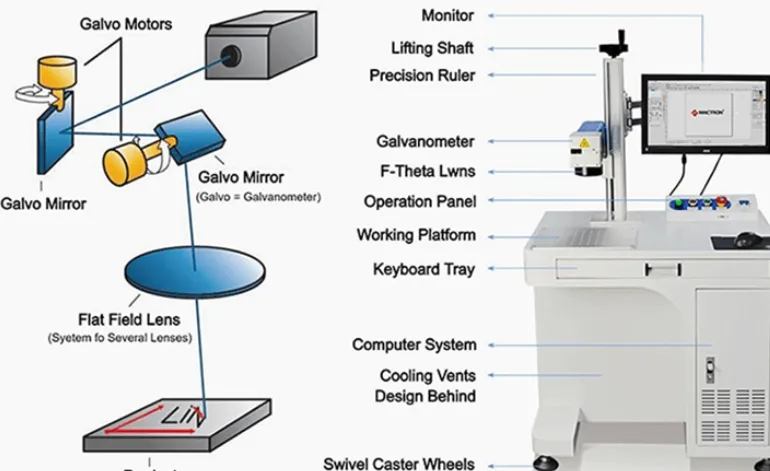
A 50W fiber laser marking machine is not a single standardized product. Two machines can both be advertised as “50W fiber laser marking machines” while having very different laser sources, optical systems, marking fields, software, enclosures, fixtures and after-sales support.
For a buyer in Pakistan, the more useful question is:
What should I pay for a 50W fiber laser marking machine with the configuration I actually need?
Based on current Pakistan market listings, international product prices, China factory pricing references and the actual 50W configuration used in one of our industrial nameplate projects, a practical 2026 purchasing benchmark is approximately:
Typical 2026 Price Range in Pakistan
| Configuration | Practical Price Reference |
|---|---|
| Basic 50W fiber marker | PKR 400,000–700,000 |
| Standard industrial 50W configuration | PKR 450,000–950,000 |
| Upgraded 50W system | PKR 750,000–1,250,000+ |
| Automation / vision / special configuration | PKR 1,250,000+ |
| Imported branded systems | Can be significantly higher |
These are market reference ranges, not a fixed Jining Junqi Laser quotation.
The final price depends on the laser source, marking area, galvo scanner, lens, enclosure, rotary axis, software, automation, shipping and local import costs.
Table of Contents
What Is the Current 50W Fiber Laser Marking Machine Price in Pakistan?
Let’s start with actual market evidence rather than a theoretical price.
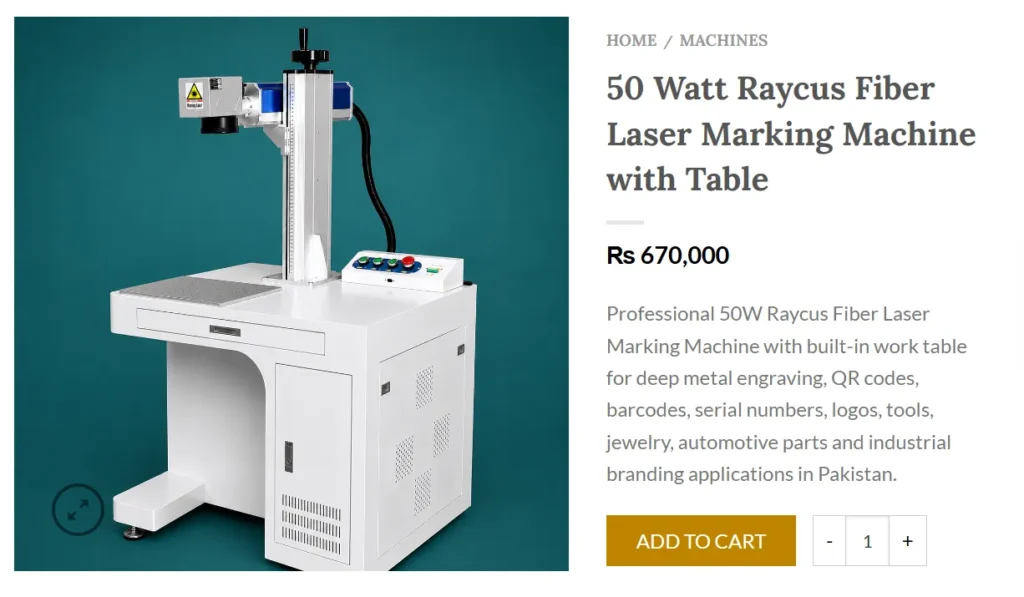
Current Pakistan listings show several 50W fiber laser marking machines in the approximately PKR 649,000–750,000 range.
For example, recent OLX Pakistan listings show 50W machines at approximately PKR 649,000, PKR 680,000, PKR 699,000 and PKR 750,000, depending on the listing and location. Other listings show a 50W machine around PKR 675,000–690,000.
There are also lower-priced machines advertised in the market.
However, I would not automatically recommend buying the cheapest machine.
The important question is what is included.
For example, a machine advertised at:
PKR 650,000
may be a perfectly reasonable purchase if it includes a genuine 50W laser source, suitable galvo scanner, correct F-Theta lens, JCZ control card, software, proper optical alignment and local technical support.
But if the machine is cheap because the supplier has reduced the laser source quality, optical components, control electronics or after-sales support, the lower purchase price may not be a bargain.
What Does a 50W Machine Cost From China?
The China factory-direct market gives another useful reference.
A current 2026 pricing guide aimed specifically at the Pakistan market places 50W/100W industrial fiber laser marking machines at approximately USD 2,000–4,500 FOB China, depending on configuration.
At an August 2026 USD/PKR exchange rate of roughly 277.6 PKR per USD, that corresponds approximately to:
- USD 2,500 ≈ PKR 694,000
- USD 3,000 ≈ PKR 833,000
- USD 3,500 ≈ PKR 972,000
- USD 4,000 ≈ PKR 1,110,000
- USD 4,500 ≈ PKR 1,249,000
The exchange-rate reference shows an August 28, 2026 USD/PKR rate of approximately 277.60.
This gives us a useful reality check.
If someone tells you that a complete new 50W industrial fiber marking machine from China must cost USD 6,000–8,000 before shipping, I would ask exactly what is included.
On the other hand, if someone offers a supposedly new industrial 50W system for an unusually low price, I would also ask questions about the laser source, optical system and warranty.
What Are Pakistani Buyers Actually Seeing?
The local market appears to sit in several different price bands.
Recent Pakistan listings provide examples such as:
- 30W around PKR 525,000
- 50W around PKR 649,000–750,000
- 100W around PKR 999,000
These listings are useful as market signals, but they should not be treated as audited quotations. OLX listings can vary in configuration, condition, included accessories and seller support.
There is another interesting reference.
A Pakistan-accessible Ubuy listing for a ComMarker 50W fiber laser shows approximately PKR 938,170, excluding shipping and customs charges.
Another 50W JPT fiber laser listing on Ubuy is around PKR 2,031,290, again excluding shipping and customs.
This is why simply searching Google for “50W fiber laser price Pakistan” can be confusing.
You may see:
PKR 650,000
and:
PKR 2,000,000
for machines that are both described as 50W.
That does not necessarily mean one seller is cheating.
The machines may not be configured or sold through the same channel.
My Recommended Price Target for a Standard 50W Machine
If I were buying a standard industrial 50W fiber laser marking machine for a Pakistani factory, I would use the following benchmark.
Around PKR 450,000–750,000
This can make sense for a relatively basic machine with:
- 50W Q-switched fiber laser
- 1064 nm
- Air cooling
- Standard marking field
- JCZ control card
- EZCAD software
- Basic worktable
- Standard positioning
- No major automation
This is the entry-level industrial range I would investigate.
Around PKR 550,000–950,000
This is the range I would consider more interesting for a factory buyer if the machine includes better components and useful accessories.
For example:
- Genuine 50W laser source
- Better optical configuration
- 110×110 mm lens
- Additional 150×150 or 200×200 mm lens
- JCZ control card
- EZCAD2/3
- Better machine structure
- Red-light positioning
- Fixture
- Better warranty
- Sample testing
- Technical support
This is the range where I think many buyers should focus.
PKR 950,000–1,250,000+
This can still be reasonable if the quotation includes:
- Larger marking field
- Rotary axis
- CCD vision
- Enclosed Class 1 structure
- Motorized Z-axis
- Higher-end laser source
- Multiple lenses
- Automatic positioning
- Production-line integration
- Fume extraction
- Additional software functions
The important point is:
Do not compare a PKR 450,000 basic machine directly with a PKR 1,100,000 automated system and conclude that one seller is overpriced.
Compare the configuration line by line.
The 50W Configuration We Actually Use as an Industrial Reference
or a real industrial project involving excavator identification plates, our delivered specification used a 50W pulsed fiber laser.
This is a useful reference because it shows what a serious industrial 50W configuration can look like.
The project specification included:
- Laser type: Pulsed fiber laser
- Rated power: 50W
- Wavelength: 1064 nm
- Forced air cooling
- AC 220V ±10%
- Single-phase 50/60 Hz
- Power consumption: ≤600–800W
- Main marking field: 110×110 mm
- Additional 150×150 mm lens
- JCZ industrial control card
- EZCAD2/EZCAD3 software
- Red-light positioning
- Reference scanning speed: ≥7,000–8,000 mm/s
- Reference minimum line width: ≤0.01–0.03 mm
- Reference minimum character height: 0.1–0.2 mm
These are project delivery specifications, not generic marketing numbers.
The project also required laser output testing, sample marking using the actual customer material, continuous operation testing of at least eight hours, and operator training.
That is the kind of specification sheet I would want to see before paying for a machine.
Why 110×110 mm Is a Useful Standard Configuration
Many Pakistani buyers immediately ask:
“Should I buy 110×110 or 200×200?”
There is no universal answer.
For small metal parts, tools, nameplates, serial numbers and logos, 110×110 mm is often a practical optical field.
The 50W project configuration we delivered used:
110×110 mm as the main lens
and:
150×150 mm as an additional lens.
The purpose was flexibility.
A smaller marking field can be useful for smaller parts and detailed marks, while a larger lens gives more working area for larger plates.
The project specification also identified 200×200 mm as an optional field for larger marking applications.
So when comparing two quotations, don’t simply ask:
“Both are 50W. Why is yours more expensive?”
Ask:
“What marking field and lens are included?”
That can explain part of the difference.
What Can a 50W Fiber Laser Mark in Pakistan?
This is where the machine becomes relevant to actual Pakistani manufacturing.
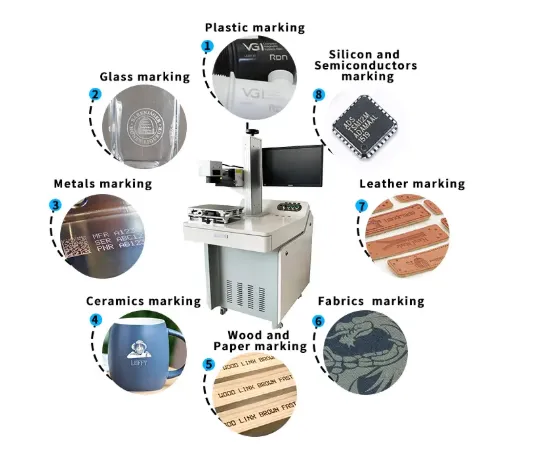
A 50W fiber laser is primarily a metal marking and engraving system, although some plastics and coated materials can also be suitable depending on the material.
Typical applications include:
Stainless Steel
Common applications include:
- Surgical instruments
- Kitchenware
- Industrial nameplates
- Machine components
- Tools
- Hardware
- Automotive components
Aluminum
Typical applications include:
- Anodized aluminum
- Electrical components
- Industrial labels
- Equipment nameplates
- Automotive parts
Brass and Copper
Applications can include:
- Electrical components
- Plumbing components
- Decorative parts
- Industrial hardware
Carbon Steel
Typical applications include:
- Machine components
- Tools
- Industrial parts
- Serial numbers
- Deep engraving
Titanium
Potential applications include:
- Medical components
- Aerospace components
- Industrial parts
- Jewelry
The actual result always depends on material grade, surface condition and process parameters.
Which Pakistani Industries Can Benefit From a 50W Fiber Laser?
The machine becomes especially interesting when you look at Pakistan’s manufacturing clusters.
Sialkot: Surgical Instruments and Metal Products
Sialkot has a major manufacturing base for surgical and medical instruments.
For metal surgical instruments, fiber laser can be considered for applications such as:
- Product identification
- Serial numbers
- Logos
- DataMatrix
- Traceability marks
However, I would not automatically recommend fiber for every medical product.
If the workpiece is a heat-sensitive medical plastic or the customer needs a specific low-thermal-effect process, UV laser may be a better starting point.
This is why material testing matters.
Lahore and Gujranwala: Automotive, Engineering and Machinery
A 50W fiber laser makes sense when the customer is marking:
- Engine components
- Machine parts
- Metal tools
- Bearings
- Gears
- Agricultural machinery
- Electrical components
- Serial numbers
If deeper engraving is required, 50W becomes more attractive than a basic 20W or 30W system.
Current Pakistan market listings also show active demand for 30W, 50W and 100W systems in Punjab industrial areas.
Karachi: Industrial and Export Manufacturing
For factories producing components for export, permanent identification becomes increasingly important.
Applications can include:
- Product codes
- Serial numbers
- Logos
- Barcodes
- QR codes
- DataMatrix
- Traceability
A fiber laser can be integrated with fixtures, rotary axes, barcode readers or automated production systems depending on the production volume.
20W vs 30W vs 50W in Pakistan
If you are unsure whether you really need 50W, this is the comparison I would use.
| Requirement | 20W | 30W | 50W |
|---|---|---|---|
| Basic metal marking | ★★★★★ | ★★★★★ | ★★★★★ |
| Small logos | ★★★★★ | ★★★★★ | ★★★★★ |
| Serial numbers | ★★★★★ | ★★★★★ | ★★★★★ |
| QR/DataMatrix | ★★★★★ | ★★★★★ | ★★★★★ |
| Deep engraving | ★★ | ★★★ | ★★★★★ |
| Faster production | ★★ | ★★★★ | ★★★★★ |
| Heavy industrial parts | ★★ | ★★★ | ★★★★★ |
| General factory use | ★★★ | ★★★★ | ★★★★★ |
| Entry price | Lowest | Medium | Higher |
If you only mark small logos and serial numbers on stainless steel, 20W or 30W may be enough.
If you need more production capacity and deeper engraving, 50W is easier to justify.
This is one of the reasons I would not tell every buyer:
“Buy 50W because 50W is better.”
That is not good engineering advice.
What Is the Real Difference Between a Cheap and Expensive 50W Machine?
This is probably the most important section of the article.
Two machines can both say:
50W Fiber Laser
but still be very different.
When I compare machines, I look at at least these eight areas.
1. Laser Source
Ask:
- Brand?
- Model?
- Serial number?
- Rated power?
- Test report?
- Warranty?
Do not accept only:
“China famous brand laser.”
Ask for the actual model.
The project specification we use requires the original laser manufacturer’s nameplate, serial number and test report.
2. Galvanometer Scanner
The scanner controls how the laser beam moves.
A poor scanner can affect:
- Speed
- Positioning
- Edge quality
- Repeatability
The project specification calls for a high-speed digital galvanometer system with a reference scanning speed of at least 7,000–8,000 mm/s and repeat positioning accuracy in the ±0.001–0.002 mm range.
3. F-Theta Lens
The lens determines the marking field and optical performance.
For the project:
110×110 mm was the main configuration.
150×150 mm was specified as an additional lens.
This is a practical setup for customers who work with different nameplate sizes.
4. Control Card
JCZ is a common industrial control-card platform.
The project specification called for a JCZ industrial control card and EZCAD2/EZCAD3 software.
When comparing quotations, ask exactly what control card and software are included.
5. Machine Structure
A cheap desktop frame may be perfectly adequate for a small workshop.
A factory producing thousands of components may need:
- Rigid worktable
- Fixture
- Enclosure
- Exhaust system
- Emergency stop
- Height adjustment
- Production interface
Do not pay for a large enclosure if you don’t need it.
But don’t buy a lightweight hobby-style frame for a production line either.
Do You Need a Rotary Axis?
If you mark:
- Rings
- Cylinders
- Pipes
- Bearings
- Handles
- Bottles
- Round metal components
a rotary axis can be useful.
For flat nameplates, you normally don’t need one.
This is another place where buyers can save money.
If your production is 90% flat metal plates, I would spend the money on:
better lens + fixture + sample testing
rather than automatically adding a rotary axis.
Do You Need CCD Vision?
For a small workshop:
Probably not.
For production where the part position changes or the marking location needs to follow a printed feature:
It can be valuable.
CCD vision can help with:
- Position recognition
- Automatic alignment
- Part orientation
- Variable marking position
- Production-line integration
The 50W project specification lists CCD vision as an optional upgrade rather than a standard requirement.
That is how I would recommend it.
Add automation when it solves a real production problem.
What About Marking Speed?
This is where many sales conversations become misleading.
A supplier may say:
“Our machine reaches 8,000 mm/s.”
That does not mean your product will be completed in a fraction of a second.
The project reference specification lists:
- Scanning speed: ≥7,000–8,000 mm/s
- Typical process speed: 500–3,000 mm/s
- Medium-complexity marking cycle: approximately 5–20 seconds
- Broader reference cycle: 5–30 seconds
The difference exists because actual production speed depends on the marking design, fill, line width, material, contrast, depth and number of passes.
This is why I recommend asking suppliers for:
A video of your actual sample being marked.
Not a generic video of an empty laser head moving quickly.
How Many Pieces Can a 50W Machine Mark Per Day?
This depends heavily on the product.
The actual project data provides a useful reference:
Standard production
Approximately:
800–1,500 pieces/day
for one machine and one eight-hour shift, including loading, positioning, focusing and changing parts.
Optimized production
With a fixture and faster loading/unloading:
1,500–2,500+ pieces/day
can be used as a planning reference.
These figures are not guaranteed production capacity for every product. The actual output depends on marking content, size, number of passes and operator workflow.
This distinction is important.
A simple serial number can be very fast.
A large logo plus deep engraving can take considerably longer.
Hidden Costs When Buying in Pakistan
The machine price is not always the final price.
When importing from China, ask about:
- Machine price
- FOB/CIF/other Incoterm
- Shipping to Karachi
- Customs duties
- Import taxes
- Local clearance
- Installation
- Training
- Spare lenses
- Protective windows
- Rotary axis
- Fume extraction
- Enclosure
- Local service
A China factory price of USD 2,500 does not mean:
“The machine will cost PKR 694,000 delivered to my factory.”
At approximately 277.6 PKR/USD, USD 2,500 is around PKR 694,000 before shipping and other import-related costs.
That is why you should always ask:
Is this EXW, FOB or CIF?
and:
What costs are excluded?
Is It Better to Buy Locally or Import From China?
There is no universal answer.
Buy locally if:
- You need immediate installation
- You don’t have an experienced operator
- You need local service
- You don’t want to deal with customs
- Downtime is expensive
Import from China if:
- You understand the specifications
- You can manage the import process
- You want more configuration choices
- You are buying multiple machines
- You want factory-direct communication
For a first-time buyer, I would not choose purely on the lowest FOB price.
If a factory gives you a machine for USD 2,500 but cannot support you when the marking quality changes, the savings may disappear quickly.
What Should a Good 50W Quotation Include?
Before paying a deposit, I recommend asking for a written quotation with these items.
Laser
- 50W
- 1064 nm
- Brand
- Model
- Warranty
- Serial number after delivery
Optics
- Galvo brand/model
- Lens brand
- Marking area
- Focal length
Control
- JCZ control card
- EZCAD version
- Computer
- Supported file formats
Machine
- Dimensions
- Weight
- Voltage
- Cooling
- Power consumption
Accessories
- Red-light positioning
- Foot pedal
- Exhaust port
- Spare protection lens
- Tools
Service
- Warranty
- Training
- Remote support
- Spare parts
- Response time
The actual project delivery data, for example, specifies 220V ±10%, air cooling, 600–800W power consumption, JCZ/EZCAD, red-light positioning and accessories including a foot switch, exhaust interface, spare protective lens and toolbox.
My Recommended 50W Configuration for a Pakistani Metalworking Factory
If the customer tells me:
“I mainly mark stainless steel, aluminum and steel parts. I need logos, serial numbers, QR codes and occasional deeper engraving.”
I would start with something close to this:
| Component | Recommended Configuration |
|---|---|
| Laser | 50W Pulsed Fiber |
| Wavelength | 1064 nm |
| Cooling | Air cooled |
| Main Lens | 110×110 mm |
| Additional Lens | 150×150 mm |
| Scanner | High-speed digital galvo |
| Control Card | JCZ |
| Software | EZCAD2/3 |
| Positioning | Red light |
| Fixture | Recommended |
| Rotary | Optional |
| CCD | Optional |
| Enclosure | Depending on workplace |
| Voltage | 220V, 50/60Hz |
| Sample Test | Strongly recommended |
This is close to the real industrial project configuration we have used, rather than a generic online shopping specification.
So, What Is a Good Price for This Configuration?
Now we can answer the original question more accurately.
For Pakistan in 2026, I would consider the following a reasonable benchmark:
Basic 50W
PKR 600,000–700,000
Suitable for buyers who mainly need standard metal marking.
Recommended industrial configuration
PKR 700,000–950,000
This is the range I would personally investigate first for a factory buyer.
You should expect a reasonable machine to include:
- Genuine 50W source
- 1064 nm
- Air cooling
- 110×110 mm lens
- JCZ
- EZCAD
- Red-light positioning
- Good optical alignment
- Sample testing
- Warranty
- Technical support
Advanced configuration
PKR 950,000–1,250,000+
Reasonable if you are getting:
- Additional lenses
- Rotary axis
- CCD
- Enclosure
- Motorized Z
- Production integration
- Better automation
- Higher-end components
This range aligns reasonably well with current Pakistan market listings and China factory pricing references. Local 50W listings are currently around PKR 649,000–750,000 in several examples, while a China factory-direct reference places industrial 50W/100W machines around USD 2,500–4,500 FOB.
When a PKR 1 Million Machine Is Actually Worth It
I would not reject a PKR 1 million quotation automatically.
For example, if you are marking:
- Automotive components
- Heavy machinery
- Export products
- Serial numbers
- DataMatrix codes
- Deep engraving
- High-volume production
then spending more on:
- Better optics
- Better fixture
- CCD
- Enclosure
- Additional lens
- Automation
may be financially sensible.
The question is not:
“Can I find a 50W machine for PKR 650,000?”
The question is:
“Will the additional PKR 300,000–400,000 reduce production time, rejects or operator labor enough to pay for itself?”
That is the right purchasing calculation.
A Simple ROI Example
Suppose your current manual marking process takes:
30 seconds per part.
Your laser process takes:
10 seconds per part.
At 1,000 parts/day, the theoretical difference is:
20 seconds × 1,000 = 20,000 seconds
which is approximately:
5.6 hours of processing time saved per day.
That does not mean the factory will automatically save 5.6 labor hours every day, because loading, inspection and handling still take time.
But it illustrates why cycle time should be measured using the actual part.
A supplier who tells you:
“Our laser is 8,000 mm/s.”
has not answered the ROI question.
A better supplier should tell you:
“We tested your part and the complete cycle is approximately X seconds under these conditions.”
That is the number worth comparing.
What I Would Ask the Supplier Before Ordering
If I were the buyer in Pakistan, I would send this message to every supplier:
Please quote your complete 50W fiber laser marking machine for metal applications.
Please include:
- Laser source brand and model
- Actual rated output power
- Galvo brand/model
- Lens brand and marking field
- Control card
- EZCAD version
- Marking speed
- Machine dimensions
- Voltage
- Warranty
- Sample testing
- Shipping terms to Karachi
- Whether customs/taxes are included
- Spare parts
- Training and after-sales support
Then send the supplier your actual material.
This makes comparing quotations much easier.
Final Recommendation: Don’t Chase the Lowest Price
After looking at the current Pakistan market, my view is fairly simple.
If you find a 50W machine around:
PKR 650,000–750,000
it is worth investigating.
If the quotation is around:
PKR 750,000–950,000
and includes a good laser source, proper optical system, JCZ/EZCAD, suitable lens, sample testing and technical support, that can be a very reasonable factory purchase.
If the price is:
PKR 1,000,000+
ask what additional value you are getting.
It may be completely justified if the machine includes automation, CCD, enclosure, multiple lenses or production-line integration.
But if the only difference is a bigger machine cabinet and a salesperson saying “industrial quality,” I would ask for more details.
What Should You Pay for a 50W Fiber Laser Marking Machine in Pakistan?
For 2026, a realistic purchasing benchmark is:
PKR 650,000–950,000 for a standard-to-good 50W fiber laser marking machine, with higher prices justified by automation, better components or more complete industrial configurations.
At the current exchange rate, this broadly corresponds to approximately:
USD 2,340–3,425
using roughly 277.6 PKR per USD.
A factory-direct industrial configuration can move higher depending on the equipment package, and current China-market references put 50W/100W industrial fiber systems around USD 2,500–4,500 FOB.
The local Pakistan market provides a useful reality check, with recent 50W listings commonly appearing around PKR 649,000–750,000.
But price should be the second question.
The first question should be:
What exactly am I getting for that price?
For a serious metal-marking application, I would rather buy a properly configured 50W machine at PKR 800,000–900,000 with a documented laser source, correct lens, JCZ/EZCAD, sample testing and technical support than a PKR 600,000 machine where the supplier cannot clearly explain the components.
And if your application only requires shallow logos and serial numbers, don’t automatically buy 50W.
A good 20W or 30W machine may already do the job.
If you need deeper engraving, higher throughput or one machine that can handle a broader range of industrial metal applications, then 50W becomes much easier to justify.
The right machine is not the cheapest 50W machine in Pakistan.
It is the machine that gives you the required marking quality, production speed and reliability at the lowest sensible total cost.
Sources and Price References
Pakistan local-market listings: Recent OLX Pakistan listings show 50W fiber laser marking machines around PKR 649,000–750,000, with variation by seller and location.
China factory-direct reference: A 2026 Pakistan-focused laser pricing guide lists 50W/100W industrial fiber laser marking machines at approximately USD 2,500–4,500 FOB China, depending on configuration.
Imported machine reference: Ubuy Pakistan currently lists a ComMarker 50W system at approximately PKR 938,170 before shipping and customs.
Higher-priced imported example: A JPT 50W, 300×300 mm system with rotary axis is listed at approximately PKR 2,031,290 before shipping and customs.
Exchange-rate reference: USD/PKR was approximately 277.60 on August 28, 2026.
Actual JQ Laser project delivery data: The 50W project configuration used a 1064 nm pulsed fiber laser, air cooling, 220V power, 110×110 mm primary marking field, 150×150 mm additional lens, JCZ control and EZCAD software, with sample testing and stability testing requirements.
Price disclaimer: Pakistan machine prices change with exchange rates, configuration, supplier, shipping terms, taxes and local service. The ranges above are market-research benchmarks, not a fixed quotation from JQ Laser.