Introduction: The Answer Is More Than a Machine Specification
Yes, a fiber laser marking machine supplier can meet your production, traceability, and export requirements—but only if its equipment configuration, manufacturing process, quality inspection, customization capability, and export support match your actual application. A supplier should be able to demonstrate marking results on your workpieces, explain the laser source and optical components, verify production cycle time, provide inspection records, and confirm spare parts and shipping arrangements. At JQ Laser, we approach each project by understanding the material, marking content, daily output, and destination market before recommending a machine. A suitable supplier should prove its capabilities, not simply promise them.
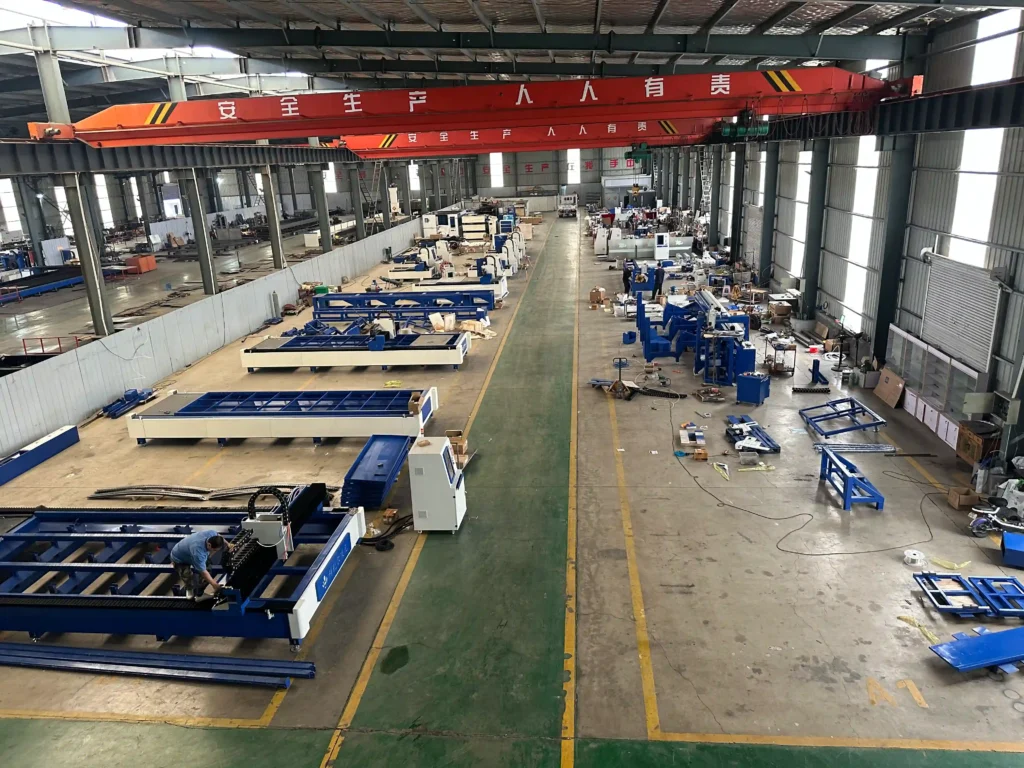
Table of Contents
1. What Should You Expect From a Professional Fiber Laser Marking Machine Supplier?
When overseas buyers contact a laser marking machine manufacturer, they usually start by asking three questions:
- How much does a 20W, 30W, or 50W machine cost?
- How quickly can you manufacture and ship it?
- Can your machine mark my products correctly?
These are reasonable questions, but they are not enough to evaluate a long-term supplier.
From our experience discussing laser marking projects with customers, the problems often appear after the machine arrives:
- The actual marking speed is slower than expected.
- QR codes look clear but cannot be consistently scanned.
- The marking depth is insufficient for the customer’s application.
- The machine cannot accommodate the customer’s workpiece dimensions.
- The supplier does not have the required spare parts.
- The machine’s electrical configuration or documentation does not match the destination market.
A professional supplier should address these issues before the order is confirmed.
Five capabilities worth checking
| Supplier capability | What you should request | Why it matters |
|---|---|---|
| Manufacturing | Factory photos, assembly process, production records | Confirms actual manufacturing capability |
| Engineering | Sample testing, parameter recommendations, technical support | Reduces application risk |
| Quality control | Inspection checklist, marking test results, electrical checks | Reduces delivery defects |
| Customization | OEM branding, fixtures, rotary devices, automation | Matches your production requirements |
| Export support | Packing details, commercial invoice, packing list, shipping terms | Makes international purchasing easier |
Our recommendation: Do not select a supplier based only on its advertised laser power or the lowest quotation. Evaluate the complete machine configuration and the supplier’s ability to support your production after delivery.
2. Can the Machine Handle Your Actual Production Requirements?
The first technical question is not whether a machine has 20W or 50W power. It is whether it can produce the required marking result within your available production time.
A machine used for marking ten stainless steel nameplates per day has very different requirements from one marking thousands of automotive components per shift.
2.1 Reference technical specifications
The following table summarizes typical JQ Laser fiber laser marking configurations. These are reference specifications, not guaranteed results for every material or workpiece.
| Parameter | Reference configuration |
|---|---|
| Laser type | Pulsed fiber laser |
| Available power | 20W / 30W / 50W / 100W |
| Typical wavelength | 1064 nm |
| Cooling | Air cooling for common configurations |
| Reference maximum scanning speed | Up to approximately 7,000 mm/s |
| Standard marking field | 110 × 110 mm |
| Optional marking fields | 150 × 150 / 175 × 175 / 200 × 200 / 300 × 300 mm |
| Control system | JCZ / BJJCZ-compatible configuration |
| Marking software | EZCAD2; other configurations subject to confirmation |
| Laser source options | Raycus / JPT / MAX and other configurations |
| Electrical supply | 110V or 220V, 50/60Hz, according to destination requirements |
Important technical note: The maximum scanner speed of 7,000 mm/s is not the actual production output. Real cycle time depends on marking content, material, line spacing, laser parameters, workpiece positioning, fixture design, and loading and unloading time.
For example, marking a small serial number on a flat stainless steel component is very different from engraving a large logo or creating a deep identification mark.
Always ask the supplier to test your actual workpiece and provide a representative marking time.
3. Can the Supplier Solve Your Product Traceability Requirements?
For many industrial manufacturers, laser marking is not simply about printing a logo on a product.
It is part of the production identification system.
A manufacturer may need every component to carry:
- A unique serial number.
- A QR code or Data Matrix code.
- A production batch number.
- A manufacturing date.
- A product model.
- A company identification code.
The purpose is to connect each physical product with its production information.
3.1 Real production scenarios
Scenario A: Automotive metal components
A manufacturer produces metal engine components and needs to mark a unique Data Matrix code on each part.
The marking must remain readable after subsequent manufacturing processes and handling.
A suitable project should consider:
- Material composition and surface condition.
- Available marking area.
- Required code dimensions.
- Required marking contrast and durability.
- Workpiece positioning.
- Code verification after marking.
A 20W or 30W fiber laser may be a starting point for conventional surface marking, but the final configuration must be validated using the actual component.
Scenario B: Electronics components
An electronics manufacturer needs small serial numbers and QR codes on metal housings.
The main difficulty is not necessarily engraving depth. It is maintaining consistent code dimensions and readability on small surfaces.
We would first test:
- Minimum code size.
- Character dimensions.
- Contrast against the material.
- Positioning repeatability.
- Reading performance using the customer’s scanner.
For automated production, a vision system or barcode reader can be considered to verify marking results.
Scenario C: Industrial tools and hardware
A hardware factory needs to mark logos, model numbers, and batch information on metal tools.
If the workpieces are cylindrical, a rotary axis may be necessary. If the parts are produced in large batches, dedicated fixtures can reduce manual positioning time.
3.2 What does a complete traceability solution include?
| Component | Function | When it is needed |
|---|---|---|
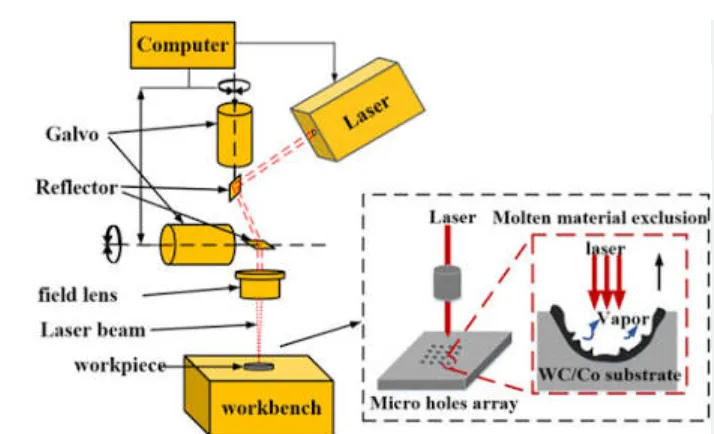
| Fiber laser source | Creates permanent identification marks | Metal marking |
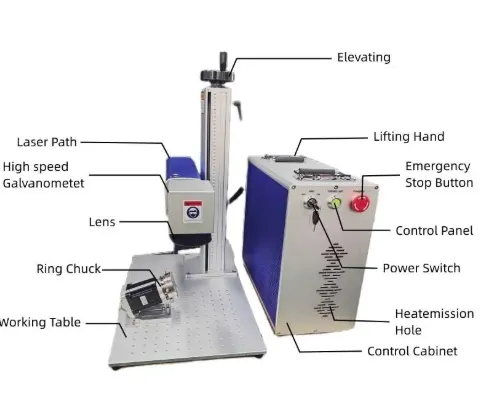
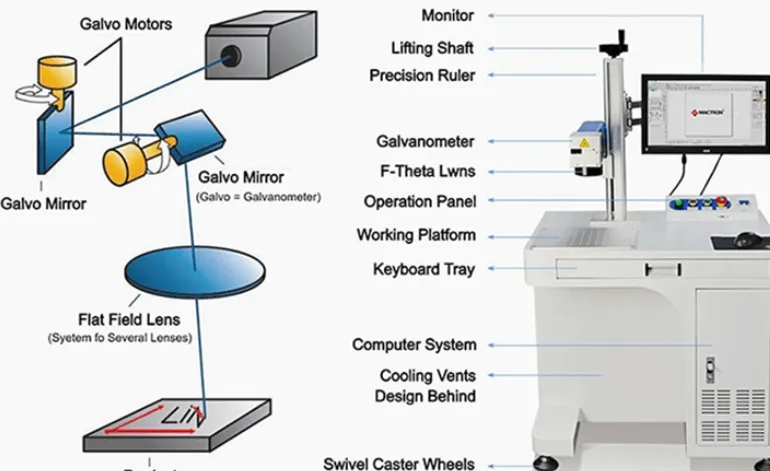
| Galvanometer scanner | Controls laser positioning | All standard marking applications |
| F-theta lens | Determines the marking field | According to workpiece size |
| Dedicated fixture | Maintains workpiece position | Repetitive batch production |
| Rotary axis | Rotates cylindrical workpieces | Rings, tubes, shafts and similar parts |
| CCD vision | Helps locate and position products | Variable positioning or automated loading |
| Barcode reader | Checks code readability | Traceability verification |
| PLC / I/O integration | Communicates with production equipment | Automated production lines |
One important distinction: a laser marking machine creates the physical identification mark. It does not automatically provide a complete MES traceability system.
If you need integration with an MES, ERP, production database, or automatic code generation system, the communication protocol, software interface, and verification process must be agreed upon before ordering.
Explore our Product Traceability Solution for more application details.
4. Can JQ Laser Test Your Actual Materials Before You Purchase?
This is one of the most important questions to ask any supplier.
A specification sheet cannot tell you exactly how your material will look after laser processing.
Even two stainless steel products can produce different marking results because of differences in alloy composition, surface treatment, polishing, coating, and finishing.
That is why we recommend sample testing before confirming a machine configuration.
4.1 Materials we can evaluate
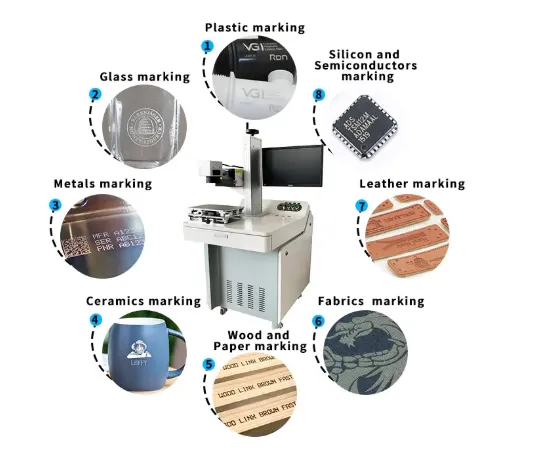
| Material / workpiece | Typical application | Technology to evaluate |
|---|---|---|
| Stainless steel | Kitchenware, tools, metal parts | Fiber / MOPA |
| Aluminum | Nameplates, electronic housings | Fiber / MOPA |
| Anodized aluminum | Industrial panels, electronic components | Fiber / MOPA |
| Brass | Hardware, fittings, decorative parts | Fiber |
| Copper | Electrical components | Fiber |
| Titanium | Medical and industrial components | Fiber / MOPA |
| Gold and silver | Jewelry, rings, pendants | Fiber / MOPA |
| ABS plastic | Electrical housings | UV or suitable fiber configuration |
| PVC | Plastic identification | Material-specific evaluation and safety review |
| Engineering plastics | Automotive and electronic components | UV / fiber, depending on formulation |
The technology column indicates starting points for evaluation, not guaranteed compatibility. Plastic formulations, additives, coatings, and safety considerations can change the result.
4.2 Our sample testing process
Step 1: Receive your workpiece information
Send us photographs, material details, product dimensions, and the marking content.
If possible, send an actual sample.
Step 2: Confirm the marking objective
Tell us whether you need:
- Black marking.
- White marking.
- Color marking.
- Surface marking.
- Deep engraving.
- QR codes or Data Matrix codes.
- Fine text or detailed logos.
Step 3: Select the initial laser configuration
Our technical team evaluates whether a standard fiber laser, MOPA fiber laser, UV laser, or another suitable configuration should be tested.
Step 4: Test different parameters
Depending on the material, technicians adjust:
- Laser power.
- Frequency.
- Pulse width, where adjustable.
- Scanning speed.
- Hatch spacing.
- Number of passes.
- Focus position.
For example, a MOPA fiber laser provides adjustable pulse duration, which can be useful when developing black marks on anodized aluminum or color effects on stainless steel.
Step 5: Review the result
We compare the sample against your requested appearance, dimensions, contrast, depth, and code readability.
Step 6: Confirm the machine configuration
Once the application is validated, we can recommend the appropriate laser source, lens, marking field, fixture, and optional automation.
<figure> <img src=”https://fiberlasermarking.com/wp-content/uploads/” alt=”JQ Laser material sample testing and fiber laser marking results” /> </figure>
Suggested image replacement: Upload actual photographs showing stainless steel, aluminum, brass, and other customer workpieces before and after laser marking. Use real samples rather than stock images.
A practical point: Do not accept a supplier’s sample test as proof of production capacity unless the test uses representative workpieces and records the relevant parameters and cycle time.
5. Does the Supplier Have Real Manufacturing and Assembly Capabilities?
A supplier’s factory capability directly affects delivery consistency, customization, and after-sales service.
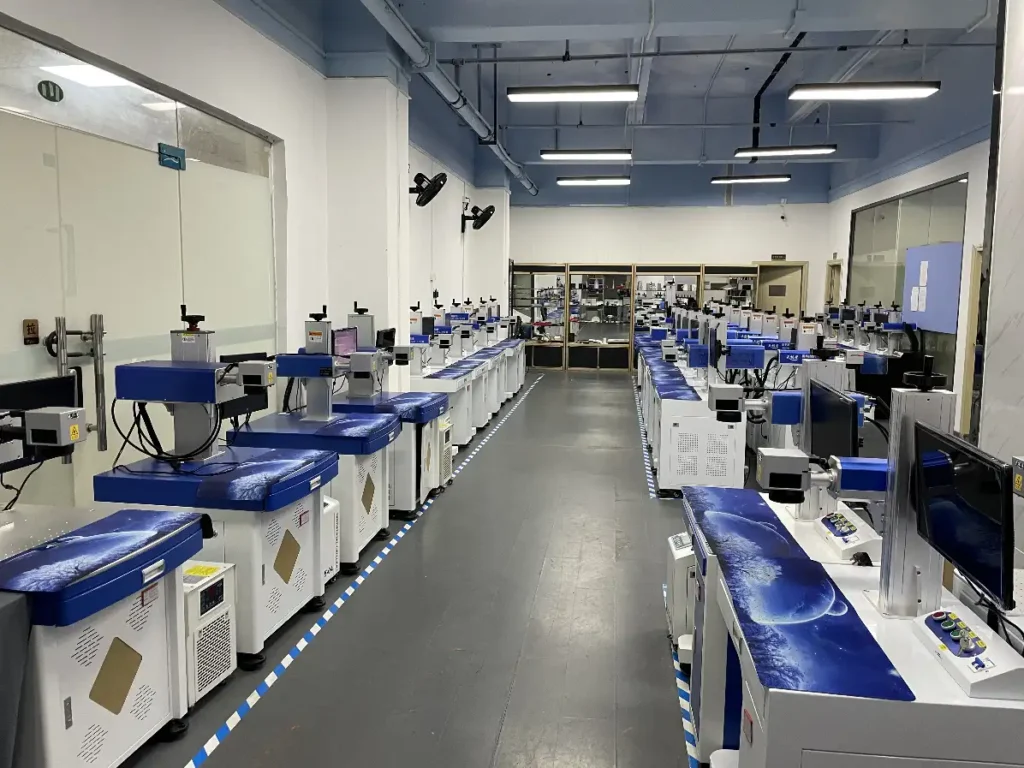
At JQ Laser, our manufacturing and assembly operations are based in Qufu, Jining, Shandong, China.
Our machine preparation process includes production, mechanical and electrical assembly, system checking, laser testing, and final inspection before shipment.
5.1 How a machine is prepared before delivery
| Production stage | Main work | What should be checked |
|---|---|---|
| Component preparation | Prepare laser source, scanner, lens, controller and electrical parts | Model and configuration |
| Mechanical assembly | Install machine structure and optical components | Mechanical stability |
| Electrical installation | Wiring, power supply and control system installation | Wiring and electrical safety |
| Software configuration | Install and configure marking software | Operating functions |
| Laser testing | Check laser operation and marking performance | Stable marking output |
| Sample verification | Test marking results | Appearance and dimensions |
| Final inspection | Check machine functions and accessories | Completeness before packing |
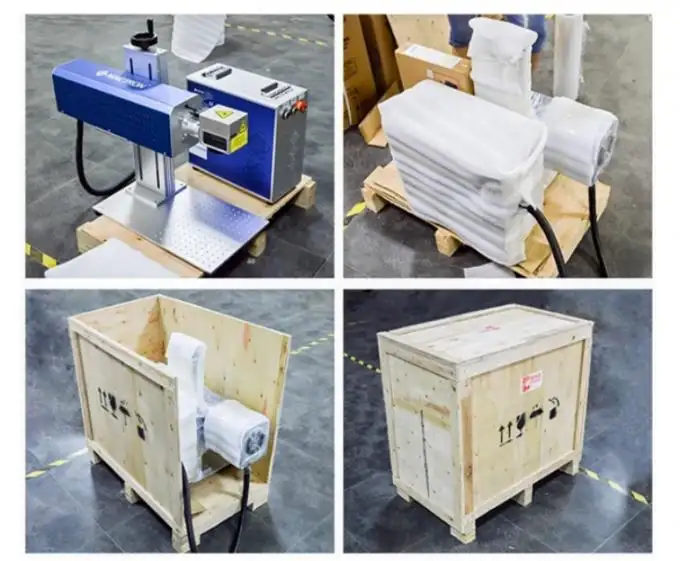
| Packaging | Prepare equipment for export | Protection and packing list |
The actual inspection records and machine configuration should be available for the relevant order.
5.2 What factory evidence should overseas buyers request?
Rather than relying on a company introduction alone, request:
- Current photographs of the assembly area.
- Videos showing technicians assembling machines.
- Laser source and scanner model information.
- A video of the machine marking your sample.
- A final machine inspection checklist.
- A photograph of the completed machine before packing.
- Confirmation of the included accessories and spare parts.
These records help you understand what you are purchasing before the equipment leaves China.
See our About JQ Laser page for more information about our manufacturing and quality inspection process.
6. Can the Supplier Provide OEM and ODM Services?
For distributors, overseas trading companies, and established equipment brands, OEM capability can be an important purchasing requirement.
A supplier should be able to explain exactly which parts of the machine can be customized.
At JQ Laser, OEM and ODM projects can be discussed according to the machine configuration and order requirements.
6.1 What can be customized?
| Customization item | Available project options |
|---|---|
| Company branding | Logo, machine nameplate, labels |
| Machine appearance | Selected colors and external design |
| Packaging | Customized labels and packaging requirements |
| Laser source | Raycus, JPT, MAX and other agreed configurations |
| Marking area | 110 × 110 mm and optional larger fields |
| Fixtures | Workpiece-specific positioning fixtures |
| Rotary system | Rotary chuck, roller or customized fixture |
| Software | Configuration according to agreed system requirements |
| Electrical supply | 110V / 220V, 50/60Hz as applicable |
| Automation | PLC, sensors, CCD vision and production-line integration |
Not every customization is suitable for every order. For example, changing a machine logo is relatively straightforward, while developing a fully automatic marking station requires engineering evaluation and testing.
6.2 What is the MOQ for OEM orders?
There is no single MOQ that applies to every OEM project.
The minimum order quantity depends on:
- Whether only the logo and packaging need customization.
- Whether the machine structure needs modification.
- Whether special fixtures are required.
- Whether the customer needs a dedicated software configuration.
- Whether the project requires a new production-line design.
For standard machines, buyers can discuss individual or small-batch purchasing.
For more complex OEM projects, we evaluate the customization scope and production arrangement before confirming the applicable MOQ.
Our advice for distributors: If you are testing a new market, start by discussing a small initial order before committing to a large customized batch. This gives you an opportunity to validate product demand, local service requirements, and customer feedback.
See our Laser Marking Machine OEM & ODM Service page.
7. What Are the Production Lead Time and Export Arrangements?
Price is only one part of the purchasing decision. Delivery time and shipping arrangements can affect your production schedule just as much.
A professional supplier should distinguish between standard machine preparation and customized project lead time.
7.1 What affects the lead time?
| Order type | Main factors affecting delivery |
|---|---|
| Standard machine | Component availability, configuration and production schedule |
| Customized machine | Structural modifications, electrical configuration and testing |
| OEM machine | Branding, labels, packaging and order quantity |
| Automatic marking system | Fixture design, PLC integration, programming and commissioning |
We recommend asking the supplier to confirm the following milestones in writing:
- Order confirmation date.
- Component preparation date.
- Assembly completion date.
- Testing and inspection date.
- Estimated packing date.
- Estimated shipment date.
Rather than publishing an unverified universal delivery promise, JQ Laser confirms the applicable lead time according to the selected configuration and current production schedule.
7.2 What export documents should you confirm?
For international shipments, discuss the following documents with your supplier and freight forwarder:
| Document | Purpose |
|---|---|
| Commercial Invoice | Declares the goods and transaction value |
| Packing List | Lists machine components and package details |
| Bill of Lading / Air Waybill | Transport document |
| Certificate of Origin | Country-of-origin documentation, where required |
| Product Technical Documentation | Machine specifications and operating information |
| User Manual | Installation and operating instructions |
| Electrical Documentation | Relevant electrical information |
| Compliance Documents | Applicable documents according to destination and product configuration |
Some markets have additional import requirements. For example, laser equipment may require specific laser safety documentation, electrical conformity documentation, or local import approvals.
Do not assume that a CE logo or a generic certificate automatically satisfies every country’s requirements.
Before paying the balance, confirm which documents are available for the exact machine being purchased and whether additional certification is needed in your destination market.
8. How Does JQ Laser Control Machine Quality Before Shipment?
A machine working correctly for five minutes during a demonstration does not automatically mean it is ready for industrial production.
For this reason, buyers should ask what is inspected before shipment and whether the supplier can provide supporting records.
8.1 Recommended inspection points
| Inspection item | What should be verified | Evidence to request |
|---|---|---|
| Laser source | Model, rated power and operation | Component label and test record |
| Galvo scanner | Scanning function and positioning | Marking test |
| F-theta lens | Marking field and optical condition | Configuration record |
| Electrical system | Wiring and machine functions | Inspection checklist |
| Software | Installation and operation | Operation video |
| Marking accuracy | Mark dimensions and positioning | Sample inspection |
| QR / Data Matrix | Actual readability | Customer-compatible reader test |
| Accessories | Included items match the order | Packing checklist |
| Machine operation | Stable operation under agreed test conditions | Test video or report |
| Final packaging | Machine protection and package contents | Packing photographs |
8.2 Why marking verification matters
Consider a manufacturer marking Data Matrix codes on small automotive components.
A code that looks acceptable to the human eye may still fail during automated scanning.
Therefore, visual inspection alone may not be sufficient.
If code readability is a critical acceptance requirement, specify:
- Code size.
- Required data format.
- Marking location.
- Surface condition.
- Reader or scanner model.
- Required verification standard or grading level.
If a formal code-quality grade is required, agree on the verification method and acceptance criteria before production.
This prevents disputes after delivery.
9. Are Spare Parts and After-Sales Support Available?
For a factory operating several machines every day, equipment downtime can be more expensive than the original purchase price difference.
A supplier should provide a clear explanation of warranty coverage, technical support, and replacement parts.
9.1 Spare parts worth discussing before ordering
| Spare part / component | Why it matters |
|---|---|
| Protective lens, where applicable | Helps protect the optical system |
| F-theta lens | Determines the marking area and optical configuration |
| Galvo scanner | Controls laser beam positioning |
| Laser source | Core laser component |
| Power supply | Supports electrical operation |
| Control card | Controls machine operation |
| Foot switch | Supports manual operation |
| Computer and software | Required for machine control |
| Exhaust equipment | Important for applications generating smoke or fumes |
Not every component needs to be purchased as a spare part with the initial order.
For a distributor, however, it is useful to discuss which consumables and components can be stocked locally.
9.2 What should a good after-sales process look like?
We recommend establishing the following support process:
- The customer reports the problem with photographs or a video.
- The technical team identifies the machine configuration and possible cause.
- The supplier provides troubleshooting instructions.
- If necessary, the customer performs a guided test.
- Replacement parts or further service are arranged according to warranty terms.
Before purchasing, confirm:
- Warranty duration and coverage.
- Whether the laser source has separate warranty conditions.
- Response and support channels.
- Availability of replacement components.
- Remote software and parameter support.
- Whether installation and operator training are included.
A clear service agreement is much more useful than a general promise of lifetime support.
10. How to Evaluate a Fiber Laser Marking Machine Supplier Before Ordering
If you are comparing three or four Chinese manufacturers, use the following checklist.
| Evaluation criteria | Questions to ask |
|---|---|
| Factory | Does the supplier have actual manufacturing and assembly facilities? |
| Experience | Can it demonstrate experience with your application? |
| Laser source | Which brand and model are included? |
| Galvo scanner | What scanner is supplied? |
| Lens | Which marking field is included? |
| Software | Which software and controller are provided? |
| Sample testing | Can it test your actual workpiece? |
| Production speed | Can it demonstrate a representative cycle time? |
| Traceability | Can it verify barcode or Data Matrix readability? |
| OEM | Can it customize branding and configuration? |
| MOQ | What is the MOQ for your specific requirements? |
| Lead time | Is the delivery schedule confirmed in writing? |
| Quality control | Can it provide final inspection evidence? |
| Spare parts | Are replacement components available? |
| Export | Can it provide the documents required for your destination? |
A simple supplier comparison method
Do not compare quotations by machine price alone.
For example:
Supplier A offers a 30W machine at a lower price but does not specify the laser source model, scanner, lens, or sample test results.
Supplier B offers a slightly higher quotation but provides a complete component list, actual sample results, inspection records, and a clear warranty agreement.
For a factory planning long-term production, Supplier B may represent the lower purchasing risk.
The objective is not to buy the cheapest machine. It is to buy a machine that meets the production requirement at an acceptable total cost.
11. Why Work With JQ Laser?
Jining Junqi Intelligent Technology Co., Ltd. operates under the JQ Laser brand and focuses on industrial laser equipment manufacturing and application solutions.
Our product range includes fiber laser, MOPA fiber laser, UV laser, CO₂ laser, portable laser marking machines, and customized marking systems.
We work with customers across different application areas, including:
- Automotive parts.
- Metal hardware.
- Electronic components.
- Jewelry.
- Medical device identification.
- Packaging.
- Industrial equipment.
What we focus on
Application-based recommendations
We first understand your material, marking content, production volume, and required result before recommending the laser configuration.
Actual sample testing
We encourage customers to send workpiece samples so that the marking result can be evaluated before the machine configuration is finalized.
Flexible machine configurations
We can discuss laser power, laser source, marking field, fixtures, rotary systems, and other options according to project requirements.
OEM and ODM discussions
Branding, packaging, and application-specific customization can be evaluated for distributors and industrial customers.
Manufacturing and quality inspection
Our production process includes machine assembly, system checking, laser testing, and final inspection.
Export-oriented support
We can discuss machine configuration, packing, technical documentation, and shipping arrangements for overseas buyers.
We do not believe that every customer needs the same machine.
A small jewelry workshop, an automotive component factory, and an automated production line have different requirements. Our job is to help identify the appropriate configuration rather than sell the highest-power machine.
12. Request a Fiber Laser Marking Machine Solution for Your Factory
If you are looking for a reliable fiber laser marking machine supplier in China, we would be happy to evaluate your application.
You do not need to know exactly which machine configuration to purchase before contacting us.
Send us your product information, and our sales and technical teams can help assess the appropriate solution.
Information that helps us prepare an accurate quotation
| Information | Example |
|---|---|
| Material | Stainless steel / aluminum / brass |
| Workpiece size | 100 × 80 × 20 mm |
| Marking content | Logo / serial number / QR code |
| Marking area | 30 × 30 mm |
| Marking requirement | Black marking / surface marking / deep engraving |
| Daily production | 500 pieces per day |
| Preferred laser power | 20W / 30W / 50W / Not sure |
| Automation | Manual / rotary / automatic |
| Destination country | United States / Germany / Mexico |
| Purchase quantity | 1 machine / 5 machines / OEM project |
You can send photographs or a drawing first. A physical sample is even better when the application requires precise marking results.
Let’s Test Your Material Before You Invest
JQ Laser — Jining Junqi Intelligent Technology Co., Ltd.
Website: https://fiberlasermarking.com/
Email: sales@fiberlasermarking.com
WhatsApp: +86 17277264168
Tell us what you manufacture. We will help you evaluate the right laser, test the marking result, and prepare a machine configuration based on your actual production needs.
Explore Our Fiber Laser Marking Machines
Frequently Asked Questions
1. How do I know if a fiber laser marking machine supplier is a real manufacturer?
Ask for current factory photographs, assembly videos, component information, sample testing records, and final inspection evidence. You should also confirm the company’s registered business information and physical manufacturing location. A website alone is not sufficient proof of manufacturing capability.
2. What is the MOQ for a fiber laser marking machine?
For standard machine configurations, individual machine purchases can be discussed. OEM and ODM minimum order quantities depend on customization, packaging, production arrangements, and engineering requirements. Always request written confirmation for your particular project.
3. How long does it take to manufacture a fiber laser marking machine?
Lead time depends on machine configuration, component availability, customization, and production scheduling. Standard machines and customized automation systems should not be treated as having the same delivery cycle. Request a confirmed production schedule before placing the order.
4. Can I request a sample test before buying?
Yes. JQ Laser offers material testing discussions for prospective customers. Send photographs, material details, and marking requirements. For more demanding applications, sending an actual workpiece allows a more meaningful evaluation.
5. Which laser power is best for industrial production?
20W is commonly used for general metal marking, 30W provides a practical balance for regular production, 50W is useful for higher processing capacity and deeper engraving, and 100W is suitable for demanding industrial applications. The actual selection depends on material, marking depth, cycle time, and production volume.
6. Can a fiber laser marking machine mark QR codes and Data Matrix codes?
Yes. Fiber laser systems can mark QR codes and Data Matrix codes on suitable materials. However, code readability depends on the material, code dimensions, contrast, focus, marking parameters, and reader capability. A sample verification test is recommended.
7. Can JQ Laser provide OEM laser marking machines?
OEM projects can be discussed, including machine branding, labels, packaging, and selected configuration customization. The available options and minimum order quantity depend on the project requirements.
8. Can the machine be customized for 110V or 220V power supplies?
Electrical configurations can be discussed according to the destination market. Buyers should confirm voltage, frequency, power requirements, plug type, and applicable electrical standards before ordering.
9. Does the machine support automatic production lines?
Automatic marking solutions can include fixtures, rotary axes, sensors, CCD vision, PLC integration, and other equipment. The actual design depends on the workpiece, production rhythm, loading method, and communication requirements.
10. What documents should I request when importing a laser marking machine?
Discuss the commercial invoice, packing list, transport documents, user manual, technical specifications, and applicable safety or conformity documents. Requirements vary by destination country and machine configuration, so confirm them before shipment.
11. What should I do if the machine stops working after delivery?
Contact the supplier with the machine model, serial number, error message, photographs, and a short video showing the problem. A qualified technical team can then guide troubleshooting and determine whether replacement components or additional service are necessary.
12. Can JQ Laser help me select a machine if I do not know the required laser power?
Yes. Send your material, workpiece dimensions, marking content, required appearance, and daily production volume. Our team can help evaluate the suitable laser technology and configuration before you make a purchasing decision.