
Are Chinese fiber laser marking machines good? Yes, many Chinese fiber laser marking machines can provide reliable industrial performance, but quality varies significantly between manufacturers and machine configurations. The country of origin alone is not enough to determine whether a laser marking machine is good or bad.
For an overseas buyer, the more useful question is: What laser source, optical components, control system, mechanical structure, calibration process and quality control does the manufacturer actually use?
A well-built Chinese fiber laser marking machine can be a practical alternative to a higher-priced European or American system for many applications. However, a low-cost machine from an unknown supplier can also create problems with marking consistency, optical alignment, software support, electrical reliability and after-sales service.
Is Chinese Fiber Laser Marking Machine Quality Good?
The short answer is yes, but you need to evaluate the manufacturer and the actual machine configuration rather than the country of manufacture.
China has a mature industrial laser supply chain covering laser sources, galvanometer scanners, optical lenses, control cards, power supplies, mechanical components and laser marking software. This allows Chinese manufacturers to build machines ranging from low-cost entry-level systems to sophisticated industrial marking equipment.
At the same time, the Chinese laser market contains many different types of suppliers. Some companies manufacture and integrate their own machines, some specialize in specific laser components, some are system integrators, and some primarily operate as trading companies.
This is one reason why two machines advertised as a “50W Chinese fiber laser marking machine” can have very different prices and production performance.
The Most Important Point for Buyers
Do not judge a Chinese fiber laser marking machine by the word “China”. Judge it by the components, engineering, calibration, testing, documentation and support behind the machine.
Why Can Two Chinese Fiber Laser Marking Machines Have Very Different Quality?
This is one of the first questions an overseas buyer should ask.
Suppose two suppliers both offer a 50W fiber laser marking machine. On the quotation, both machines may appear almost identical:
- 50W fiber laser
- 1064 nm wavelength
- 110 × 110 mm marking area
- EZCAD software
- Industrial galvanometer scanner
- Air cooling
The specifications look similar, but the machines may still behave differently in actual production.
Why?
Because the final machine is not simply the laser source.
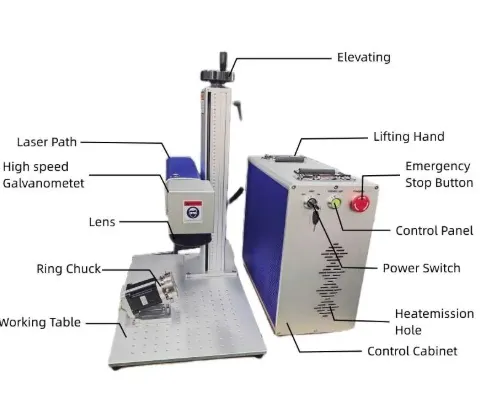
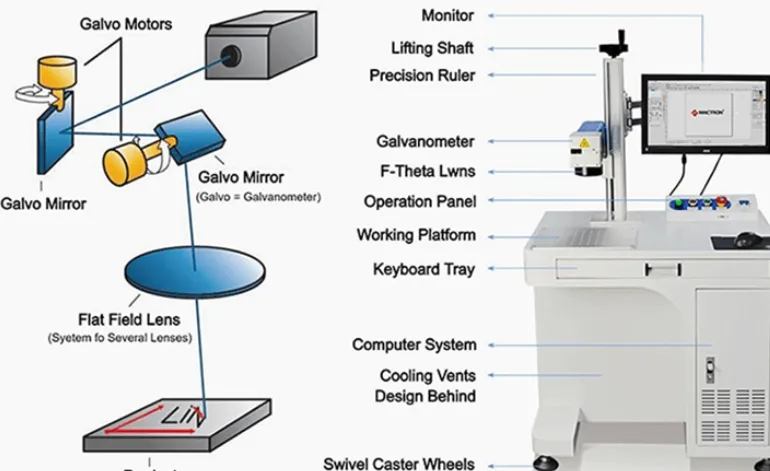
A complete fiber laser marking system is an integration of multiple optical, electronic, mechanical and software components.
A Fiber Laser Marking Machine Is a System, Not Just a Laser
When buyers compare machines, one of the most common mistakes is to focus almost entirely on laser power.
For example:
20W vs 30W vs 50W vs 100W
Power is important, but it does not describe the complete quality of a marking machine.
A more realistic quality model is:
Machine Quality = Laser Source + Galvo Scanner + F-Theta Lens + Controller + Software + Mechanical Integration + Optical Alignment + Calibration + Electrical Assembly + QC + Technical Support
If one of these areas is poorly controlled, the final production result can be affected even when the laser source itself is a reputable brand.
1. Laser Source Quality
The laser source is obviously one of the most important components in a fiber laser marking machine.
For industrial fiber marking, Chinese buyers and manufacturers commonly encounter laser source brands such as Raycus, JPT and Max, as well as other international and regional suppliers.
The important point is not simply asking:
“Is this a 50W laser?”
A professional buyer should ask:
- What is the laser manufacturer?
- What is the exact laser model?
- What is the wavelength?
- What is the pulse duration?
- What is the frequency range?
- What is the maximum pulse energy?
- What is the beam quality?
- Is the laser source serial number available?
- Can the model be verified from the laser manufacturer’s documentation?
This distinction is important because “50W fiber laser” is only a power description. It does not tell the buyer which source was installed or what its operating characteristics are.
2. Galvanometer Scanner Quality
The galvanometer scanner controls how the laser beam moves across the marking field.
This component affects important production characteristics such as:
- Scanning speed
- Positioning accuracy
- Repeatability
- Line quality
- Corner performance
- Long-term stability
A machine with a good laser source but a poorly selected or poorly calibrated scanning system may still produce unsatisfactory results.
For example, a customer may notice that a simple logo looks acceptable in the center of the marking field but becomes less accurate toward the edge. This is why the complete optical system needs to be evaluated rather than judging the laser source alone.
3. F-Theta Lens Quality
The F-theta lens is another component that is easy for inexperienced buyers to overlook.
The lens determines the relationship between the laser beam, focal position and marking field.
Different lenses provide different working fields, such as:
- 70 × 70 mm
- 110 × 110 mm
- 175 × 175 mm
- 200 × 200 mm
- 300 × 300 mm
A larger marking field is not automatically better.
If the application requires very small text or fine graphics, a smaller field may be more appropriate. If the customer needs to mark a larger product, a larger field may be necessary.
This is why the lens should be selected according to the actual marking area rather than simply choosing the largest available field.
4. Controller and Software
The controller connects the software, laser source and scanning system.
In a basic application, the controller may only need to execute standard text, graphics, serial numbers or QR codes.
In an automated production line, the requirements can become much more demanding.
The system may need to communicate with:
- PLC systems
- Sensors
- Conveyors
- Rotary axes
- Barcode scanners
- Production databases
- Inspection systems
Therefore, when comparing Chinese fiber laser marking machines, buyers should consider the control system according to the intended production environment.
5. Mechanical Integration
A fiber laser marking machine may look mechanically simple, but the enclosure, column, worktable, optical mounting structure and fixture all affect usability.
For a manual desktop marking machine, the structure needs to provide stable positioning and convenient operation.
For an automated application, the requirements become more demanding.
The fixture needs to locate the product consistently, while the laser head and optical system need to remain stable relative to the marking position.
For example, if a manufacturer is marking circular saw blades, the machine should not be evaluated only by the laser specification. Blade positioning, center reference, fixture repeatability and marking location also become important.
6. Optical Alignment and Calibration
This is one of the areas where a machine can look good in photographs but perform differently in production.
The laser source, scanner and F-theta lens need to work together as an optical system.
The marking field must be calibrated so that the programmed position corresponds accurately to the actual position on the workpiece.
For applications involving small text, QR codes, DataMatrix codes, logos or precision graphics, calibration becomes especially important.
Practical buyer tip: Do not only ask a supplier for the advertised positioning accuracy. Ask how the accuracy was measured, under what conditions, and whether the supplier can demonstrate the result on your actual product.
7. Electrical Assembly and Machine Reliability
A laser marking machine also contains electrical components that are often invisible in product photographs.
These may include:
- Power supplies
- Switches
- Relays
- Cooling fans
- Terminal blocks
- Emergency-stop components
- Control wiring
- Grounding connections
Good electrical design is not particularly visible when a machine is working correctly. Its value becomes obvious when the machine operates continuously in a production environment.
For an overseas buyer, it is therefore reasonable to ask the supplier for photographs of the internal electrical cabinet or wiring layout and to request information about the major electrical components.
8. Factory Quality Control
Another major difference between suppliers is how the machine is tested before shipment.
A professional quality-control process should go beyond switching the machine on and confirming that the laser produces a mark.
Depending on the machine configuration and application, final inspection can include:
- Laser source verification
- Optical alignment
- Marking field calibration
- Focus verification
- Software and controller testing
- Electrical inspection
- Sample marking
- Machine operation testing
- Final appearance inspection
- Packaging inspection
The exact QC process varies between manufacturers. The important point for a buyer is to understand what is actually tested before the machine leaves the factory.
Why the Cheapest Chinese Machine Is Not Always the Cheapest Solution
Price is one of the biggest reasons overseas buyers consider Chinese laser marking machines.
There is nothing wrong with comparing price. In fact, cost efficiency is one of the major advantages of sourcing industrial equipment from China.
The problem occurs when the purchase decision is based almost entirely on the lowest quotation.
Consider two machines:
| Factor | Machine A | Machine B |
|---|---|---|
| Advertised Power | 50W | 50W |
| Laser Model | Clearly specified | Not clearly specified |
| Galvo | Specified | Generic |
| Lens | Specified | Not specified |
| Calibration | Documented | Unknown |
| Sample Testing | Customer material | Generic sample |
| Technical Support | Defined | Unclear |
Even though both machines are advertised as 50W, they should not be considered equivalent.
This is why the correct purchasing question is not:
“Which Chinese machine is cheapest?”
It is:
“Which supplier gives me the required production result at the lowest reasonable total cost?”
Chinese Manufacturing Quality Is Not One Single Standard
It is important to avoid another common mistake: treating all Chinese laser manufacturers as one category.
The Chinese laser equipment industry includes companies with very different business models, technical capabilities and quality-control standards.
A useful way for buyers to think about suppliers is:
| Supplier Type | Typical Characteristics | Buyer Consideration |
|---|---|---|
| Laser Manufacturer | Produces or specializes in laser equipment/components | May provide stronger technical knowledge |
| System Integrator | Combines components from multiple suppliers | Integration and component selection become critical |
| Trading Company | Primarily handles sourcing and sales | Need to verify who actually builds and supports the machine |
| Low-Cost Assembler | Focuses heavily on minimum purchase price | Component transparency and long-term support require careful checking |
What Should Overseas Buyers Ask a Chinese Laser Manufacturer?
If you are considering purchasing a fiber laser marking machine from China, the following questions can quickly reveal how transparent and technically capable the supplier is.
- What is the exact model of the laser source?
- Which galvanometer scanner do you use?
- Which F-theta lens is included?
- Which controller and software are included?
- Can you test my actual material?
- Can you mark my actual logo, text or DataMatrix code?
- What is the actual cycle time for my product?
- How is the marking field calibrated?
- What exactly is covered by the warranty?
- Who provides technical support after delivery?
A supplier that can answer these questions clearly is usually easier to evaluate than a supplier that only provides a machine photograph and a price quotation.
One Important Rule: Test the Actual Product
For laser marking equipment, sample testing is one of the most useful purchasing steps.
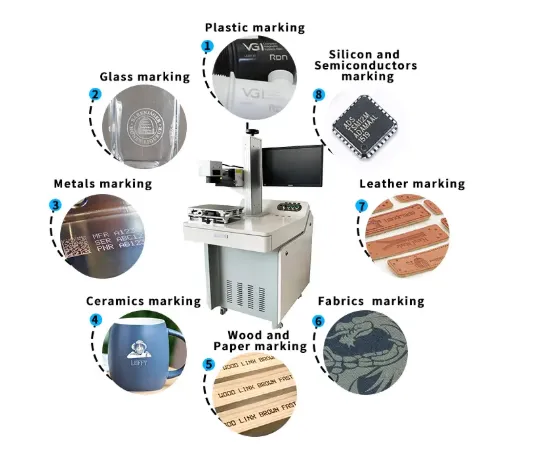
A supplier may show excellent results on stainless steel, aluminum or another common material, but your actual production material may have a different surface treatment, alloy composition, coating or geometry.
The same principle applies to the marking content.
A simple piece of text is not the same as:
- A detailed company logo
- Small serial numbers
- High-density QR codes
- DataMatrix codes
- Large filled graphics
- Deep engraving
Therefore, a proper sample test should use the actual material and actual marking content whenever possible.
The JQ Laser Testing Principle
When evaluating a laser marking application, we recommend starting with the customer’s actual material and marking requirement rather than selecting the machine only from a catalog specification.
Material → Marking Requirement → Sample Test → Parameter Optimization → Production Requirement → Machine Configuration
Real Example: Metal Saw Blade Marking
A good example of why application testing matters is a saw blade marking project for a Bosch production application in the Netherlands.
The application uses a 50W fiber laser marking machine to mark a metal saw blade. The marking includes the Bosch logo and product specifications, and the application covers multiple blade specifications.
The reported marking cycle is approximately 1 second per blade.
This example demonstrates why a buyer should evaluate a machine according to the actual production requirement.
| Application Factor | Real Case |
|---|---|
| Material | Metal |
| Laser | 50W Fiber Laser |
| Product | Saw blades |
| Product Sizes | Multiple specifications |
| Marking | Logo + product specifications |
| Marking Cycle | Approximately 1 second / blade |
The lesson for buyers is simple: the useful specification is not just “50W”. The useful specification is what that 50W system can actually achieve on the customer’s product.
Chinese Fiber Laser Quality: The Five Questions That Matter Most
1. What components are actually installed?
Ask for exact brands and model numbers rather than accepting generic descriptions.
2. Has the complete machine been calibrated?
A good component combination still requires proper optical and software calibration.
3. Can the supplier reproduce your required marking?
Test the actual material and actual marking content.
4. Can the machine maintain the result in production?
Repeatability and cycle time matter more than one impressive demonstration sample.
5. What happens after the machine arrives?
Warranty, spare parts, technical support, documentation and remote assistance are part of machine quality from the buyer’s perspective.
Final Answer: Should You Buy a Chinese Fiber Laser Marking Machine?
If your concern is simply whether a fiber laser marking machine manufactured in China can meet industrial production requirements, the answer is yes, it can.
But you should not treat “Made in China” as a quality guarantee—or as a quality problem.
The quality of a Chinese fiber laser marking machine depends much more on the manufacturer’s component selection, engineering integration, optical calibration, assembly quality, testing procedures and technical support.
For an overseas buyer, the safest purchasing strategy is therefore not to ask:
“Is Chinese laser machine quality good?”
Instead, ask:
“What evidence can the manufacturer provide that this specific machine will meet my production requirements?”
That question leads to a much more reliable purchasing decision.
What We Will Examine Next
In the next section of this guide, we will look at why Chinese fiber laser marking machines can have such large price differences even when the advertised specifications appear similar.
We will break down the real cost structure behind a fiber laser marking machine, including the laser source, galvanometer scanner, F-theta lens, controller, software, mechanical system, electrical components, assembly, calibration and after-sales service.
Understanding these differences is essential if you want to compare quotations from different Chinese suppliers fairly.
Why Are Chinese Fiber Laser Marking Machines Often Cheaper?
One of the first questions overseas buyers ask is simple: Why is a Chinese fiber laser marking machine sometimes much cheaper than a similar-looking machine from Europe, Japan or the United States?
The answer is more complicated than simply saying that Chinese labor is cheaper. China’s laser equipment industry has developed a large domestic supply chain covering laser sources, optical components, scanning systems, controllers, mechanical parts, electrical components and machine integration. This can reduce procurement and manufacturing costs, but it also creates a very wide range of machine configurations and quality levels.
For a buyer, the important question is therefore not whether a Chinese machine is cheap. The important question is: Where does the price difference actually come from?
China’s Price Advantage Is More Than Cheap Labor
When people hear that Chinese industrial equipment is cheaper, the first explanation is often:
“Chinese labor costs are lower.”
Labor is certainly one factor, but it does not explain the complete price difference of a fiber laser marking machine.
A modern fiber laser marking machine contains relatively expensive optical and electronic components. The final machine price is influenced by the entire supply chain:
- Laser source
- Galvanometer scanner
- F-theta lens
- Laser control system
- Marking software
- Computer and electrical components
- Mechanical enclosure
- Worktable and fixture
- Optical assembly
- Machine calibration
- Testing
- Packaging
- Technical support
- Dealer or distributor margin
China’s advantage is that many of these components can be sourced within a relatively dense industrial ecosystem.
For example, Chinese laser manufacturers such as Raycus and JPT publish industrial fiber laser sources covering different power levels and configurations. Raycus currently lists a 50W Q-switched pulse fiber laser specifically for marking and micromachining applications, with a 1064 nm central wavelength. :contentReference[oaicite:0]{index=0}
JPT also publishes MOPA fiber laser products in the 20–50W range. Its M8 50W model, for example, is specified at 1064 nm with a 1–4000 kHz repetition-rate range and 1–350 ns pulse-width range. :contentReference[oaicite:1]{index=1}
This type of domestic component availability is one reason Chinese system manufacturers can build and customize fiber laser marking equipment at competitive prices.
The Chinese Laser Industry Has a Deep Component Supply Chain
A fiber laser marking machine is not normally manufactured from one single supplier.
Instead, a machine manufacturer may integrate components from several specialized companies.
| Machine Component | Typical Supplier Role | Why It Matters |
|---|---|---|
| Fiber Laser Source | Specialized laser manufacturer | Controls the primary laser output and pulse characteristics. |
| Galvanometer Scanner | Optical scanning manufacturer | Controls beam movement, positioning and scanning performance. |
| F-Theta Lens | Optical manufacturer | Determines focus and marking field characteristics. |
| Control Card | Laser control-system manufacturer | Coordinates software, scanner, laser and machine I/O. |
| Software | Software/control-system developer | Provides graphic processing, text, serial numbers, codes and other functions. |
| Mechanical Structure | Machine manufacturer / fabricator | Provides physical stability and product positioning. |
| Electrical System | Machine integrator | Affects safety, reliability and serviceability. |
This specialization can actually be an advantage.
A machine manufacturer does not need to develop every laser source, scanner and optical component internally. Instead, it can select components according to the application and integrate them into a complete marking system.
The critical issue is therefore not whether every component is manufactured by the same company. The critical issue is whether the manufacturer knows how to select, integrate and calibrate those components correctly.
Why a Chinese Machine Can Be Much Cheaper Than Another Chinese Machine
This is where overseas buyers need to be careful.
There can be a large difference between two Chinese suppliers even when both machines are advertised as:
50W Fiber Laser Marking Machine
The specifications shown on an online marketplace may look almost identical, but the actual configurations can be very different.
| Cost Area | Lower-Cost Configuration | Higher-Value Configuration |
|---|---|---|
| Laser Source | Generic or poorly documented | Specified brand and exact model |
| Galvo | Basic specification | Known model with defined performance |
| Lens | Lowest-cost suitable lens | Selected according to application and marking field |
| Controller | Basic control configuration | Appropriate for application and future automation |
| Mechanical Structure | Basic construction | Designed for stability and repeatability |
| Calibration | Basic setup | Application-specific calibration and verification |
| Testing | Basic functional test | Application and production-oriented testing |
| Support | Limited | Defined technical support and spare-parts process |
This is why the phrase “same 50W” should never be interpreted as “same machine.”
Where Does the Price Difference Actually Come From?
A useful way to compare quotations is to divide the machine into several cost layers.
Layer 1 — Core Components
Laser source, galvanometer scanner, F-theta lens, controller and other optical/electronic components.
Layer 2 — Machine Integration
Mechanical assembly, optical mounting, electrical wiring, software installation and system integration.
Layer 3 — Calibration and Testing
Focus adjustment, marking-field calibration, parameter setup, sample marking and final inspection.
Layer 4 — Engineering
Application testing, fixture development, automation integration and customized machine configuration.
Layer 5 — Service
Documentation, training, remote support, spare parts and warranty handling.
Layer 6 — Commercial Cost
Factory overhead, sales expenses, distributor margins, packaging, logistics and other commercial costs.
Two suppliers can therefore arrive at very different prices without either supplier necessarily being dishonest.
The real question is whether the difference in price corresponds to a meaningful difference in the machine or simply to a different sales margin.
Low Price Does Not Always Mean Low Quality
This is an important distinction.
A Chinese machine can have a competitive price while still using reputable components and providing good industrial performance.
For example, a Chinese manufacturer may source a laser source directly through the domestic supply chain, assemble the machine locally, perform application testing and sell directly to an overseas customer.
A distributor in another country may purchase essentially the same type of machine, add local sales costs, warehousing, installation, service and margin, and sell it at a substantially higher price.
The higher price does not automatically mean the second machine is technically better.
At the same time, the lower Chinese price does not automatically mean the first machine is better value.
The Correct Way to Think About Price
Price should be compared against configuration, application performance, production reliability and after-sales support—not against the country of origin alone.
When a Very Low Price Should Make You Ask More Questions
A low quotation is not necessarily a problem. However, a very large price difference should trigger a more detailed technical comparison.
For example, if Supplier A quotes a machine at significantly less than Supplier B, ask both suppliers for the following information:
- Exact laser source brand and model
- Laser source serial number or identification
- Galvanometer model
- F-theta lens brand and specification
- Controller model
- Software version
- Actual marking field
- Actual marking speed on your product
- Electrical component list
- Warranty terms
- Spare-parts policy
- Sample test results
If the cheaper supplier can provide the same technically relevant information and achieve the same application result, the lower price may simply reflect a more efficient supply chain.
If the supplier cannot explain what is inside the machine, the price difference may be coming from component substitution, reduced testing, reduced engineering or weaker after-sales support.
Do Not Compare Machines by Wattage Alone
One of the easiest ways for buyers to make a poor comparison is to compare only the advertised laser power.
For example:
| Quotation | Advertised Specification | What Is Still Unknown? |
|---|---|---|
| Supplier A | 50W Fiber | Source model, galvo, lens, calibration, testing |
| Supplier B | 50W Fiber | Source model, galvo, lens, calibration, testing |
The two quotations cannot be meaningfully compared until those variables are known.
A professional RFQ should therefore specify the important components and performance requirements rather than simply stating:
“50W Fiber Laser Marking Machine”
Real Example: 50W Does Not Tell the Whole Story
Raycus, for example, publishes a 50W Q-switched pulse fiber laser with a 1064 nm central wavelength and positions the product for industrial marking and micromachining. Its published specifications also include technical characteristics such as output stability, pulse energy and other optical parameters. :contentReference[oaicite:2]{index=2}
JPT’s published M8 50W MOPA laser has a different parameter structure, including independently adjustable pulse frequency and pulse width, with published specifications of 1064 nm, 1–4000 kHz repetition rate and 1–350 ns pulse width for that model. :contentReference[oaicite:3]{index=3}
Both can be described broadly as “50W fiber lasers”, but their operating characteristics are not identical.
This illustrates an important purchasing principle:
The number on the front of the machine tells you the average power. It does not tell you the complete marking process.
Why Domestic Component Availability Can Benefit Overseas Buyers
A mature component ecosystem can provide another advantage: replacement and customization can sometimes be easier.
If a manufacturer has established relationships with laser-source, scanner, optical and control-system suppliers, it can potentially configure a machine around the customer’s application instead of selling only one fixed configuration.
This can be particularly useful for:
- Custom marking fixtures
- Rotary marking
- Different marking fields
- Different laser powers
- MOPA configurations
- Automated production lines
- Vision positioning
- Special material testing
For example, JCZ’s published control-system applications include communication interfaces, I/O control and motion-control functions for automated systems, illustrating how the control layer can become part of a broader production system rather than simply a basic marking interface. :contentReference[oaicite:4]{index=4}
But Supply Chain Advantages Do Not Replace Engineering
This is where buyers need to distinguish between component availability and machine quality.
A manufacturer can purchase good components and still build a poor machine.
For example:
- A good laser source can be installed with the wrong lens.
- A good scanner can be poorly calibrated.
- A good lens can be incorrectly focused.
- A good controller can be incorrectly configured.
- A good optical system can be mounted in an unstable structure.
- A good machine can be delivered without adequate application parameters.
Therefore:
Good Components + Poor Integration = Poor Machine
Good Components + Good Engineering + Good Testing = Much Better Production Potential
Factory Direct Does Not Automatically Mean Better
Another common misunderstanding is:
“If I buy directly from a Chinese factory, I will automatically get the best price and best quality.”
Not necessarily.
Direct purchasing can remove some intermediary costs, but the buyer still needs to evaluate the manufacturer’s technical capability.
A factory that produces hundreds of standardized machines may be excellent for a common application but less experienced with a specialized marking process.
Conversely, a smaller manufacturer may provide more application engineering and customization but have less local service coverage.
The right supplier depends on the buyer’s actual requirements.
Factory vs. Trading Company: Why It Matters to Price
An overseas quotation can pass through several commercial layers:
Component Supplier → Machine Manufacturer → Exporter → Distributor → Local Dealer → End Customer
Every additional commercial layer can add cost.
However, intermediaries can also provide useful services such as local installation, language support, inventory and after-sales service.
Therefore, the objective should not be to eliminate every intermediary at any cost.
The objective should be to understand what value each commercial layer provides and whether you actually need it.
What Overseas Buyers Should Compare Instead of the Quoted Price
| Compare | Better Question |
|---|---|
| Laser Power | What can this power level achieve on my actual product? |
| Laser Brand | What is the exact model and specification? |
| Marking Speed | What is the actual cycle time for my marking? |
| Marking Area | Which lens provides the required field and resolution? |
| Machine Price | What exactly is included in the quotation? |
| Warranty | Which components and failures are actually covered? |
| Support | Who will solve a production problem after delivery? |
When a Higher-Priced Chinese Machine May Be Worth It
A higher-priced Chinese machine can make sense when the additional price corresponds to something that improves the buyer’s production process.
Examples include:
- Higher-quality laser source
- Better galvanometer scanner
- Better optical configuration
- More appropriate lens
- Higher-quality electrical components
- Better fixture design
- Application-specific parameter development
- Automated loading or unloading
- Vision positioning
- Production-line integration
- Better documentation
- More comprehensive technical support
These are meaningful differences because they can affect production performance.
When a Higher Price May Not Be Worth It
On the other hand, a buyer should not assume that a higher quotation automatically means higher quality.
A higher price may sometimes reflect:
- Brand premium
- Distributor margin
- Local sales overhead
- Marketing expenses
- Additional packaging or logistics
- Dealer commission
These costs may be justified in some markets, especially when local installation and service are important. But they should still be separated from the actual technical value of the machine.
The Best Way to Compare Three Chinese Suppliers
Suppose you receive three quotations for the same application.
Do not immediately choose the lowest number.
Instead, create a technical comparison sheet:
| Item | Supplier A | Supplier B | Supplier C |
|---|---|---|---|
| Laser source/model | — | — | — |
| Galvo | — | — | — |
| Lens | — | — | — |
| Controller | — | — | — |
| Software | — | — | — |
| Marking field | — | — | — |
| Actual cycle time | — | — | — |
| Sample result | — | — | — |
| Warranty | — | — | — |
| Total price | — | — | — |
This simple comparison often reveals that a large price difference is caused by differences in configuration rather than by the word “China”.
The Real Advantage of Buying Directly from a Chinese Manufacturer
For many overseas buyers, one of the strongest reasons to source a fiber laser marking machine directly from China is not simply the purchase price.
It is the ability to communicate directly with the manufacturer about the application.
This can be particularly valuable when the customer needs:
- Custom fixtures
- Special marking fields
- Rotary marking
- Different laser powers
- MOPA configurations
- Automation
- Vision positioning
- Special materials
- Custom software communication
- Production-line integration
When the manufacturer and customer communicate directly, application requirements can be discussed before the machine configuration is finalized.
What JQ Laser Believes a Quotation Should Include
From an engineering and purchasing perspective, a useful quotation should contain enough information for the buyer to understand what they are actually purchasing.
At minimum, the buyer should be able to identify:
- Laser source brand
- Laser source model
- Rated power
- Wavelength
- Galvanometer configuration
- F-theta lens and marking field
- Controller
- Software
- Machine dimensions
- Electrical requirements
- Included accessories
- Warranty terms
- Sample-testing arrangement
The more transparent the quotation is, the easier it is for an overseas buyer to compare different suppliers fairly.
Our View as a Laser Equipment Manufacturer
We do not believe that the lowest machine price is always the best offer, and we also do not believe that the highest price automatically represents the highest quality.
A good machine should be configured according to the application. If a customer only needs standard stainless-steel serial-number marking, there is no reason to sell an unnecessarily complicated system. If another customer needs one-second saw-blade marking, deep engraving or automated production, the machine should be configured around that production requirement.
The objective should be to provide the right machine for the process—not simply the cheapest machine or the most expensive machine.
Key Takeaways: Why Chinese Fiber Laser Machines Can Be Competitive
- China’s competitive pricing is not based only on low labor costs. A mature laser-component and manufacturing supply chain also plays an important role.
- Chinese laser manufacturers can source specialized components from established domestic suppliers.
- Two machines with the same advertised wattage can have significantly different configurations.
- A reputable laser source does not automatically make the complete machine high quality.
- Good integration, calibration and testing are essential.
- A low price can be legitimate when it comes from supply-chain efficiency.
- A very low price should trigger a technical comparison, not an automatic rejection.
- Buyers should compare actual production performance instead of comparing wattage alone.
- Factory-direct purchasing can provide cost and customization advantages, but the manufacturer’s technical capability still needs to be verified.
- The best purchasing decision is based on total value and production requirements, not the lowest quotation.
What to Check Before Accepting a Low Chinese Laser Quote
Before choosing the lowest quotation, ask these ten questions:
- What exact laser source model is included?
- What galvanometer scanner is included?
- What F-theta lens is included?
- What controller is included?
- What software version is included?
- What is the actual cycle time for my product?
- Can you test my actual material?
- What calibration procedure is used?
- What does the warranty actually cover?
- Who will provide technical support after delivery?
If the supplier can answer these questions clearly, you can begin comparing the quotation based on engineering value rather than price alone.
Conclusion: Cheap Is Not the Same as Low Quality
Chinese fiber laser marking machines can be competitively priced because China has developed a strong ecosystem for laser sources, optical components, control systems, mechanical manufacturing and machine integration.
However, the same ecosystem also means there are many different machine configurations and supplier types in the market.
Therefore, overseas buyers should avoid two extreme assumptions:
- “Chinese machines are cheap, so they must be low quality.”
- “Chinese machines are cheap and use good components, so every supplier must offer the same quality.”
Neither assumption is reliable.
The better approach is to inspect the actual configuration, test the actual application and evaluate the manufacturer’s engineering and support capabilities.
The right question is not “Why is the Chinese machine cheaper?”
The right question is “What exactly am I getting for the price?”
In the next section, we will go one level deeper and examine the individual components that determine fiber laser marking machine quality—especially the laser source, galvanometer scanner, F-theta lens, controller, software and optical calibration.
What Actually Determines Chinese Fiber Laser Marking Machine Quality?
Chinese fiber laser marking machine quality is determined by the complete system—not simply by the laser power or the brand of the laser source. A reliable machine depends on the laser source, galvanometer scanner, F-theta lens, controller, software, mechanical structure, electrical system, optical alignment, calibration, factory testing, and the manufacturer’s ability to integrate these components correctly.
This is why two machines advertised as “50W fiber laser marking machines” can produce very different results in marking speed, line quality, positioning accuracy, depth, repeatability, and long-term stability.
What Determines the Quality of a Chinese Fiber Laser Marking Machine?
For an overseas buyer, the most useful way to evaluate a Chinese fiber laser marking machine is to stop looking at the machine as a single product.
Think of it as a complete laser processing system consisting of multiple critical subsystems.
| Component | What It Controls | What Buyers Should Check |
|---|---|---|
| Fiber Laser Source | Laser energy, pulse characteristics and processing capability | Brand, model, wavelength, pulse width, frequency, pulse energy, stability |
| Galvanometer Scanner | Beam movement and marking dynamics | Scanner brand, speed, repeatability, temperature stability, calibration |
| F-Theta Lens | Focused spot and marking field | Brand, focal length, field size, distortion, spot quality |
| Controller | Laser/scanner synchronization and motion control | Controller model, compatibility, I/O, automation capability |
| Software | Graphics, text, QR codes, serial numbers and parameter control | Genuine software, version, licensing, language and support |
| Mechanical Structure | Physical stability and positioning | Frame rigidity, column stability, moving components and assembly |
| Electrical System | Power distribution and machine control | Wiring, grounding, protection, component quality and assembly |
| Optical Alignment | Beam path and focus consistency | Alignment procedure and factory calibration records |
| Factory QC | Consistency between machines | Burn-in testing, sample testing, inspection records |
| After-Sales Support | Recovery when problems occur | Documentation, remote support, spare parts and response capability |
1. The Fiber Laser Source Is Important — But It Is Not the Whole Machine
The laser source is one of the most important components in a fiber laser marking machine because it determines fundamental characteristics such as wavelength, pulse behavior, average power and pulse energy.
For example, Raycus publishes 50W Q-switched pulsed fiber laser specifications including a 1064 nm wavelength, 50W average output power, 120–150 ns pulse width, up to 1 mJ single-pulse energy and air cooling. The manufacturer also lists applications including marking and precision processing. :contentReference[oaicite:0]{index=0}
JPT’s M8 50W MOPA fiber laser, by comparison, is specified at 1064 nm with a 1–4000 kHz frequency range, 1–350 ns pulse width and up to 4 mJ pulse energy. The M8 50W is also air cooled. :contentReference[oaicite:1]{index=1}
These specifications illustrate an important purchasing principle:
“50W” tells you the nominal power class. It does not tell you the complete processing behavior of the machine.
A standard Q-switched fiber source and a MOPA fiber source may both be sold as 50W machines, but their pulse characteristics and application flexibility can be different.
What Should Buyers Ask About the Laser Source?
- What is the laser source brand?
- What is the exact model number?
- Is the source Q-switched or MOPA?
- What is the central wavelength?
- What is the pulse-width range?
- What is the repetition-frequency range?
- What is the maximum pulse energy?
- What is the beam quality specification?
- What cooling method is used?
- Can the supplier provide the original laser source datasheet?
- Can the source serial number be provided?
- What warranty applies to the laser source?
2. Galvanometer Scanner Quality Directly Affects Marking Performance
The galvanometer scanner controls the movement of the laser beam across the marking field.
In practical production, this means the scanner has a direct influence on how quickly the machine can move between marking positions and how accurately the laser follows the programmed path.
JCZ describes its galvo scanner systems as being designed for high-speed laser marking and engraving applications, with 2D scanners using X and Y mirror movement for flat-surface processing. :contentReference[oaicite:2]{index=2}
This is why simply comparing the advertised “maximum marking speed” of two machines can be misleading.
A machine may advertise a very high scanner speed, but the useful production speed can be much lower when the actual marking requires high density filling, small text, QR codes, multiple passes or precise contours.
Important Buyer Principle
Do not compare laser marking machines using maximum scanning speed alone.
Instead, ask the supplier to demonstrate your actual logo, text, QR code, serial number or product marking and measure the complete cycle time.
3. The F-Theta Lens Determines More Than Just the Marking Area
The F-theta lens focuses and distributes the laser beam over the marking field.
Typical fiber laser marking machines may be configured with different marking fields such as 70 × 70 mm, 110 × 110 mm, 175 × 175 mm, 200 × 200 mm or larger fields.
However, a larger marking field is not automatically better.
When the marking field becomes larger, the optical design and spot characteristics need to be considered together with the required marking resolution.
| Marking Field | Typical Buyer Consideration |
|---|---|
| 70 × 70 mm | Small parts and applications requiring a concentrated marking area |
| 110 × 110 mm | General-purpose industrial marking |
| 175 × 175 mm | Larger parts and wider marking coverage |
| 200 × 200 mm | Larger product identification and industrial components |
| 300 × 300 mm | Large marking areas where field size is more important than the smallest possible spot |
The correct lens should therefore be selected according to the actual product size, required character size, marking depth, working distance and production requirements.
4. The Controller Is the Connection Between Software and Hardware
The controller is another component that is often overlooked when buyers compare Chinese laser marking machines.
A laser marking controller coordinates the laser source, galvanometer scanner and software. In automation applications, it can also communicate with sensors, PLC systems, conveyors and other production equipment.
JCZ’s current controller portfolio includes LMC and DLC series systems. Its published information shows support for laser marking applications, scanner control, automation functions and different motion-control configurations. The company’s comparison also lists functions such as high-precision scanner calibration, flying marking, camera imaging and multi-head support depending on the control platform. :contentReference[oaicite:3]{index=3}
For a basic desktop marking machine, a standard controller may be sufficient.
For an automated production line, however, the controller becomes much more important.
For Automation Applications, Ask About:
- PLC communication
- Digital input/output
- Encoder synchronization
- Flying marking
- Sensor triggering
- Rotary-axis control
- Camera integration
- Multiple-head control
- Ethernet or other communication interfaces
- Remote or secondary development requirements
5. Genuine Software Matters More Than Many Buyers Expect
Software is sometimes treated as a minor part of the machine because it does not look like a physical component.
In production, however, software affects how easily operators can create graphics, configure marking parameters, generate serial numbers and produce traceability codes.
EZCAD, for example, supports functions such as text marking, barcode generation, QR code marking, serial-number automation and variable data. JCZ also provides official EZCAD2 and EZCAD3 downloads and manuals. :contentReference[oaicite:4]{index=4}
This leads to an important purchasing question:
Is the software supplied with the machine genuine, licensed and supported?
Buyers should be especially careful when a supplier offers a machine with unknown, modified or unauthorized software.
For a production machine, software stability and future support can be more important than saving a small amount of money at the time of purchase.
6. Mechanical Structure Affects Long-Term Stability
Laser marking does not require the same heavy mechanical structure as a CNC milling machine, but mechanical stability still matters.
The laser head, column, worktable and product fixture must remain stable during marking.
If the workpiece moves or the marking head changes position relative to the product, the resulting mark can shift.
What Should Be Checked?
- Column rigidity
- Base stability
- Laser head mounting
- Height adjustment mechanism
- Worktable flatness
- Rotary attachment stability
- Product fixture repeatability
- Overall machine assembly quality
For a machine used for thousands of identical parts, repeatability is usually more important than how impressive the machine looks in photographs.
7. Optical Alignment Is One of the Hidden Quality Factors
A laser source can be excellent, but the complete machine still needs correct optical integration.
The laser beam must travel correctly through the optical path and reach the galvanometer and focusing lens in the intended configuration.
Incorrect alignment can contribute to problems such as:
- Uneven marking quality
- Different results across the marking field
- Poor focus
- Distorted graphics
- Inconsistent line width
- Reduced energy density
- Difficulty reproducing tested parameters
This is one reason why a buyer should not evaluate a laser marking machine only from the datasheets of individual components.
The real question is whether the manufacturer can integrate those components into a stable optical system.
8. Calibration Is Critical for Professional Marking
Even when the scanner, lens and controller are high-quality components, the marking system needs appropriate calibration.
Calibration compensates for optical characteristics and scanner behavior so that the programmed dimensions correspond correctly to the physical marking result.
Modern JCZ control systems, for example, publish high-precision scanner calibration as one of their functions. :contentReference[oaicite:5]{index=5}
For buyers, the practical question is not simply:
“Does your machine have calibration?”
A better question is:
“How do you verify the dimensional accuracy of the final marking?”
Ask the supplier to demonstrate a known-size square, circle, text or dimensional pattern and provide the measured result.
9. Electrical Assembly Is an Important Part of Machine Quality
A laser marking machine also contains power supplies, switches, cooling fans, connectors, wiring and other electrical components.
These components may not affect the appearance of the machine, but poor electrical assembly can create unnecessary reliability problems.
For Overseas Buyers, Check:
- Input voltage configuration
- Grounding
- Electrical protection
- Internal wiring organization
- Connector quality
- Power-supply selection
- Emergency-stop configuration where applicable
- Cooling and ventilation
- Compatibility with the destination country’s electrical environment
A professional manufacturer should be able to explain the machine’s electrical configuration rather than simply saying “220V is available.”
10. Factory QC Is What Turns Components Into a Machine
This is one of the most important differences between a component reseller and an experienced machine manufacturer.
A manufacturer can purchase a good laser source, scanner and lens from reputable suppliers. That does not automatically guarantee that every completed machine will perform identically.
The factory needs a process for assembly, calibration, sample testing and final inspection.
| QC Stage | What Should Be Checked? |
|---|---|
| Incoming Components | Model, quantity, appearance and specifications |
| Mechanical Assembly | Structure, mounting and stability |
| Electrical Assembly | Wiring, power and safety configuration |
| Optical Setup | Beam path and optical alignment |
| Software Setup | Driver, controller and software compatibility |
| Calibration | Marking dimensions and scanner correction |
| Sample Testing | Actual marking quality on specified materials |
| Final Inspection | Machine operation and customer configuration |
11. A Good Laser Source + Poor Integration = Poor Machine
This is one of the most important concepts for anyone buying a Chinese fiber laser marking machine.
Quality Is a System Equation
Machine Quality ≠ Laser Source Quality
Machine Quality = Components + Integration + Calibration + QC + Application Testing + Support
A premium laser source cannot compensate for incorrect optical alignment.
A high-speed galvanometer cannot compensate for poor parameter development.
A high-quality controller cannot compensate for an unstable mechanical structure.
And a technically excellent machine can still create production problems if the supplier never tests the customer’s actual material before shipment.
12. What Should You Compare Between 20W, 30W and 50W Machines?
Many buyers make the mistake of comparing machines only according to wattage.
A better comparison looks at the complete configuration and the intended production process.
| Item | 20W | 30W | 50W |
|---|---|---|---|
| Typical Position | General marking | Higher productivity | Higher throughput / deeper processing potential |
| Common Materials | Stainless steel, aluminum, coated metals | Stainless steel, aluminum, coated metals | Metal parts, tools, industrial components |
| Fine Marking | Very suitable depending on application | Very suitable depending on application | Suitable with appropriate optical configuration |
| Deep Engraving | Possible but slower | More productive | Better suited to higher material-removal requirements |
| Production Volume | Low to medium | Medium | Medium to high depending on application |
| Most Important Comparison | Beam quality + application result | Speed + application result | Power + process efficiency + thermal behavior |
These are application-level purchasing guidelines, not universal performance guarantees. The actual result depends on material, marking content, lens, focus, frequency, pulse characteristics, hatch strategy, number of passes and required finish.
13. Why Maximum Marking Speed Is Not Enough
Suppose Supplier A advertises 12,000 mm/s and Supplier B advertises 7,000 mm/s.
It would be tempting to assume that Supplier A’s machine is automatically faster.
That conclusion can be wrong.
Actual production cycle time can include:
- Laser acceleration and deceleration
- Jump movement
- Hatch filling
- Laser switching
- Frequency limitations
- Pulse width
- Number of passes
- Object size
- Text complexity
- QR code density
- Required marking quality
For production purchasing, the better measurement is:
Complete cycle time per finished part
not simply
Maximum scanner speed
14. One Perfect Sample Does Not Prove Production Stability
This is another important lesson for overseas buyers.
A supplier can produce an excellent sample under controlled conditions.
That is useful—but it is not enough to prove long-term production stability.
A serious evaluation should ask:
- Was the sample produced on the same machine configuration?
- Was the same laser source used?
- Was the same lens used?
- Was the same material used?
- Was the same marking file used?
- How many parts were tested?
- Was the result repeated after continuous operation?
- Can the supplier provide parameter files?
The goal is not to produce one beautiful sample. The goal is to produce thousands of acceptable parts with repeatable results.
15. What a Professional Chinese Laser Manufacturer Should Be Able to Explain
Before placing an order, ask the supplier to explain the complete configuration in writing.
| Question | Good Supplier Response | Warning Sign |
|---|---|---|
| What laser source is used? | Brand + exact model + datasheet | Only “high-quality Chinese laser” |
| What scanner is used? | Brand + model + specification | Only “high-speed scanner” |
| What lens is used? | Field size + focal configuration | No clear lens information |
| What controller is used? | Model + software compatibility | Unidentified control board |
| Can you test my material? | Yes, with actual sample files/materials | Only generic sample photos |
| What is the actual cycle time? | Measured on the buyer’s sample | Only maximum speed advertised |
| Can I see the factory? | Video/live inspection or visit supported | Avoids showing production area |
| What happens if a component fails? | Clear replacement/support procedure | Unclear responsibility |
16. The Most Important Quality Indicator: Transparency
One of the strongest practical indicators of a professional laser machine supplier is how transparent the company is about the machine configuration.
A supplier that can clearly explain the laser source, scanner, lens, controller, software, machine structure, testing procedure and application parameters gives the buyer something that can actually be evaluated.
A supplier that only says:
“High quality.”
“Fast speed.”
“Best price.”
has not provided enough information to make a professional purchasing decision.
17. The Correct Question Is Not “Is China Good?”
Overseas buyers sometimes ask:
“Are Chinese fiber laser marking machines good?”
This question is too broad.
The more useful questions are:
- Which manufacturer built the machine?
- Which components are installed?
- How are those components integrated?
- How is the machine calibrated?
- How is production stability tested?
- Can the manufacturer reproduce my marking result?
- Can the supplier provide technical support after delivery?
The real comparison is manufacturer vs. manufacturer—not simply China vs. Europe.
18. How JQ Laser Evaluates Machine Quality
For JQ Laser, the machine should be evaluated as a complete marking solution rather than only by laser power.
For a buyer evaluating a JQ configuration, the useful information to request includes:
- Laser source brand and model
- Laser power
- Fiber laser or MOPA configuration
- Galvanometer scanner configuration
- F-theta lens and marking field
- Controller and software configuration
- Machine dimensions
- Input voltage
- Cooling method
- Actual sample result
- Recommended marking parameters
- Application-specific cycle time
This approach makes the machine easier for an overseas buyer to compare against other suppliers.
19. A Simple Formula for Evaluating Chinese Fiber Laser Machine Quality
The Buyer’s Quality Formula
Laser Source
+
Optical System
+
Scanner + Controller
+
Mechanical & Electrical Integration
+
Calibration
+
Application Testing
+
Factory QC + After-Sales Support
=
Real Machine Quality
20. Final Takeaway: Buy the Process, Not Just the Machine
If you are buying a Chinese fiber laser marking machine for industrial production, the most important lesson is simple:
Do not buy based on wattage, advertised speed or price alone.
Evaluate the laser source, optical system, scanner, controller, software, mechanical construction, calibration, QC process and actual application result as one complete system.
A 20W machine with a well-matched configuration can be a better purchase than a poorly integrated 50W machine.
A 50W machine can be an excellent production solution when its configuration, application parameters and process requirements are correctly matched.
And a higher-priced machine is not automatically better unless the additional cost produces measurable value in reliability, productivity, accuracy, service or total cost of ownership.
Three Questions Every Buyer Should Ask
- Can this machine produce my required marking result?
- Can it reproduce that result consistently in production?
- Can the manufacturer support the machine after delivery?
If a supplier can answer these three questions with actual technical evidence rather than marketing claims, you are already much closer to identifying a reliable Chinese fiber laser marking machine.
Frequently Asked Questions
Does a more expensive Chinese fiber laser marking machine always have better quality?
No. Price alone does not determine quality. Buyers should compare components, integration, calibration, application performance, QC and after-sales support.
Is the laser source the most important component?
The laser source is extremely important, but it is only one part of the complete system. Scanner, lens, controller, optical alignment, calibration and application parameters also strongly affect the final result.
Is a 50W fiber laser always better than a 20W machine?
No. Higher power can provide advantages for certain production requirements, but the correct power depends on the material, marking content, required depth, cycle time and production volume.
Should I compare laser marking machines by maximum speed?
No. Maximum scanner speed is only one specification. Actual cycle time on the buyer’s product is a more useful production comparison.
What laser source brands should I consider?
Buyers should evaluate the exact source model rather than relying only on brand names. Raycus and JPT are examples of established Chinese laser-source manufacturers, but the complete machine configuration still needs to be evaluated.
Does genuine EZCAD software matter?
Yes. Genuine software provides a more reliable basis for updates, compatibility and technical support. Buyers should confirm the software version and licensing status before purchasing.
How can I verify the quality of a Chinese laser marking machine?
Ask the supplier to test your actual material and marking file, provide the complete configuration, demonstrate dimensional accuracy and provide information about calibration and factory testing.
Should I buy directly from a Chinese factory?
Direct factory purchasing can provide better configuration transparency and communication, but “factory direct” does not automatically guarantee quality. The manufacturer’s engineering and QC capability still need to be verified.
What is more important: brand or actual test results?
Both matter, but actual application testing is particularly important because the same laser technology can produce different results depending on the optical configuration and process parameters.
What is the best way to compare two Chinese fiber laser suppliers?
Give both suppliers the same material, marking file and requirements, then compare configuration, measured cycle time, marking quality, repeatability, documentation, price and after-sales support.