FIBER LASER MARKING MACHINE BUYER’S GUIDE
30W vs. 50W Fiber Lasers: Marking Speed and Engraving Depth Compared
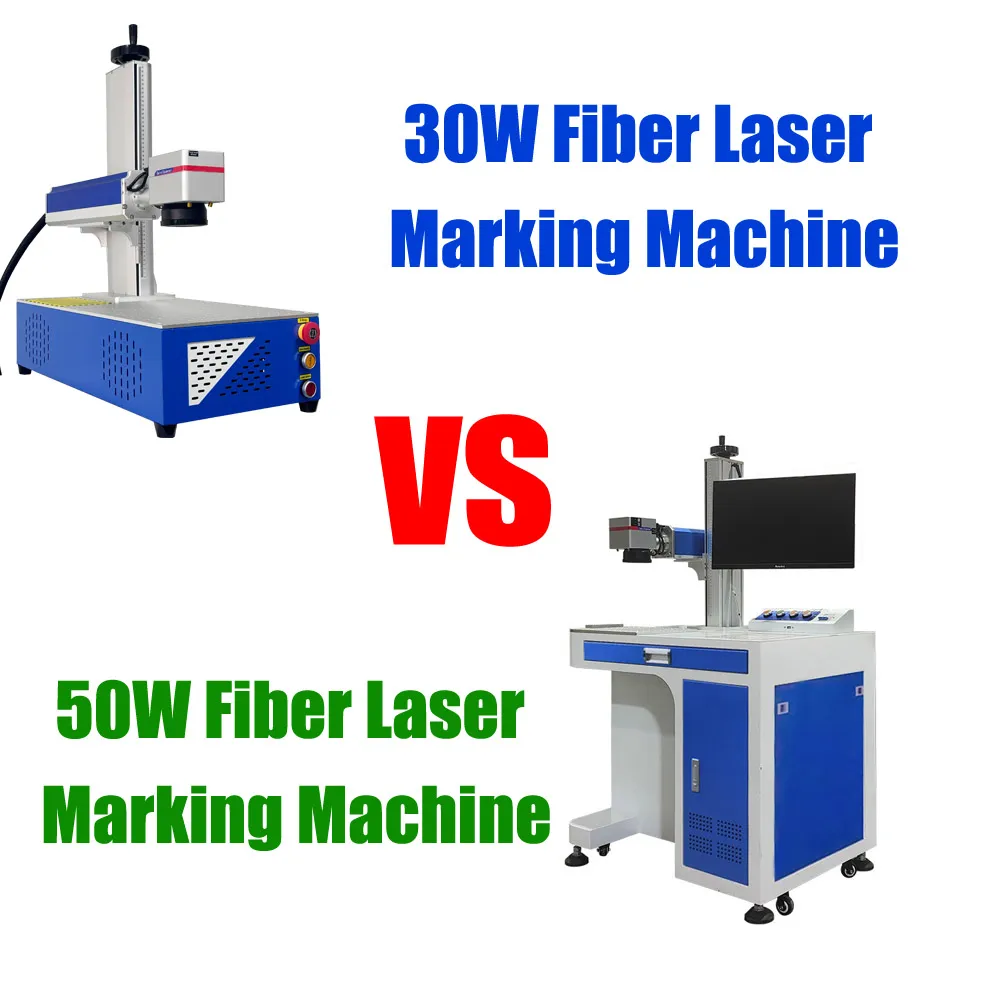
Is a 50W fiber laser really worth the extra investment over a 30W machine? The answer depends on what you mark, how much material you need to remove, how many parts you process and how quickly your production line needs to run.
This guide compares both power levels from a practical manufacturing perspective: surface marking, deep engraving, stainless steel, aluminum, brass, production speed, process parameters and purchasing cost.
Quick Answer: Should You Choose 30W or 50W?
Choose 30W as your starting point if your main jobs are serial numbers, QR codes, barcodes, logos, nameplates and normal metal marking. It is often sufficient for general industrial identification and small-to-medium batch production.
Consider 50W if you regularly engrave deeper into metal, process large filled graphics, remove more material, or need to shorten a production cycle that a 30W machine cannot meet.
But do not expect 50W to be automatically 66.7% faster or to produce 66.7% more engraving depth. The extra rated power creates more processing capacity; the actual result depends on the laser source, pulse characteristics, optics, material and process settings.
30W vs. 50W Fiber Laser: The Main Differences at a Glance
Both machines can use a 1064 nm pulsed fiber laser source and can mark common industrial metals. The difference becomes more noticeable when the job requires more energy delivered to the workpiece, particularly for material removal and repeated filled engraving.
30W Fiber Laser
Best starting point for general marking.
- Serial numbers and QR codes
- Logos and product identification
- General stainless-steel marking
- Small and medium batch production
- Light engraving on suitable metals
50W Fiber Laser
More capacity for demanding jobs.
- Deeper metal engraving
- Large filled graphics
- Higher material removal requirements
- Repeated production with demanding cycle times
- Tooling and hardware applications
| Comparison | 30W Fiber Laser | 50W Fiber Laser |
|---|---|---|
| Rated output power | 30W | 50W |
| Power difference | Reference | 66.7% higher rated average output than 30W |
| Typical wavelength | 1064 nm | 1064 nm |
| General metal marking | Suitable for many standard jobs | Suitable; may offer more process capacity |
| QR code and serial number marking | Usually sufficient for many applications | Can be useful when cycle time is demanding |
| Light engraving | Suitable for many jobs | May reduce processing time depending on the job |
| Deep engraving | Possible, but may require more passes or time | Generally offers more capacity for material removal |
| Large filled graphics | Can take longer on demanding jobs | Worth testing when filled area is a production bottleneck |
| Heat-sensitive or thin parts | Can be easier to manage in some applications | Requires careful parameter development to avoid excess heat |
| Investment | Usually lower | Usually higher; compare the complete configuration |
Important: This is a practical application comparison, not a universal performance guarantee. A 30W MOPA source and a 50W Q-switched source, for example, may behave differently because their pulse characteristics are not identical. Always compare the exact source model and machine configuration.
1. Does a 50W Fiber Laser Mark Faster Than a 30W Machine?
In many applications, yes. But the size of the improvement depends on the marking job.
For a simple serial number, the difference may be relatively small. The job may already be limited by scanner movement, acceleration, the number of characters or the required mark quality. Increasing laser power cannot remove all those limits.
For a large filled logo or an engraving job that needs repeated passes, the extra power can become more useful. It may allow a different combination of speed, power and pass count while maintaining the required result.
Example A: Serial Numbers on Stainless-Steel Parts
Imagine a factory marking a short serial number on a stainless-steel component. The marking area is small and the content consists mainly of text.
A 30W fiber laser may already complete the job within the required cycle time. A 50W machine may also mark the part faster, but the factory should calculate whether the time saved is enough to justify the higher equipment cost.
In this case, I would not recommend upgrading just because 50W sounds more powerful. I would first test both machines using the same font, text size, material and quality requirement.
Example B: Large Filled Logo or Graphic
Now imagine marking a large filled logo on a metal plate. The laser has to scan many filling lines rather than simply draw a few text characters.
This is where the extra power of a 50W source may offer a more noticeable advantage. Depending on the material and process window, it may support a higher processing rate or reduce the number of passes needed to achieve the target result.
However, the fill spacing, scan direction, acceleration, overlap and heat accumulation still matter. A poorly developed 50W process can produce a worse result than a well-tuned 30W process.
Example C: Deep Engraving on Steel
Deep engraving is different from surface marking. The laser must remove material, and the process normally involves repeated passes.
A 50W machine is worth evaluating when the required depth is substantial or the factory needs to produce many engraved parts. But it is important to measure both depth and quality. A fast process that creates excessive heat, uneven edges or unacceptable distortion may not be a good production process.
A machine may list a maximum scanner speed of several thousand millimeters per second. That is not the same as the time required to finish your product. The real cycle includes marking content, filling, acceleration, positioning, fixture loading, unloading and inspection.
2. Engraving Depth: What Can 30W and 50W Actually Achieve?
This is probably the question buyers ask most often: “How deep can your 30W or 50W fiber laser engrave metal?”
I would be careful about giving one fixed depth number without seeing the material and the required engraving area.
Engraving depth is influenced by:
- Metal type and alloy composition
- Material hardness and heat treatment
- Laser source and pulse energy
- Pulse duration and repetition frequency
- Average power and peak power
- Marking speed and hatch spacing
- Number of passes
- Focus position and optical configuration
- Cooling time between passes
- Required surface quality and dimensional tolerance
A 50W laser generally has more average output power available than a 30W laser. That can help remove material more efficiently under suitable conditions. It does not mean every 50W configuration will engrave every metal 66.7% deeper.
Surface Marking vs. Deep Engraving
| Process | What Happens | Typical Requirement | Power Decision |
|---|---|---|---|
| Surface marking | Creates contrast or a visible surface change with little material removal | Serial numbers, QR codes, logos and product IDs | 30W is often a practical starting point |
| Light engraving | Removes a limited amount of surface material | Shallow text, logos and identification | Test both 30W and 50W if cycle time matters |
| Deep engraving | Removes material through repeated passes | Tool markings, recessed identifiers and depth requirements | 50W is worth evaluating for greater removal capacity |
| Large-area engraving | Removes material across a relatively large filled region | Large logos, panels and industrial components | 50W may offer a production advantage, but verify heat and quality |
A Published Deep-Engraving Example: Why More Power Is Not the Whole Story
Trotec has published a stainless-steel deep-engraving example using a 20W MOPA laser and an F-160 lens. In its time-optimized example, the target depth was 200 μm on a 5 × 5 mm square. The reported process used 250 mm/s, 60 kHz, 200 ns pulse duration, 0.03 mm fill spacing and 32 passes, taking 112 seconds.
In its quality-optimized example, the same target depth was reached using 900 mm/s, 180 kHz, 200 ns, 0.03 mm fill spacing and 450 passes, taking 375 seconds. Trotec reports that the quality-focused process took about three times as long, but produced a more controlled result with less distortion.
This is not a direct 30W-versus-50W test. It is useful because it shows something important: engraving depth, speed and quality are process trade-offs. Even a 20W source can reach a substantial depth with a carefully developed multi-pass process, but the time and surface result may be very different.
Do not copy these parameters directly to a different machine. The source, optics, material and control system may not match.
3. Real Parameter References: What Should Buyers Compare?
When comparing two quotations, ask for more than the rated power. The following parameters are more useful for an engineering comparison.
| Parameter | Why It Matters | What to Ask the Supplier |
|---|---|---|
| Laser source model | Different source models can have different pulse characteristics | What is the exact manufacturer and model number? |
| Wavelength | Affects how the beam interacts with the material | Is it a 1064 nm pulsed fiber source? |
| Pulse duration | Influences peak power and thermal interaction | What pulse-width range does this source support? |
| Frequency | Changes pulse repetition and energy per pulse behavior | What frequency range is available, and how is it controlled? |
| Pulse energy | Relevant to material removal and engraving behavior | What is the maximum pulse energy for the exact model? |
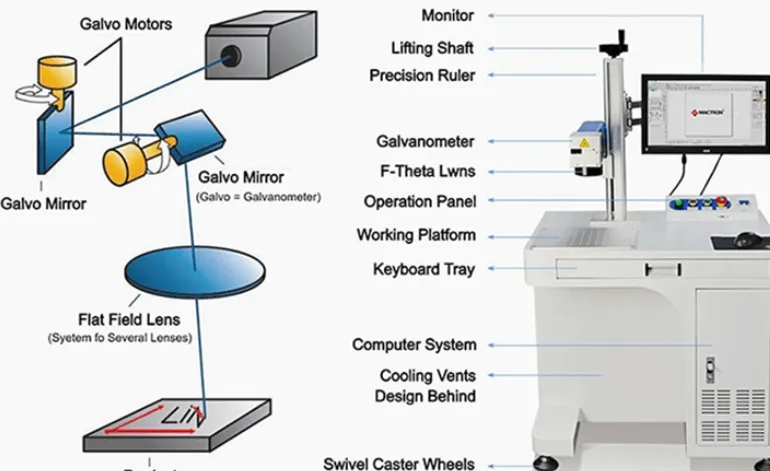
| Galvo scanner | Affects beam movement and dynamic marking performance | What scanner model is included? |
| F-theta lens | Changes marking field and optical spot characteristics | What is the lens focal length and marking field? |
| Hatch spacing | Controls overlap and material coverage in filled engraving | What spacing was used in the sample test? |
| Pass count | Strongly affects total engraving time and heat input | How many passes are required for the target depth? |
| Measured depth | Confirms actual material removal | Was depth measured with a profilometer or suitable measuring instrument? |
JQ Laser Published Machine Specifications
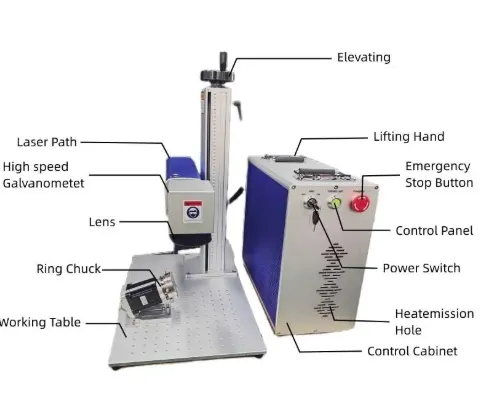
JQ Laser publishes a 30W fiber laser marking machine configuration with the following specifications:
- Laser power: 30W
- Wavelength: 1064 nm
- Maximum marking speed: up to 8,000 mm/s
- Standard marking field: 110 × 110 mm
- Optional marking fields: 70 × 70 mm, 175 × 175 mm and 200 × 200 mm
- Cooling: air cooling
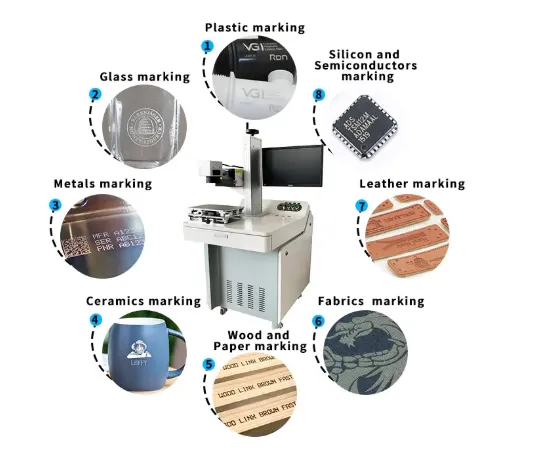
- Applications: metal and selected engineering plastics
JQ’s broader fiber laser product range lists 20W, 30W, 50W, 60W and 100W configurations, with a typical 1064 nm wavelength, multiple marking fields and a maximum marking speed stated up to 12,000 mm/s for applicable configurations.
These are published machine-family specifications. The 12,000 mm/s figure should not be interpreted as a guaranteed production speed for every 30W or 50W configuration. Confirm the exact source, galvo, lens and machine specification on the quotation.
For a specific 50W quotation, ask JQ to confirm the exact laser source model, rated output, frequency range, pulse characteristics, scanner and lens. Do not assume that every 50W configuration has identical source specifications.
4. Which Materials Benefit More from 50W?
The answer depends on whether you need a visible surface mark or actual material removal.
Stainless Steel
For serial numbers, logos, QR codes and general identification, 30W is often a sensible starting point. If the job requires deeper engraving or a large filled area, 50W deserves a sample comparison.
For black annealing or color-related effects, do not assume that more power will improve the result. Controlled thermal input and suitable pulse characteristics can matter more than simply increasing wattage.
Carbon Steel and Hardened Steel
For normal surface identification, a 30W fiber laser may be sufficient. For deeper engraved marks on tools, dies or industrial parts, 50W can provide additional processing capacity.
Hardness, heat treatment, surface finish and the required depth should all be included in the sample test. A supplier should not quote a guaranteed depth without identifying the material and test conditions.
Aluminum
Both 30W and 50W machines can be used on suitable aluminum parts. The result depends on whether the material is anodized or bare, the alloy, surface finish and the required appearance.
For routine identification on anodized aluminum, 30W may already be sufficient. If the application requires deeper engraving or larger filled areas, compare 50W under the same quality criteria.
Brass and Copper
Reflective metals require careful application testing. A 50W source may offer more processing capacity, but it does not remove the need to verify the optical setup, surface response and process stability.
For copper or brass components, send the exact grade and surface condition to the supplier. Do not approve a machine based only on a test performed on stainless steel.
5. Four Real Purchasing Scenarios: Which Power Would I Recommend?
Scenario 1: Small Hardware Factory Marking Logos and Serial Numbers
Production: Stainless-steel fittings, metal brackets, fasteners and small hardware parts.
Marking content: Company logo, model number, batch number and serial number.
Production volume: Small or medium batches.
My starting recommendation: 30W fiber laser.
Why? These jobs normally focus on surface marking rather than substantial material removal. A 30W machine is often capable of handling the work without requiring the extra investment in 50W.
I would upgrade to 50W only if the sample test shows that the 30W cycle time is too long or the customer requires deeper engraving.
Scenario 2: Saw Blades and Cutting Tools
Production: Metal saw blades, cutting tools and hardware products.
Marking content: Brand logo, diameter, tooth count, model and specifications.
My starting recommendation: Test 30W and 50W if the required content includes a large filled logo or deeper identification.
For simple text and logo marking, 30W may be enough. If the factory needs a deeper mark or has a demanding cycle time, 50W is worth comparing.
Do not forget the fixture. Thin blades need stable positioning, and the marking process must avoid unwanted heat effects or distortion. The machine’s cycle time should include loading and unloading, not just laser-on time.
Scenario 3: Deep Engraving on Industrial Metal Components
Production: Tooling, molds, dies, machine components and metal plates.
Requirement: A measurable engraved depth that remains visible after handling or surface cleaning.
My starting recommendation: 50W is worth testing first, with 30W retained as a comparison if the production volume is low.
For this type of work, the supplier should report the measured depth, number of passes, marking time, fill spacing and material grade. A photo of a dark mark is not proof of engraving depth.
Scenario 4: High-Volume Automotive Part Identification
Production: Repeated marking of metal automotive components.
Marking content: Data Matrix, serial number and production traceability information.
My recommendation: Start by calculating the required line cycle. Then test both 30W and 50W with the real marking file.
If the job is a small Data Matrix code, 30W may already meet the target. If the code includes a large filled area, the surface needs more processing, or the line has a strict takt time, 50W may be justified.
For automated lines, also consider sensors, fixtures, PLC communication, code verification and part handling. A higher-power laser cannot compensate for slow loading or unreliable positioning.
6. Purchasing Decision Checklist: 10 Things to Confirm Before Buying
Use this checklist when comparing a 30W and a 50W quotation. Each item identifies the operating condition, the evidence or test method and the limitation that should be clarified.
| No. | Decision Item | Applicable Condition | Evidence / Test Method | Limitations to Clarify |
|---|---|---|---|---|
| 1 | Required marking result | Surface marking, black marking, light engraving or deep engraving | Provide an approved sample and written acceptance criteria | A visually dark mark does not necessarily mean material has been removed |
| 2 | Material and grade | Stainless steel, carbon steel, aluminum, brass or copper | Test the actual alloy, heat treatment and surface finish | A result on one metal grade cannot be assumed to apply to another |
| 3 | Target engraving depth | Tooling, dies, wear-exposed parts or recessed identification | Measure depth with a suitable profilometer or calibrated measurement method | Depth varies with material, passes, hatch spacing and process settings |
| 4 | Marking cycle time | Batch production or a fixed production takt time | Time the complete marking file under the required quality standard | Maximum scanner speed is not the same as actual part cycle time |
| 5 | Laser source model | Any project comparing 30W and 50W | Request manufacturer, exact model, rated power and source datasheet | Two sources with the same wattage may have different pulse characteristics |
| 6 | Pulse characteristics | Deep engraving, black marking or heat-sensitive parts | Compare pulse duration, frequency and pulse energy on the actual application | Do not compare frequency ranges without considering pulse energy and source design |
| 7 | Galvo and lens configuration | Fine text, small codes, large marking areas or high-speed filling | Confirm scanner model, lens focal length, field size and sample result | A larger marking field can affect spot size and optical resolution |
| 8 | Thermal effect and part distortion | Thin sheets, small precision parts or heat-sensitive surfaces | Inspect dimensions, discoloration and surface condition after repeated marking | More power can increase heat input if parameters are not adjusted correctly |
| 9 | Repeatability | Production batches and customer-controlled specifications | Mark multiple samples and compare depth, contrast, dimensions and position | One successful sample does not prove long-term production consistency |
| 10 | Total ownership cost | Any purchase where 50W costs more than 30W | Compare machine price, cycle time, labor, fixtures, maintenance and expected output | A higher initial price is justified only if it creates measurable production value |
7. 30W vs. 50W: Production and Investment Comparison
After completing the technical checklist, compare the machines as production tools rather than simply comparing their wattage.
| Factor | 30W | 50W | What the Buyer Should Do |
|---|---|---|---|
| Standard text and serial numbers | Often sufficient | Also suitable | Choose based on measured cycle time and price difference |
| QR codes and Data Matrix | Often sufficient | Useful if processing time is a bottleneck | Compare readability and total cycle time |
| Large filled logos | May take longer | May offer better processing capacity | Test the same artwork and fill spacing |
| Deep engraving | May require more passes | Generally worth evaluating first | Measure actual depth and time |
| Thin or heat-sensitive parts | May be easier to control in some processes | Needs careful parameter adjustment | Inspect heat effects and distortion |
| Initial equipment cost | Usually lower | Usually higher | Compare complete configurations, not power alone |
| Production upgrade | Suitable if current cycle is acceptable | Useful when power-related processing is the bottleneck | Identify the real bottleneck before upgrading |
How to Calculate Whether 50W Is Worth the Extra Cost
Use a simple production calculation rather than guessing.
Annual time saved = (30W cycle time − 50W cycle time) × annual production quantity.
Then estimate the labor or machine-hour value of that saved time. Compare the annual benefit with the additional investment and any changes in operating or integration costs.
For example, suppose a factory marks 100,000 parts per year. If the 50W process saves 2 seconds per part under the same acceptance standard:
- Time saved per part: 2 seconds
- Annual parts: 100,000
- Total time saved: 200,000 seconds
- Equivalent time saved: approximately 55.6 hours
This is only an illustrative calculation, not a claim about the performance difference between JQ’s 30W and 50W machines. Use the measured sample-test cycle times from your own application.
Also remember that a laser may not be the production bottleneck. If loading, unloading, operator handling or inspection takes longer than the marking operation, upgrading from 30W to 50W may have little effect on total output.
8. When Should You NOT Buy a 50W Fiber Laser?
I would not recommend 50W just because the customer has a larger budget. There are situations where 30W is the more sensible purchase.
- Your work is mainly simple surface marking. Serial numbers, short text and basic logos may not need the additional power.
- Your 30W cycle time already meets production demand. There is little reason to pay more if the current process is not a bottleneck.
- Your parts are thin or sensitive to heat. A higher-power source requires careful process development to avoid unwanted thermal effects.
- Your production volume is low. The additional investment may take too long to recover.
- Your real bottleneck is handling or automation. A fixture, conveyor or better data workflow may create more value than a power upgrade.
On the other hand, if the 30W machine needs many passes to achieve a required depth, or the factory has a clear production target that the current machine cannot meet, 50W deserves a serious test.
9. How to Run a Fair 30W vs. 50W Sample Test
This is the most important part of the buying process. If I were comparing two machines for a customer, I would use the same test conditions as far as the source configurations allow.
- Use the same workpiece. Same alloy, thickness, heat treatment and surface finish.
- Use the same artwork. Same logo, text, size, filled area and marking position.
- Define the same target. For example, a specified depth, contrast, readability or surface appearance.
- Record the source model. Do not record only “30W” or “50W”. Include the manufacturer and model number.
- Record the optical configuration. Include galvo scanner, F-theta lens and marking field.
- Develop a suitable process for each machine. Do not force identical settings if the two sources have different pulse characteristics.
- Record all parameters. Power, speed, frequency, pulse width if applicable, hatch spacing, pass count and focus position.
- Measure the result. Use a suitable instrument for engraving depth and a defined visual or dimensional acceptance method.
- Record complete cycle time. Include loading, positioning, marking and unloading.
- Repeat the test. Use several samples to check consistency rather than selecting the best-looking single result.
A useful comparison report should show the material, source model, lens, parameters, pass count, measured depth, marking time and sample photos. If the supplier cannot tell you how the depth was measured, treat the depth claim as unverified.
10. What Should You Send a Supplier Before Requesting a Quote?
If you want an accurate recommendation, do not send only the message “I need a 50W laser.” Send enough application information for the engineering team to understand the real job.
- Material name and grade
- Workpiece dimensions and photos
- Surface finish, coating or heat treatment
- Marking content: text, logo, QR code or graphic
- Marking area and required depth
- Required contrast or appearance
- Parts per hour or per shift
- Current cycle time, if replacing an existing machine
- Whether a fixture, rotary axis or conveyor is required
- Any customer quality or durability requirements
If possible, send actual samples. A photo is helpful, but it cannot fully show material composition, surface hardness or how the laser will interact with the workpiece.
Frequently Asked Questions
1. Is a 50W fiber laser 66.7% faster than a 30W laser?
No. A 50W source has approximately 66.7% more rated average output power than a 30W source, but marking speed does not increase in a fixed linear ratio. The result depends on material, marking content, pulse characteristics, scanner, lens, parameters and required quality.
2. Can a 30W fiber laser engrave stainless steel?
Yes. A 30W pulsed fiber laser can engrave stainless steel, but the achievable depth and cycle time depend on the steel grade, process settings, pass count and optical configuration. For demanding depth requirements, test 30W against 50W using the actual part.
3. Is 50W better for deep engraving?
In many applications, 50W provides more processing capacity and is worth evaluating for deeper engraving. However, depth is not determined by average power alone. Pulse energy, pulse duration, frequency, focus, hatch spacing