A practical engineering and purchasing guide for 20W, 30W, 50W and 100W fiber laser marking machines.
If you are buying a fiber laser marking machine, one of the first questions you may ask is: Should I choose an IPG, Raycus or JPT laser source?
The short answer is: there is no single winner for every application.
IPG, Raycus and JPT all have legitimate industrial laser products, but they are not identical technologies and they are not aimed at exactly the same purchasing priorities.
For a standard metal marking machine, Raycus can be a very practical choice. For applications that need flexible pulse control, JPT MOPA becomes much more interesting. For buyers who prioritize a premium global industrial laser platform and advanced system integration, IPG deserves serious consideration.
The important question is not: “Which brand is the best?”
It is: “Which laser source is the best match for my material, marking effect, production volume and budget?”
This article is written from the perspective of a laser marking manufacturer and application sales engineer. The purpose is not to declare one laser source “the best”, but to explain where IPG, Raycus and JPT make sense in real marking applications. Technical specifications are based on manufacturer-published information where available. Machine-level performance also depends on the galvanometer scanner, F-theta lens, optical alignment, control board, software, parameter settings and material being processed.
IPG vs Raycus vs JPT: My Quick Verdict
If I were helping you choose a machine today, this is how I would think about it.
Raycus: A strong practical choice for conventional fiber laser marking where cost, availability and straightforward industrial marking are important.
JPT MOPA: My first consideration when pulse-width control, color marking, black marking on aluminum, fine surface effects or more flexible process optimization are important.
IPG: A premium option worth considering when the project places greater emphasis on industrial laser technology, system integration, advanced marking platforms and global industrial applications.
Raycus
Standard Fiber Cost-Effective Metal MarkingGood fit for conventional metal marking and buyers looking for a mature Chinese fiber laser source.
JPT MOPA
MOPA Pulse Control Color MarkingGood fit when the process needs wider control over pulse width and repetition frequency.
IPG
Premium Industrial System IntegrationGood fit for demanding industrial applications and buyers who prioritize a premium global laser platform.
1. First: What Does the Laser Source Actually Do?
Before comparing brands, it is worth understanding what you are actually buying.
The laser source generates the laser radiation that eventually reaches your workpiece through the beam-delivery system. In a typical fiber laser marking machine, however, the source is only one part of the complete system.
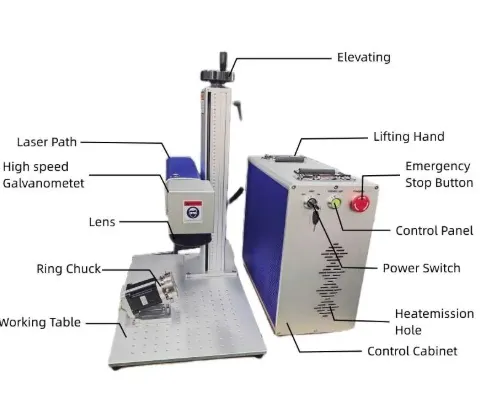
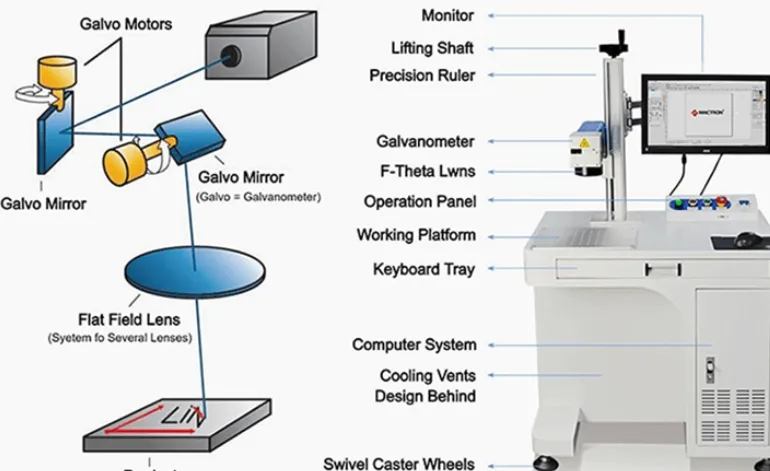
A complete marking system also includes:
- Laser source
- Galvanometer scanner
- F-theta scanning lens
- Laser control board
- Marking software
- Computer or industrial controller
- Power supply
- Mechanical structure
- Cooling system
This distinction matters because I sometimes see customers comparing two machines only by saying:
“Both machines use a 30W laser, so why is one more expensive?”
The laser source may be the same power rating, but the scanner, lens, beam quality, optical alignment, electronics and machine construction may be different.
So when comparing IPG vs Raycus vs JPT, we should treat the laser source as a major component—not the entire machine.
2. IPG vs Raycus vs JPT: The Three Brands at a Glance
| Factor | IPG | Raycus | JPT |
|---|---|---|---|
| Origin / Market Position | Global industrial laser manufacturer with a broad high-performance laser portfolio | Major Chinese fiber laser manufacturer with established pulsed and CW laser products | Chinese laser manufacturer with strong MOPA and pulsed fiber laser offerings |
| Typical Marking Technology | Nanosecond fiber, integrated marking systems and advanced laser platforms | Q-switched pulsed fiber and other industrial fiber laser technologies | MOPA pulsed fiber plus other laser technologies |
| Common Marking Power Range | 20W / 30W / 50W / 100W in IPG’s integrated IR marker platform | 20W / 30W / 50W and higher configurations | 20W / 30W / 60W / 100W in the M7 series, with additional power ranges |
| Typical Wavelength | 1064nm for IR marking systems | Approximately 1064nm for common pulsed marking sources | 1064nm for M7 MOPA fiber sources |
| Pulse Control | Depends on specific product family | Typical Q-switched sources have defined pulse-width ranges | Strong advantage of MOPA architecture: pulse width and repetition frequency can be independently adjusted |
| Typical Strength | Premium industrial laser technology and system integration | Conventional industrial metal marking with competitive economics | Flexible pulse control and precision marking applications |
Do not compare brand names without comparing the exact laser model. “Raycus”, “JPT” and “IPG” are product families, not single laser models. A 20W Raycus Q-switched source and a 20W JPT MOPA source can behave very differently even though both are labeled “20W”.
3. IPG Laser Source: What Are You Actually Paying For?
IPG is one of the best-known names in industrial fiber laser technology. Its product portfolio is much broader than the small marking heads commonly seen on desktop marking machines.
For marking applications, IPG currently lists integrated infrared marking systems using:
- 1064nm wavelength
- 20W, 30W, 50W and 100W average power options
- 80–120ns pulse duration
- 2–500kHz pulse repetition rate
- Up to 1mJ pulse energy
- Scan fields including 60×60, 110×110, 170×170, 204×204 and 300×300mm depending on lens
These are manufacturer-published specifications for IPG’s integrated infrared marking platform, not a claim that every IPG source on the market has these exact specifications.
3.1 Where IPG Makes the Most Sense
If the application is a high-value industrial production project, I would pay more attention to IPG.
For example:
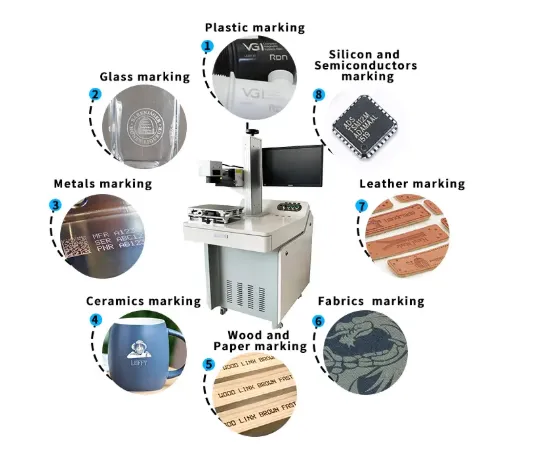
- Automotive component marking
- Medical device identification
- Aerospace traceability
- High-value industrial components
- Deep engraving
- High-throughput marking systems
- OEM and production-line integration
IPG itself describes marking applications including deep engraving of automotive components and permanent marking of medical devices that need to withstand repeated sterilization.
3.2 What I Would Not Do
I would not automatically recommend IPG just because the customer says:
“I want the best laser.”
If the customer is marking 300 stainless steel plates per day and only needs a serial number and QR code, spending significantly more on a premium laser source may not produce a meaningful return.
That is an important distinction between technical recommendation and sales promotion.
4. Raycus Laser Source: Why It Is So Common in Chinese Fiber Marking Machines
Raycus is a major Chinese fiber laser manufacturer, and its pulsed fiber sources are widely used for industrial marking and micromachining.
The Raycus RFL-P20QB is a useful example.
| Raycus RFL-P20QB Parameter | Official Published Specification |
|---|---|
| Average Output Power | 20W |
| Central Wavelength | 1064nm |
| Repetition Frequency | 20–60kHz |
| Pulse Width | 90–110ns |
| Maximum Single Pulse Energy | 1mJ |
| Beam Quality M² | <1.5 |
| Cooling | Air-cooled |
| Power Adjustment | 10–100% |
| Operating Temperature | 0–40°C |
Raycus also publishes a 30W RFL-P30QB with 1064nm wavelength, 20–60kHz repetition frequency, 90–110ns pulse width and air cooling.
The 50W RFL-P50QB moves to a 50–100kHz repetition range and lists a 120–150ns pulse width.
4.1 Why I Often Recommend Raycus for Standard Metal Marking
For a customer who tells me:
“I mainly mark stainless steel, aluminum, brass and steel parts. I need logos, serial numbers and QR codes. I don’t need special color marking.”
Raycus is often a very reasonable choice.
The reason is not that Raycus is universally better than IPG or JPT. It is because the conventional Q-switched fiber architecture already fits a large portion of everyday metal marking.
4.2 Typical Applications
- Stainless steel nameplates
- Hardware components
- Tools
- Automotive metal parts
- Aluminum housings
- Brass and copper components
- Serial numbers
- Barcodes and QR codes
- Basic metal engraving
5. JPT MOPA Laser Source: Where the Difference Becomes Interesting
JPT becomes particularly interesting when we move from conventional Q-switched fiber marking to MOPA.
JPT’s M7 series covers 20W through 100W configurations and uses a MOPA architecture.
The important feature is not simply the word “MOPA”.
It is the ability to control pulse width and repetition frequency independently.
| JPT M7 Model | Power | Frequency Range | Pulse Width | Wavelength | Cooling |
|---|---|---|---|---|---|
| YDFLP-E2-20-M7-S-R | 20W | 1–4000kHz | 2–500ns | 1064nm | Air |
| YDFLP-E2-30-M7-S-R | 30W | 1–4000kHz | 2–500ns | 1064nm | Air |
| YDFLP-E2-60-M7-M-R | 60W | 1–4000kHz | 2–500ns | 1064nm | Air |
| YDFLP-E2-100-M7-M-R | 100W | 1–4000kHz | 2–500ns | 1064nm | Air |
For the 20W and 30W M7 versions, JPT publishes beam quality of less than 1.5, maximum single pulse energy of 1mJ and a 7.0±1.0mm output beam diameter.
The 60W version reaches up to 2mJ pulse energy, while the 100W version is specified at up to 1.5mJ.
5.1 Why MOPA Matters in Real Marking
This is where I would explain the difference to a customer in simple language:
Q-switched fiber gives you a proven general-purpose tool. MOPA gives the engineer more ways to tune how the laser interacts with the surface.
That additional control can become useful for:
- Black marking on anodized aluminum
- Color marking on stainless steel
- Fine surface marking
- Heat-sensitive applications
- Special plastic formulations
- Precision micro-marking
- Applications where surface finish matters
5.2 Example: Black Marking on Aluminum
Suppose you manufacture anodized aluminum electronic housings.
The customer may not care about deep engraving. They may want a clean, dark, high-contrast mark without damaging the anodized layer.
This is exactly the kind of application where I would consider a MOPA source.
The additional pulse control can give the process engineer more room to optimize the interaction between pulse duration, frequency, speed and surface response.
6. The Most Important Technical Difference: Q-Switched vs MOPA
When customers compare Raycus and JPT, the real technical discussion should often be:
Q-switched vs MOPA
rather than simply:
Raycus vs JPT
| Feature | Typical Q-Switched Fiber | MOPA Fiber |
|---|---|---|
| Basic Metal Marking | Excellent | Excellent |
| Serial Numbers / QR Codes | Excellent | Excellent |
| Deep Engraving | Good | Good to Excellent depending on configuration |
| Black Aluminum Marking | Good | Excellent process flexibility |
| Stainless Steel Color Marking | Limited process flexibility | Excellent application fit |
| Pulse Width Adjustment | Limited / model dependent | Wide adjustment capability |
| Process Optimization | Good | Excellent |
| Cost Efficiency for Basic Marking | Excellent | Good |
“MOPA is better” is also too simplistic. If the customer only needs standard stainless-steel serial numbers, the additional flexibility of MOPA may not justify the additional cost. The correct question is whether the application actually benefits from that flexibility.
7. IPG vs Raycus vs JPT: Which One Would I Choose?
If you ask me to choose a source without giving me any application information, my answer is: I cannot responsibly choose one yet.
Give me the material and production requirement first.
| Application | My First Choice to Test | Reason |
|---|---|---|
| General stainless steel marking | Raycus / JPT | Both can provide suitable 1064nm pulsed fiber solutions |
| General aluminum marking | Raycus / JPT | Both are suitable; exact result depends on alloy and surface |
| High-contrast black anodized aluminum | JPT MOPA | Pulse-width control provides more process flexibility |
| Stainless steel color marking | JPT MOPA | More flexible pulse control |
| Deep engraving | Raycus / JPT / IPG | Power, pulse energy and production requirements matter more than brand alone |
| High-end industrial integration | IPG | Strong industrial laser and integrated marking-system portfolio |
| Small factory, standard marking | Raycus | Practical balance of performance and investment |
| Precision / special surface effects | JPT MOPA | Flexible pulse control |
8. What Matters More Than the Laser Brand?
This is one of the most important sections for buyers.
I have seen customers spend a lot of time comparing laser brands while ignoring the rest of the machine.
That is a mistake.
For actual marking quality, I would also look at:
- Galvanometer scanner
- F-theta lens
- Optical alignment
- Beam quality
- Control board
- Software
- Laser parameter optimization
- Mechanical stability
- Material testing
- After-sales technical support
A premium laser source installed in a poorly aligned optical system will not magically turn a cheap marking machine into a premium production system.
Conversely, a properly configured machine using a suitable Raycus or JPT source can produce excellent industrial marking results.
9. Why the Same Laser Source Can Produce Different Marking Results
Let’s say two suppliers both use a Raycus 30W source.
Supplier A produces a clean, sharp QR code. Supplier B produces rough edges and inconsistent contrast.
Does that mean the Raycus source is different?
Not necessarily.
The difference may come from:
- Different scan head
- Different lens
- Different focal position
- Different beam alignment
- Different hatch spacing
- Different frequency
- Different speed
- Different power setting
- Different material batch
- Different software settings
This is why professional sample testing is more useful than simply sending customers a specification sheet.
10. My Practical Buying Rule for 20W, 30W, 50W and 100W
If your application is standard metal marking:
20W: Good starting point for many surface-marking jobs.
30W: My preferred general-purpose starting point when the customer wants more production margin.
50W: Choose it when depth, speed or production volume justifies the additional investment.
100W: More appropriate for demanding industrial production, deeper engraving or high-throughput applications.
And if you need special color marking, black anodized aluminum marking or more process flexibility: I would investigate JPT MOPA before simply increasing laser power.
11. A Real Sales Engineer’s Question: What Are You Actually Marking?
Before I recommend IPG, Raycus or JPT, I would ask you five questions.
- What is the exact material?
- What is the part size?
- What marking content do you need?
- How many parts do you mark per day?
- Do you need surface marking, deep engraving or a special color/contrast effect?
For example:
Customer A: 500 stainless steel parts/day, serial number + QR code.
I would probably start with a 20W or 30W standard fiber source.
Customer B: Stainless steel color marking for premium consumer products.
I would test a JPT MOPA configuration.
Customer C: Deep engraving of steel components in high-volume production.
I would compare 50W/100W configurations and evaluate cycle time—not simply compare source brands.
Customer D: High-end medical or aerospace production with demanding traceability and system integration.
I would consider IPG alongside other industrial-grade configurations and compare the complete system rather than only the source.
12. Bottom Line: IPG vs Raycus vs JPT
If you want a simple answer, here it is:
- Choose Raycus when you need a practical, conventional fiber laser source for general industrial metal marking.
- Choose JPT MOPA when pulse control and special marking effects are important.
- Consider IPG when the project requires a premium industrial laser platform, advanced system integration or demanding production requirements.
But I would never choose the laser source from the brand name alone.
I would choose it from the application.
The best laser source is not necessarily the most expensive one. It is the one that gives you the required marking result, cycle time and reliability at the lowest sensible total cost.
IPG vs Raycus vs JPT Laser Source: Technical Comparison for Real Marking Applications
Comparing laser sources by brand name alone is one of the easiest ways to make the wrong purchasing decision. In real production, the laser source works together with the scanner, F-theta lens, control board, software, optical path, workpiece fixture and marking parameters.
This section looks at the three brands from a more practical perspective: pulse behavior, frequency, pulse energy, heat input, reflective metals, black marking, color marking, deep engraving, QR codes and production-line applications.
1. The Most Important Technical Difference: Pulse Behavior
When customers ask me, “Which is better, IPG, Raycus or JPT?”, my first question is usually not about the brand. I ask what material they need to mark and what kind of mark they want.
A stainless-steel serial number, a black mark on anodized aluminum, a colored logo on stainless steel, a deep engraving on a steel tool and a high-speed QR code on an automotive component are not the same process.
The laser source determines how laser energy is delivered to the material. Parameters such as average power, pulse duration, pulse energy and repetition rate affect the interaction between the beam and the workpiece.
“Is this a 30W laser?”
Ask:
“What is the pulse duration, pulse energy, frequency range and beam quality of the exact laser source model?”
2. IPG vs Raycus vs JPT: What the Numbers Actually Tell You
The following table is intended as a technical comparison rather than a universal ranking. Specifications vary by exact model and generation, so buyers should always request the manufacturer’s current datasheet for the specific source being quoted.
| Parameter | IPG | Raycus | JPT MOPA |
|---|---|---|---|
| Typical marking wavelength | 1064 nm for IR fiber marking systems | Approximately 1060–1085 nm for Q-switched fiber families | 1064 nm |
| Typical power range discussed | 20W / 30W / 50W / 100W | 20W / 30W / 50W / 60W / 70W / 100W families | 20W / 30W / 60W / 100W and other MOPA configurations |
| Pulse type | Nanosecond pulsed fiber | Q-switched pulsed fiber | MOPA pulsed fiber |
| Pulse-width flexibility | Model dependent | Generally more fixed compared with MOPA | Major MOPA advantage |
| Frequency flexibility | Broad model-dependent range | Model-dependent conventional range | Very broad on MOPA models |
| Reflective-metal applications | Good with correct configuration | Good with correct parameters | Excellent process-control flexibility |
| Black anodized aluminum | Possible, model/process dependent | Possible, process dependent | Strong application fit |
| Stainless-steel color marking | Possible with suitable process | Possible but parameter dependent | One of the major MOPA applications |
| Deep engraving | Excellent in suitable high-power systems | Very suitable | Very suitable, especially when process flexibility matters |
| General metal marking | Excellent | Excellent | Excellent |
3. Why MOPA Is Different From a Conventional Q-Switched Fiber Laser
This is one of the most important points for buyers who are comparing Raycus and JPT.
A conventional Q-switched fiber laser can be extremely good at standard metal marking. For many applications, there is no reason to pay extra simply because a laser is called “MOPA”.
The difference becomes more interesting when the process requires control over heat input, surface appearance or pulse characteristics.
JPT’s own technical material explains that MOPA architecture separates power generation from pulse shaping, allowing pulse width and frequency to be adjusted for different reflective-metal processes.
Conventional Q-Switched
A strong choice for standard stainless steel, carbon steel, tools, hardware, serial numbers, logos and QR codes.
Usually attractive when the application is well understood and the customer wants a reliable machine without unnecessary complexity.
MOPA Fiber
More process variables are available. Pulse width and frequency can be adjusted over wider ranges on suitable models.
This is useful for anodized aluminum, stainless-steel color marking, plastics and heat-sensitive surface processes.
High-End Industrial Source
The value is not simply the laser source itself. Integration, reliability, process control and system-level requirements can become more important in industrial production.
4. Application Comparison: Stainless Steel
Application: Stainless-Steel Serial Numbers
This is probably the easiest application for a conventional fiber laser.
If the customer needs a permanent black or light-colored serial number, QR code, logo or simple text, a 20W or 30W fiber system can often be sufficient.
In this situation, I would not automatically recommend a premium IPG source or a MOPA source.
The more important questions are:
- How many parts are produced per day?
- How large is the marking area?
- How fast must one part be completed?
- Does the mark need to be cosmetic or deeply engraved?
- Does the QR code need to meet a specific verification grade?
- Is the marking system integrated into a production line?
For normal stainless-steel identification, a properly configured Raycus or JPT fiber system can already be a very capable solution.
Choose IPG when the overall system requirements, integration environment, process stability requirements or customer specifications justify the additional investment.
5. Application Comparison: Black Marking on Anodized Aluminum
Anodized aluminum is where the conversation becomes more interesting.
The objective is often not to remove a large amount of material. The customer wants a high-contrast black mark while preserving the underlying aluminum surface.
This means that simply increasing laser power is not always the correct solution.
Pulse width, frequency, speed, hatch spacing and defocus can all influence the final appearance.
| Requirement | Conventional Fiber | MOPA Fiber | Recommended Approach |
|---|---|---|---|
| Simple logo | Good | Excellent | Either can work |
| High-contrast black marking | Good | Excellent | Test MOPA if contrast is critical |
| Fine text | Good | Excellent | Optimize frequency and speed |
| Very low heat effect | Application dependent | Better control potential | MOPA is often worth testing |
| High-volume production | Good | Excellent | Compare actual cycle time |
6. Application Comparison: Stainless-Steel Color Marking
This is another application where customers sometimes misunderstand the technology.
“Color marking” does not mean that the laser is simply printing colored ink onto stainless steel.
The appearance is created by controlling the laser-material interaction and the resulting surface condition or oxide-related optical effect.
This is why pulse parameters matter so much.
The same MOPA source can produce different results on 304 stainless, 316 stainless, brushed stainless and polished stainless steel.
A supplier who promises a specific color without testing the customer’s actual material is making a risky promise.
Typical customer requirement
“I want my logo in blue, black, gold or multiple colors on stainless steel.”
How I would handle the project
- Request the actual stainless-steel sample.
- Confirm grade and surface finish.
- Test several pulse-width/frequency windows.
- Record power, speed, frequency and hatch parameters.
- Check the result under the customer’s normal lighting conditions.
- Repeat the test on multiple parts.
- Only then finalize the machine configuration.
7. Application Comparison: Deep Metal Engraving
Deep engraving changes the purchasing logic.
If the customer only wants a logo on a metal plate, 20W may be enough. If the customer wants 0.3 mm, 0.5 mm or deeper material removal, the discussion becomes much more about power, pulse energy, scanning strategy, number of passes, heat accumulation and cycle time.
This is where 50W and 100W systems start to make more sense.
| Power | Typical Position | Typical Applications | Deep Engraving | Production Throughput |
|---|---|---|---|---|
| 20W | Entry / general marking | Serial numbers, QR codes, logos, nameplates | Limited | Good for normal marking |
| 30W | General-purpose production | Hardware, tools, automotive components, identification | Better | Very good balance |
| 50W | Industrial production | Deep engraving, tooling, metal components | Good | High |
| 100W | High-throughput / heavy engraving | Deep engraving, large-volume production, material removal | Excellent | Very high when correctly configured |
A customer says “I need deep engraving,” and the salesperson immediately sells a 100W machine.
First calculate the required depth, area, material, cycle time and number of parts.
Sometimes a 50W machine is the better economic choice. Sometimes 100W is justified. The answer should come from the production requirement rather than the salesperson’s desire to sell a larger machine.
8. Copper, Brass and Aluminum: Where Source Selection Gets More Important
Copper and aluminum are highly reflective materials at 1064 nm compared with many common steels. That does not mean a fiber laser cannot process them. It means the process window needs more attention.
JPT’s technical material specifically discusses reflective-metal processing and explains why pulse width, repetition rate, beam quality, scanning strategy and back-reflection considerations matter.
Raycus also lists copper, aluminum, gold and silver among materials that can be processed by its Q-switched pulsed fiber laser families.
| Material | Main Difficulty | Conventional Fiber | MOPA Advantage |
|---|---|---|---|
| Aluminum | Surface condition / oxide / heat control | Good | More process adjustment |
| Copper | High reflectivity / heat conduction | Possible with correct setup | Useful pulse flexibility |
| Brass | Alloy variation / appearance | Good | Useful when contrast or heat control matters |
| Silver | Very high reflectivity | Requires careful process setup | Can provide more process flexibility |
9. QR Codes: Does the Laser Brand Matter?
For QR codes and Data Matrix codes, customers sometimes focus too much on the laser brand.
In reality, code readability is a process result.
The laser source is important, but the final result also depends on the spot size, focus, marking speed, hatch strategy, contrast, material, surface finish and code dimensions.
For production traceability, check these items:
- Required code size
- Minimum module size
- Required contrast
- Required verification grade
- Marking cycle time
- Part positioning repeatability
- Data communication with PLC/MES
- Vision verification requirements
- Marking-on-the-fly requirements
- Actual material and surface finish
10. IPG vs Raycus vs JPT for Automotive Parts
Automotive marking is a good example of why there is no universal winner.
A small automotive supplier may only need a permanent serial number and Data Matrix code. A large Tier 1 production line may need automatic positioning, PLC communication, vision inspection, production tracking and strict cycle-time requirements.
These are completely different machine projects even if both customers say “automotive marking”.
| Automotive Requirement | 20W Fiber | 30W Fiber | 50W Fiber | 100W Fiber |
|---|---|---|---|---|
| VIN / serial marking | Excellent | Excellent | Excellent | Usually unnecessary |
| Data Matrix | Excellent | Excellent | Excellent | Excellent |
| Logo marking | Excellent | Excellent | Excellent | Excellent |
| Deep engraving | Limited | Good | Very good | Excellent |
| High-volume line | Good | Very good | Excellent | Excellent |
| Large material removal | Limited | Limited / moderate | Good | Excellent |
11. IPG vs Raycus vs JPT for Electronics
Electronics is another category where “more power” is not necessarily better.
Small electronic components often require fine, clean marking rather than aggressive material removal.
On sensitive plastics, coatings or components, excessive heat can be more damaging than insufficient laser power.
This is one reason why UV lasers are often considered when a 1064 nm fiber laser produces too much thermal effect. The correct answer therefore may be neither IPG nor Raycus nor JPT fiber.
Before comparing fiber laser source brands, confirm that 1064 nm fiber laser is actually the correct wavelength for your material.
If the application is mainly glass, transparent plastics, delicate packaging or highly heat-sensitive materials, a UV laser evaluation may make more sense.
12. Which Laser Source Would I Recommend at 20W, 30W, 50W and 100W?
If I were helping a customer choose a machine rather than simply trying to sell the most expensive configuration, I would use the following logic.
20W
Choose conventional fiber when the job is mainly surface marking: logos, serial numbers, QR codes, nameplates and standard metal identification.
Choose MOPA when the customer needs more control over appearance, anodized aluminum or special surface effects.
30W
This is the configuration I would seriously consider first for many general industrial customers.
It provides a useful balance between marking speed, general-purpose processing and purchase cost.
50W
Move to 50W when cycle time, deeper engraving or higher daily production starts to justify the additional power.
MOPA becomes particularly interesting when the customer also needs process flexibility.
100W
I would normally reserve 100W for customers who can explain exactly why they need it.
Examples include high-throughput production, significant material removal, deep engraving or industrial systems where cycle time has a measurable economic value.
If a customer tells me, “I just want the strongest machine,” that is not enough information to justify 100W.
13. A Practical Procurement Matrix
| Customer Requirement | First Configuration to Test | Source Direction | Why |
|---|---|---|---|
| Basic stainless-steel marking | 20W / 30W fiber | Raycus / JPT / IPG | Most conventional fiber sources can handle the application |
| High-volume metal marking | 30W / 50W | Raycus / JPT / IPG | Compare cycle time and system integration |
| Black anodized aluminum | 20W / 30W MOPA | JPT MOPA is worth testing | Pulse flexibility can improve process control |
| Stainless color marking | 20W / 30W MOPA | MOPA-oriented configuration | Pulse control is important |
| Deep engraving | 50W / 100W | Compare exact model specifications | Higher power can reduce cycle time |
| Large industrial production line | 50W / 100W+ | IPG / JPT / Raycus depending on system | Integration and production stability become critical |
| Fine plastic marking | Test fiber and UV | Application dependent | Material response is more important than brand |
| Glass / highly sensitive material | Evaluate UV | Do not automatically choose fiber | Wavelength and thermal effect become critical |
14. What Should Be Written on the Purchase Contract?
This is something I strongly recommend for overseas buyers.
Do not let the quotation say only:
That description is not specific enough.
The exact laser source model should be identified.
Ask the supplier to specify:
- Laser source brand
- Exact laser source model
- Nominal output power
- Wavelength
- Pulse width
- Frequency range
- Maximum pulse energy where applicable
- Beam quality / M² specification where available
- Cooling method
- Galvo scanner brand and model
- F-theta lens brand and marking field
- Control board
- Software version
- Machine power supply
- Warranty terms
- Sample-test result
15. Why the Same Raycus or JPT Source Can Produce Different Results
This is one of the most important lessons I have learned from laser marking projects.
Two suppliers can use the same 30W JPT source and produce noticeably different results.
That does not necessarily mean one source is fake or defective.
The rest of the optical system may be different.
| Component | Possible Effect on Marking |
|---|---|
| Laser source | Power, pulse characteristics, beam quality and stability |
| Galvo scanner | Positioning accuracy, speed and repeatability |
| F-theta lens | Spot size, working field and edge performance |
| Optical alignment | Beam quality reaching the workpiece |
| Control board | Scanning behavior and software control |
| Marking software | Hatch, frequency, speed and path control |
| Fixture | Focus and positioning repeatability |
| Operator parameters | Final color, contrast, depth and heat effect |
When comparing suppliers, compare the complete optical and mechanical configuration rather than only the laser-source logo.
16. The Sample Test Is More Valuable Than a Brand Ranking
If a customer sends me a real part, I can usually answer the important questions much faster than by looking at a product specification sheet.
The sample tells us whether the material actually absorbs the wavelength, whether the required contrast is achievable, how much heat is generated, how many passes are required and whether the required cycle time is realistic.
A proper sample test should record:
- Material grade
- Surface finish
- Laser source model
- Laser power
- Pulse width
- Frequency
- Marking speed
- Hatch spacing
- Number of passes
- Lens / marking field
- Marking depth
- Contrast
- Heat-affected area
- Cycle time per part
- QR / Data Matrix readability if applicable
17. My Final Ranking Is Not “IPG First, JPT Second, Raycus Third”
After looking at the specifications and the actual applications, I would not publish a simple ranking such as:
That ranking is too simplistic to be useful to a real buyer.
A more useful way to look at the three technologies is:
IPG
Best considered when the project places strong emphasis on industrial system integration, process requirements, advanced configurations or a premium industrial laser platform.
It is especially interesting when the laser source is only one part of a larger automated production system.
Raycus
A practical choice for conventional fiber laser marking where the customer needs reliable metal marking without requiring the broader pulse-control flexibility of MOPA.
It can be a very sensible choice for general-purpose 20W, 30W and higher-power marking systems.
JPT MOPA
Particularly attractive when the application benefits from adjustable pulse characteristics.
Strong candidates include black anodized aluminum, stainless-steel color marking, reflective metals and applications where heat control and surface appearance matter.
18. The Buying Decision in One Table
| If Your Main Goal Is… | Start By Evaluating… | My Practical Direction |
|---|---|---|
| Low-cost general metal marking | 20W / 30W conventional fiber | Raycus or equivalent |
| General industrial marking | 30W fiber | Raycus / JPT / IPG depending on requirements |
| Black aluminum | 20W / 30W MOPA | JPT MOPA is worth testing |
| Stainless color marking | MOPA process | Prioritize parameter flexibility |
| Deep engraving | 50W / 100W | Compare actual depth and cycle time |
| High-volume production | 50W+ | Evaluate complete system integration |
| Highly demanding industrial integration | Industrial-grade complete system | IPG may justify the premium |
19. Questions I Would Ask Before Quoting Any Laser Source
If you are a buyer, you can actually send these questions directly to a laser marking machine supplier.
- What exact laser source model are you using?
- Is it Q-switched or MOPA?
- What is the pulse width range?
- What is the frequency range?
- What is the maximum single-pulse energy?
- What is the beam quality specification?
- What galvo scanner is included?
- What F-theta lens is included?
- What is the actual marking field?
- What marking speed can you demonstrate on my actual product?
- Can you provide a sample video using my material?
- Can you provide the actual marking parameters?
- What is the cycle time per part?
- Can the system communicate with my PLC or production line?
- What happens if the laser source fails during warranty?
20. Final Technical Conclusion
IPG, Raycus and JPT are not simply three different logos on the same product.
They represent different approaches to laser-source design, process flexibility, system integration and application positioning.
For standard metal marking, a properly configured Raycus fiber source can be more than sufficient.
For applications where pulse control and surface appearance matter, JPT MOPA can be particularly attractive.
For demanding industrial applications where system integration, process control and overall industrial platform requirements justify a premium solution, IPG deserves serious consideration.
But the most important conclusion is this:
The best laser source is not the most expensive one. It is the one that produces the required result at the required production cost and cycle time.
If a 20W Raycus produces the required mark in 0.8 seconds, buying a much more expensive source may not create meaningful value.
If a 30W MOPA solves a difficult aluminum or stainless-steel application that a conventional source cannot process consistently, the additional investment can make sense.
And if a production line loses thousands of dollars because a marking system cannot maintain repeatability, the discussion changes completely.
Which Laser Source Should You Choose for Stainless Steel, Aluminum, Copper, Brass and Titanium?
Now we get to the part that matters most to an actual buyer: what happens when the laser reaches the material?
IPG, Raycus and JPT can all be used in industrial fiber laser systems, but material behavior is not determined by the brand name alone.
The correct source depends on the material, surface finish, desired contrast, engraving depth, cycle time and whether the application requires special pulse control.
21. Stainless Steel: Raycus vs JPT vs IPG
Stainless steel is probably the most common material we test on fiber laser marking machines.
For ordinary text, serial numbers, logos and QR codes, this is not usually a difficult application.
A conventional 1064nm pulsed fiber laser can normally produce a permanent mark on stainless steel.
The buying decision becomes more complicated when the customer asks for:
- Jet-black marking
- Color marking
- Very fine cosmetic marking
- Deep engraving
- High-speed production
- Minimal surface damage
| Stainless Steel Requirement | Raycus | JPT MOPA | IPG | My First Direction |
|---|---|---|---|---|
| Serial number | Excellent | Excellent | Excellent | 20W–30W standard fiber |
| QR / Data Matrix | Excellent | Excellent | Excellent | Optimize contrast and module size |
| Logo marking | Excellent | Excellent | Excellent | Choose by production requirement |
| Black marking | Possible | Excellent process flexibility | Application dependent | Test MOPA if appearance is critical |
| Color marking | More limited process window | Strong application | Model/process dependent | JPT MOPA worth testing first |
| Deep engraving | Very good | Very good | Very good | 50W–100W depending on depth |
What I Would Recommend
If the customer tells me:
“We only need serial numbers and QR codes on 304 stainless steel.”
I would probably start with a conventional 20W or 30W fiber system.
There is no strong reason to make the customer pay for MOPA unless the application benefits from it.
But if the customer says:
“We need consistent black cosmetic marks on premium stainless-steel products.”
Then I would test MOPA.
Example Starting Parameters for Stainless Steel
The following values are starting points for sample testing, not guaranteed production recipes.
Actual parameters depend on stainless grade, surface finish, lens, focal position, laser-source model and required result.
| Application | Power Setting | Speed | Frequency | Hatch | Passes |
|---|---|---|---|---|---|
| General dark marking | 50–80% | 600–1500 mm/s | 30–80 kHz | 0.03–0.05 mm | 1–2 |
| Fast identification | 70–100% | 1000–2500 mm/s | 30–60 kHz | 0.04–0.07 mm | 1 |
| Deep engraving | 80–100% | 100–600 mm/s | 20–60 kHz | 0.02–0.05 mm | Multiple |
22. Aluminum: Where MOPA Becomes More Interesting
Aluminum is one of those materials where the phrase “aluminum marking” is not specific enough.
We need to know whether the customer has:
- Bare aluminum
- Anodized aluminum
- Painted aluminum
- Coated aluminum
- Cast aluminum
- Machined aluminum
These surfaces behave differently.
Case Example: Electronics Housing
Imagine a manufacturer producing anodized aluminum electronic housings.
The customer wants:
- Black logo
- Serial number
- QR code
- No deep engraving
- Clean cosmetic appearance
I would not automatically increase power from 30W to 50W.
I would first test a MOPA source because pulse-width control may be more valuable than simply adding average power.
When the problem is marking quality, do not automatically solve it by increasing wattage.
Sometimes the correct solution is better pulse control, a different lens, different focus or a completely different wavelength.
23. Copper: A Material That Deserves a Real Sample Test
Copper has high reflectivity and high thermal conductivity, which makes it more demanding than ordinary steel.
That does not mean a 1064nm fiber laser cannot mark copper. Raycus itself lists copper among the materials processed by its Q-switched pulsed fiber laser family.
But I would be more careful with parameter selection and sample validation.
Simple Copper Identification
For logos, serial numbers and identification marks, conventional fiber may already be suitable.
Start with the lowest-cost configuration capable of producing the required contrast and cycle time.
Precision Copper Processing
If the application requires tight heat control, very fine features or a special surface result, I would investigate pulse-control options more carefully.
This is where MOPA may provide useful additional process flexibility.
24. Brass: Usually Easier Than Buyers Expect
Brass hardware, valves, fittings, locks, tools and decorative components are common fiber-laser applications.
For normal logos, text and serial numbers, a standard fiber source is usually the first configuration I would test.
Again, I would not sell MOPA simply because MOPA is technically more flexible.
If a 30W conventional fiber machine gives the required result in the required cycle time, that may be the better purchasing decision.
For brass hardware and industrial components: 20W or 30W Raycus/JPT conventional fiber is often the logical starting point.
Move to MOPA when the customer has a specific surface-effect requirement. Move to 50W when productivity or engraving depth justifies it.
25. Titanium: Medical, Aerospace and Premium Products
Titanium appears frequently in medical devices, aerospace components, jewelry and high-value industrial products.
This changes the discussion because the value of the workpiece may be much higher than the value of a simple hardware component.
For these projects, I care about:
- Repeatability
- Surface quality
- Traceability
- Code readability
- Thermal effect
- Process documentation
- Fixture accuracy
This is also where the complete machine becomes more important than the laser source alone.
26. Data Matrix and Industrial Traceability
For automotive, medical, aerospace and electronics customers, the real goal may not be “laser marking”.
The goal is often: traceability.
The laser is simply the tool that creates the permanent identifier.
| Traceability Requirement | What Actually Matters |
|---|---|
| Data Matrix code | Module definition, contrast, quiet zone and readability |
| Serial number | Permanent and repeatable marking |
| Production database | Software / MES / PLC communication |
| Automatic loading | Fixture, robot or conveyor integration |
| Code verification | Vision system and verification process |
| Cycle time | Laser + scanner + automation performance |
For Data Matrix projects, buyers should be aware of ISO/IEC 16022:2024, which defines Data Matrix symbology characteristics, symbol formats, dimensions, error correction, decoding and other requirements.
This standard applies to Data Matrix symbols produced by printing or marking technologies, so it is relevant to industrial laser traceability projects.
27. Don’t Confuse Scanner Speed With Production Speed
This is one of the most common specification misunderstandings in the laser marking industry.
A supplier may advertise:
“Maximum marking speed: 12,000 mm/s.”
That does not mean your product will actually be marked at 12,000 mm/s.
Actual production speed depends on:
- Graphic complexity
- Number of characters
- QR/Data Matrix size
- Hatch spacing
- Number of passes
- Laser frequency
- Required contrast
- Required engraving depth
- Scanner acceleration
- Part loading time
Ask for cycle time—not maximum scanner speed.
If Supplier A says the scanner reaches 12,000 mm/s but your actual part takes 4.2 seconds, and Supplier B’s system completes the same qualified mark in 2.8 seconds, Supplier B has the faster process.
The specification-sheet number is not the production result.
28. 20W vs 30W vs 50W vs 100W: How I Would Spend My Own Money
If I were buying a machine with my own money, I would not automatically buy the highest wattage I could afford.
I would buy the lowest-power configuration that comfortably meets the production requirement with some reasonable capacity margin.
| Power | Who I Would Recommend It To | Why | When I Would Upgrade |
|---|---|---|---|
| 20W | Small shops, identification marking, low/medium volume | Low investment and enough for many surface marks | When depth or throughput becomes limiting |
| 30W | General industrial buyers | Very practical balance between price and processing margin | When deep engraving or production speed requires more power |
| 50W | Factories with higher throughput or engraving requirements | More production headroom | When material removal or cycle time still becomes limiting |
| 100W | High-volume and demanding industrial applications | High material-removal capability and production potential | Only after process economics justify it |
Why I Usually Start With 30W
For a new industrial customer who mainly marks metal, 30W is often my first recommendation.
It is not because 20W is bad.
20W can handle a large number of standard metal marking applications.
The reason I like 30W is that the additional processing margin can be useful over the lifetime of the machine without immediately moving the customer into a more expensive 50W system.
29. When 50W Is Worth the Extra Money
I would move from 30W to 50W for three main reasons.
Reason 1: Deep Engraving
If material needs to be physically removed rather than simply marked, higher power can reduce the required number of passes.
Reason 2: Production Throughput
If a factory produces thousands of parts per shift, saving even one second per part can matter financially.
Reason 3: Process Margin
Higher power can provide more room for demanding processes.
But I would still test the actual part first.
30. When 100W Is Actually Necessary
100W sounds impressive in a quotation.
That is not a good enough reason to buy it.
I would seriously consider 100W when:
- Deep metal engraving is required
- Material-removal rate matters
- Production volume is high
- Cycle time has measurable financial value
- The system will run as part of an automated production line
For simple QR codes and serial numbers, 100W may provide very little economic benefit compared with a properly configured 20W or 30W system.
31. When I Would Pay Extra for JPT MOPA
I would pay extra for MOPA when I actually need its process flexibility.
Good Reasons
- Stainless-steel color marking
- Black anodized aluminum
- Special surface effects
- Heat-sensitive processing
- Pulse-width optimization
- Reflective-metal process development
Weak Reasons
- “MOPA sounds more advanced.”
- “The salesperson says it is better.”
- Simple serial numbers
- Basic QR codes
- Normal hardware logos
- No requirement for adjustable pulse behavior
32. When I Would Pay Extra for IPG
The same logic applies to IPG.
IPG’s current integrated infrared marking platform includes 20W, 30W, 50W and 100W configurations at 1064nm, with up to 1mJ pulse energy.
But a premium source only makes economic sense when the project benefits from the overall industrial platform.
I would consider the premium more seriously for:
- High-value production equipment
- Large OEM projects
- Automotive production lines
- Medical-device manufacturing
- Aerospace applications
- High-cost downtime environments
- Complex system integration
For a small workshop marking stainless-steel tags, I would not automatically recommend the most expensive solution.
33. When Raycus Is the Sensible Buying Decision
Raycus is sometimes incorrectly described online as simply the “cheap alternative”.
That description is too simplistic.
Raycus has a substantial industrial Q-switched fiber laser product family and officially lists marking and precision processing applications on metals including gold, silver, copper and aluminum.
For standard industrial marking, a Raycus source can therefore be a completely rational engineering choice rather than merely a budget compromise.
- Stainless-steel serial numbers
- Metal QR codes
- Hardware marking
- Tools
- Automotive components
- Aluminum parts
- Brass components
- General industrial identification
34. A More Useful Brand Comparison
| Buying Priority | IPG | Raycus | JPT MOPA |
|---|---|---|---|
| General metal marking | Excellent | Excellent | Excellent |
| Purchase cost efficiency | Project dependent | Strong | Strong |
| Pulse flexibility | Model dependent | More limited on conventional Q-switched models | Excellent |
| Color marking | Process dependent | Process dependent | Strong |
| Black anodized aluminum | Good | Good | Strong |
| Deep engraving | Strong | Strong | Strong |
| Premium industrial integration | Strong | Strong | Strong |
| Standard small-factory application | May be unnecessary premium | Very practical | Very practical |
35. What I Would Ask the Supplier to Prove Before I Pay
A datasheet is useful.
A sample test is better.
A repeatable sample test with documented parameters is much better.
| Evidence | Why I Want It |
|---|---|
| Photo of exact laser source label | Confirm brand, model and serial information |
| Manufacturer datasheet | Verify technical specifications |
| Sample marking video | Confirm actual processing |
| Finished sample | Inspect contrast, depth and surface quality |
| Recorded parameters | Improve process traceability |
| Cycle-time video | Verify production speed |
| QR/Data Matrix scan test | Verify code readability |
| Machine configuration sheet | Confirm scanner, lens, source and control board |
36. Three Quotations That Look Similar—but Are Not
Quotation A
30W Raycus + standard galvo + 110×110mm lens.
Best fit: general metal marking where price and reliability matter.
Quotation B
30W JPT MOPA + high-speed galvo + 110×110mm lens.
Best fit: customers requiring pulse flexibility, black marking or special surface effects.
Quotation C
30W premium industrial source + integrated production system.
Best fit: customers where machine integration, downtime and production-system requirements justify the additional investment.
All three machines can be described as:
“30W Fiber Laser Marking Machine.”
But they are not necessarily equivalent products.
37. My Purchasing Decision Flow
Step 1 — Tell me the material.
Stainless steel? Aluminum? Copper? Brass? Titanium? Plastic?
Step 2 — Tell me the required effect.
Black mark? White mark? Color? Deep engraving? QR code?
Step 3 — Tell me the production volume.
100 pieces/day and 10,000 pieces/day require different thinking.
Step 4 — Tell me the required cycle time.
Do not simply say “fast”. Give the supplier a target.
Step 5 — Test the real sample.
Do not choose IPG, Raycus or JPT from a logo.
Step 6 — Compare total cost.
Machine price + productivity + maintenance + downtime + expected service life.
38. Final Material Selection Table
| Material / Application | First Laser to Test | Typical Power Direction | Source Direction |
|---|---|---|---|
| Stainless steel serial number | 1064nm Fiber | 20W–30W | Raycus / JPT / IPG |
| Stainless steel QR code | 1064nm Fiber | 20W–30W | Raycus / JPT / IPG |
| Stainless steel color | MOPA Fiber | 20W–30W+ | JPT MOPA worth testing |
| Anodized aluminum black mark | MOPA Fiber | 20W–30W | JPT MOPA worth testing |
| Aluminum general marking | Fiber | 20W–30W | Raycus / JPT / IPG |
| Copper identification | Fiber sample test | 20W–50W depending on result | Exact process determines choice |
| Brass hardware | Fiber | 20W–30W | Raycus / JPT / IPG |
| Titanium traceability | Fiber | 20W–30W+ | Choose by process and integration |
| Deep steel engraving | High-power Fiber | 50W–100W | Compare pulse energy and cycle time |
| High-volume industrial engraving | High-power Fiber | 50W–100W+ | Evaluate complete system |
39. My Conclusion After Comparing IPG, Raycus and JPT
After all these specifications and tables, the conclusion is actually quite simple.
I would not buy a laser source because somebody told me one brand is “the best”.
For normal metal marking, I would seriously consider Raycus because a conventional Q-switched fiber source can already do the job very well.
If I need pulse-width flexibility, black anodized aluminum, stainless-steel color marking or special surface control, I would look closely at JPT MOPA.
If I am building a high-value industrial system where integration, production reliability and the overall laser platform justify a premium, IPG becomes more attractive.
But the final decision still comes back to one thing:
Show Me the Part.
Give me the material, marking file, required depth, required contrast and production target.
Then we can test the process and decide whether you actually need Raycus, JPT MOPA, IPG, 20W, 30W, 50W or 100W.
That is a much safer way to buy a laser marking machine than choosing from a specification sheet.
40. Technical Sources & Traceability
The technical conclusions in this article should be checked against the current datasheet of the exact laser source being purchased. Specifications can change between product generations and models.
- IPG Photonics: Integrated infrared laser marking platform — 1064nm; 20W, 30W, 50W and 100W configurations; pulse duration and repetition rate depend on the specific product platform.
- Raycus: Official Q-switched pulsed fiber laser product family including 20W, 30W, 50W and higher-power configurations for marking and precision processing.
- JPT: MOPA fiber laser technology and M7-series documentation should be consulted for the exact pulse-width, repetition-rate and pulse-energy specification of the selected model.
- ISO/IEC 16022:2024: Data Matrix symbology specification relevant to industrial traceability projects using laser-marked Data Matrix codes.
Testing policy: Process parameters shown in this guide are engineering starting points only. They should not be interpreted as guaranteed settings for every material. JQ Laser recommends testing the customer’s actual material before final machine selection.
IPG vs Raycus vs JPT Laser Source: Final Buying Guide
After comparing the three laser-source technologies, the most important conclusion is simple: there is no universal “best” laser source.
The right choice depends on the material, marking effect, production volume, cycle time, required depth, automation level and total cost of ownership.
40. IPG vs Raycus vs JPT: The Short Answer
| If You Need… | Start Evaluating… | Why |
|---|---|---|
| General metal marking at a competitive cost | Raycus | Strong fit for conventional fiber marking applications |
| Flexible pulse control | JPT MOPA | Pulse-width and frequency flexibility can expand the process window |
| Premium industrial laser platform | IPG | Strong candidate for demanding industrial and integrated applications |
| Black anodized aluminum | JPT MOPA | Pulse flexibility is useful for controlling surface effects |
| Simple stainless-steel marking | 20W–30W conventional fiber | Usually does not require an expensive configuration |
| Deep engraving | 50W–100W+ | Higher power can improve material removal rate and cycle time |
| Heat-sensitive plastic | Evaluate UV first | Fiber is not automatically the correct wavelength |
41. Frequently Asked Questions About IPG, Raycus and JPT
Is IPG better than Raycus for laser marking?
Not automatically.
IPG has strong industrial laser technology and system-level positioning, but whether it produces a better result for a particular marking job depends on the exact laser model, optical system, material and process requirements.
For standard stainless-steel serial numbers or QR codes, a properly configured Raycus fiber marking system may already meet the customer’s requirements.
Is JPT MOPA better than Raycus?
It depends on the application.
JPT MOPA is particularly attractive when adjustable pulse width and frequency are useful for controlling surface appearance, heat input or special marking effects.
For straightforward metal marking, a conventional Raycus fiber source may be the more economical solution.
Which laser source is best for stainless steel?
IPG, Raycus and JPT fiber sources can all be suitable for stainless steel.
For ordinary serial numbers, logos and QR codes, I would normally start testing a 20W or 30W fiber laser.
For color marking or specialized surface effects, a MOPA configuration is often worth testing.
Which laser source is best for anodized aluminum?
A MOPA fiber laser is often a strong candidate when the customer wants a high-contrast black mark with controlled surface effects.
JPT MOPA is therefore worth testing, but the final result still depends on the actual anodized coating and marking parameters.
Can Raycus mark aluminum?
Yes. Raycus Q-switched fiber laser families are designed for industrial processing applications including metals such as aluminum.
The actual marking quality depends on alloy, surface condition, laser model and process parameters.
Can JPT MOPA mark stainless steel?
Yes.
JPT MOPA fiber lasers are widely used for stainless-steel marking, including applications where pulse-width and frequency control are useful for achieving specific surface effects.
Can IPG mark stainless steel and aluminum?
Yes. IPG offers infrared fiber laser systems designed for marking and materials processing.
The exact performance should be evaluated using the specific IPG source, scanner and optical configuration.
Is 20W enough for stainless-steel marking?
For many surface-marking applications, yes.
20W can be suitable for serial numbers, logos, QR codes and identification marks.
However, if the customer requires deep engraving or very high throughput, 30W, 50W or 100W may provide a better production solution.
Should I buy a 30W or 50W fiber laser?
For general industrial metal marking, I would normally test 30W first.
Move to 50W when the customer needs deeper engraving, shorter cycle time or higher production throughput.
The correct decision should be based on the customer’s actual production numbers rather than simply buying more power.
Is a 100W fiber laser better than a 30W laser?
100W provides substantially more available power, but that does not mean it is automatically the better machine.
If the application only requires a small serial number or QR code, a 100W machine may simply increase the purchase cost without creating meaningful production value.
Does higher laser power always mean faster marking?
No.
Marking speed depends on the graphic, material, required contrast or depth, pulse characteristics, frequency, hatch strategy and optical configuration.
Higher power can improve processing speed for some applications, but the relationship is not simply proportional.
What is the difference between MOPA and Q-switched fiber lasers?
Both are pulsed fiber-laser technologies, but MOPA architecture provides greater flexibility in controlling pulse characteristics on suitable laser models.
That flexibility can be useful for black anodized aluminum, stainless-steel color marking and applications where heat input or surface appearance needs more precise control.
Is MOPA worth the extra money?
Only if the application benefits from the additional process flexibility.
If you only need standard stainless-steel identification, conventional fiber may provide better value.
If you need special surface effects or difficult aluminum/stainless processes, MOPA can be worth the additional investment.
Can one laser marking machine mark every plastic?
No.
Different plastics contain different pigments, fillers and additives and can respond very differently to the same wavelength.
For difficult or high-value plastic applications, sample testing is strongly recommended.
Should I choose fiber laser or UV laser for plastic?
It depends on the polymer and the required marking effect.
Fiber lasers can work very well on selected plastics, especially when the material formulation absorbs 1064 nm effectively.
UV can be a better candidate for some heat-sensitive, transparent or fine-detail plastic applications.
The correct answer should come from testing the actual material.
What laser source should I choose for QR code marking?
For common metal QR and Data Matrix marking, 20W or 30W fiber lasers are often a practical starting point.
The source brand is only one factor. Code size, module size, contrast, marking speed, lens selection and surface finish all affect readability.
Does the laser source brand affect QR code readability?
It can, but it is not the only factor.
A QR code is the final result of the complete optical and marking system. Scanner accuracy, lens quality, focus, parameters and material condition are all important.
What should I ask a laser marking machine supplier before buying?
- Exact laser source brand and model
- Laser power
- Wavelength
- Pulse width
- Frequency range
- Maximum pulse energy
- Beam quality specification
- Galvo scanner model
- F-theta lens model
- Marking field
- Control board
- Software
- Cycle time
- Sample test
- Warranty
Should I request a sample test before buying?
Yes, especially for plastics, coatings, reflective metals, medical components, cosmetic surfaces and applications with strict color or contrast requirements.
A sample test is one of the most reliable ways to verify that the proposed laser source and optical configuration can actually meet the customer’s requirements.
42. What Makes This Comparison More Reliable?
There are thousands of laser-source comparison articles online. Many simply copy specifications from different suppliers and then declare one brand the winner.
That is not how we approach a laser marking project.
- Use manufacturer-published technical information whenever possible.
- Compare the exact source model rather than only the brand.
- Separate conventional Q-switched sources from MOPA sources.
- Separate surface marking from deep engraving.
- Consider the material and surface treatment.
- Consider production volume and cycle time.
- Consider the complete optical system.
- Verify difficult applications with real samples.
43. Why We Do Not Publish a Simple “Winner”
There is a strong temptation in comparison articles to create a ranking:
#1 IPG
#2 JPT
#3 Raycus
That may be useful for getting clicks, but it is not particularly useful for a factory buyer.
The more honest answer is:
The “best” source changes with the application.
Raycus can be the right economic choice for conventional metal marking.
JPT MOPA can be the better technical choice when pulse flexibility matters.
IPG can be the stronger candidate for demanding industrial configurations.
None of those statements means that one brand is universally superior.
44. Procurement Checklist for Overseas Buyers
Before placing a purchase order, confirm:
- The exact laser-source model is written on the quotation.
- The source power is clearly specified.
- The source wavelength is specified.
- Pulse width and frequency range are available where relevant.
- The galvo scanner brand/model is specified.
- The F-theta lens brand/model is specified.
- The actual marking field is specified.
- The required sample result has been approved.
- The marking cycle time has been confirmed.
- The software and control system are specified.
- Automation requirements are documented if applicable.
- Warranty terms are written clearly.
- Spare-part and after-sales support are defined.
- Shipping terms are clearly stated.
45. About JQ Laser
JQ Laser is a laser marking machine manufacturer focused on fiber laser, MOPA laser, UV laser and CO2 laser marking solutions for international customers.
Our approach is application-first. Instead of selecting the most expensive laser source by default, we evaluate the customer’s material, marking content, required appearance, production volume and cycle time.
For standard metal marking, this may lead to a conventional 20W or 30W fiber system.
For special surface effects, it may lead to a MOPA system.
For sensitive plastic, glass or other difficult materials, the correct answer may be a UV laser instead of a fiber laser.
The objective is not to sell the highest specification. The objective is to build a marking system that works reliably in the customer’s production environment.
46. Technical Sources and Traceability
For laser-source specifications, buyers should always verify the exact model using the current manufacturer’s documentation.
Manufacturer Sources
- IPG Photonics — industrial fiber laser and laser marking systems
- Wuhan Raycus Fiber Laser Technologies — Q-switched fiber laser sources
- JPT Opto-Electronics — MOPA fiber laser sources
Manufacturer specifications can change between product generations. Therefore, the exact model number should be recorded in the purchase quotation and technical agreement.
Still Not Sure Which Laser Source You Need?
Send the laser supplier four things:
- Your actual material
- A photo of the product
- The marking you want
- Your production quantity or cycle-time requirement
A professional supplier should be able to explain why a particular source, power and optical configuration is appropriate for your application.
If the material is difficult, ask for a sample test before making the purchase.