10 Applications of Fiber Laser Marking Machines: A Practical Buying Guide
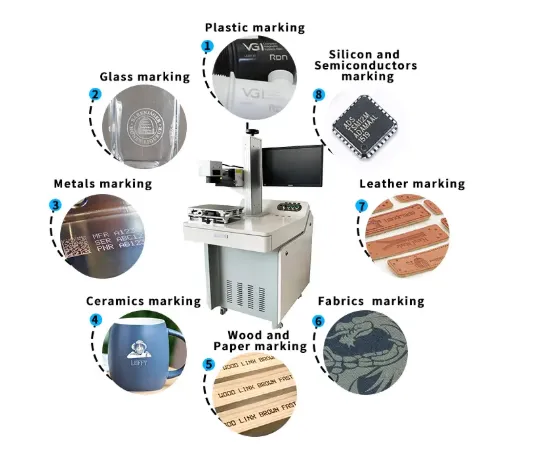
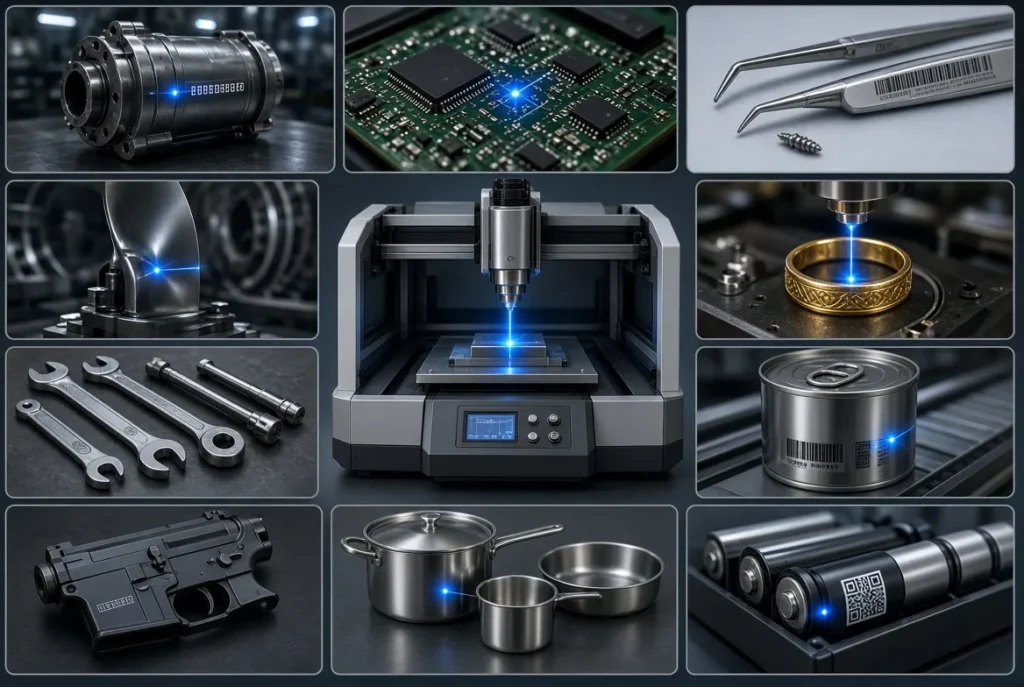
From automotive components and electronics to medical devices, jewelry and industrial traceability, fiber laser marking is used for much more than simply adding a logo to metal.
Why Are Fiber Laser Marking Machines Used in So Many Industries?
When customers first contact us about a fiber laser marking machine, one of the first questions is usually: “Should I buy 20W, 30W or 50W?”
As someone involved in both laser equipment sales and application discussions, I usually don’t recommend starting with the wattage. The better starting point is the product itself.
The same fiber laser can be used to mark an automotive component, a stainless steel medical instrument, a gold ring or an aluminum nameplate. But the required laser parameters and machine configuration can be quite different.
Material → Marking Content → Required Result → Workpiece Size → Production Volume → Cycle Time → Laser Power & Configuration
This approach is also consistent with the way direct part marking and traceability are treated in industrial standards. ISO 28219:2026, for example, covers linear and two-dimensional symbols for direct product, part and component marking and includes applications related to manufacturing, inventory, distribution and quality control.
Reference: ISO 28219:2026
1. Automotive Parts: Traceability Codes, VIN, QR Codes and Part Numbers
Automotive manufacturing is one of the most established applications for fiber laser marking.
In many automotive projects, the purpose of the laser is not simply to create an attractive logo. The mark is part of the component’s identification and traceability system.
Typical Applications
- Engine components
- Transmission components
- Brake system parts
- Gears and shafts
- Aluminum components
- Stainless steel components
- Automotive electronics
- Tools and dies
Typical Marking Content
- Serial numbers
- Part numbers
- QR codes
- Data Matrix codes
- Production codes
- Batch numbers
- Logos
- VIN-related information
The Automotive Industry Action Group (AIAG) has published guidance for 2D direct parts marking in the automotive supply chain, including the use of Data Matrix and QR codes for direct part identification.
Reference: AIAG – 2D Direct Parts Marking
If you are marking several hundred parts per day, a 20W or 30W machine may already be sufficient for many applications. For an automated production line, however, don’t judge the project only by laser power.
A better calculation is: loading time + marking time + unloading time + inspection time = actual cycle time.
If marking takes one second but manual loading takes five seconds, changing from 20W to 50W will not solve the real bottleneck.
2. Electronic Components: Small Characters, QR Codes and Product Identification
Electronics applications often require a different approach from general metal marking. The goal is usually not deep engraving. It is more often about creating a small, clean and repeatable mark without negatively affecting the component.
Typical Applications
- PCB components
- Connectors
- Metal terminals
- Aluminum housings
- Electronic components
- Sensors
- Power supply components
- Electronic enclosures
Typical Marking Content
- Model numbers
- Serial numbers
- QR codes
- Data Matrix codes
- Logos
- Batch information
One common mistake is assuming that a higher-power laser is always better. If the requirement is a small 0.5 mm character, for example, optics, focal position, beam quality and process parameters can be more important than simply increasing laser power.
For aluminum housings and general metal components, a 20W or 30W fiber laser can be a sensible starting point. If you need a wider process window or special effects on difficult materials, compare a standard fiber laser with a MOPA fiber laser through sample testing.
Compare MOPA Fiber Laser →3. Medical Devices: UDI, Data Matrix and Permanent Identification
Medical devices are a good example of why laser marking should not be evaluated only by visual appearance.
In many medical applications, the mark needs to remain identifiable through the product’s expected handling, cleaning or reprocessing conditions.
Typical Applications
- Surgical instruments
- Orthopedic instruments
- Stainless steel medical tools
- Dental instruments
- Medical device components
- Medical equipment parts
Typical Marking Content
- UDI information
- Data Matrix codes
- Serial numbers
- Product identification
- Manufacturer identification
The U.S. FDA’s Unique Device Identification system requires applicable medical devices to carry a unique device identifier. FDA also provides specific guidance concerning direct marking of certain devices that are intended to be reused and reprocessed.
Reference: FDA – UDI Basics
For direct marking: FDA – UDI Direct Marking of Devices
Do not ask a supplier only: “Can your machine mark stainless steel?”
For a medical project, ask whether the supplier can test your actual device, actual Data Matrix size and actual marking requirements.
The practical validation sequence should be: Mark → Clean/Reprocess → Scan → Verify.
4. Hand Tools and Hardware: Logos, Models, Serial Numbers and Deep Engraving
Hardware is one of the most straightforward applications for a fiber laser marking machine.
- Wrenches
- Screwdrivers
- Pliers
- Cutting tools
- Drill bits
- Bearings
- Locks
- Metal fittings
- Molds
Typical marking includes company logos, models, sizes, serial numbers, QR codes and product grades.
For a simple logo or model number, 20W or 30W may be sufficient. However, if the customer needs deeper engraving that must survive subsequent grinding, blasting or long-term mechanical wear, the question changes.
Define the required marking depth first. Then evaluate laser power, speed, frequency, hatch settings and number of passes.
A 50W machine may provide more processing capacity for deeper engraving, but it should still be selected based on the actual production requirement.
View 50W Fiber Laser Marking Machine →5. Jewelry: Gold, Silver, Rings and Personalized Engraving
Jewelry is another important application for fiber laser marking. Common jobs include names, dates, logos, symbols and personalized messages.
- Gold rings
- Silver rings
- Pendants
- Bracelets
- Jewelry components
- Personalized jewelry
For example, if a jewelry workshop only needs to engrave a name inside a ring, there is no automatic reason to purchase a 100W machine.
A 20W or 30W fiber laser combined with the appropriate fixture and rotary axis may be a much more sensible starting point.
One Important Point About Precious Metals
Do not simply copy marking parameters from another gold or silver product. Different alloys, surface finishes and product geometries can require different process settings.
For jewelry applications, we strongly recommend testing the actual workpiece before finalizing the machine configuration.
Explore Gold & Silver Laser Marking →6. Battery Manufacturing: QR Codes, Serial Numbers and Traceability
Battery manufacturing increasingly relies on product identification and production traceability.
Typical Applications
- Battery metal housings
- Battery covers
- Battery components
- Battery module components
- Metal connectors
Typical Marking Content
- QR codes
- Data Matrix codes
- Serial numbers
- Batch numbers
- Production dates
- Model numbers
One thing we always clarify with battery customers is exactly where the laser will be used. Marking a metal housing is not the same application as marking a sensitive internal battery material.
For metal battery housings and components, fiber laser is a logical technology to evaluate. If thermal impact is particularly critical, compare fiber, MOPA or UV technology through an actual material test.
Explore Battery Industry Applications →7. Aerospace Components: Permanent Identification and Traceability
Aerospace marking is less about making a logo look attractive and more about creating a durable identification mark that can remain associated with the component throughout its service life.
- Aircraft components
- Aluminum parts
- Titanium components
- Stainless steel components
- Engine components
- Aerospace fasteners
Typical identification includes part numbers, serial numbers, Data Matrix codes and manufacturer information.
For these projects, I would not recommend asking only: “Can a 50W fiber laser mark titanium?”
The more useful questions are:
- What marking depth is required?
- What contrast is required?
- What level of surface impact is acceptable?
- Can the Data Matrix be reliably read?
- What inspection method will be used?
- What are the actual acceptance criteria?
For aerospace applications, sample testing and validation can be more important than simply choosing a higher laser power.
8. Packaging: Date Codes, Batch Codes, QR Codes and Identification
Packaging is an application where the material must be identified before selecting the laser.
If you are marking metal caps, aluminum packaging or metal cans, fiber laser can be an appropriate technology to evaluate.
But if the product is primarily paper, cardboard, wood or certain transparent plastics, CO2 or UV may be more appropriate depending on the material and required result.
Typical Marking
- Date codes
- Batch codes
- Serial numbers
- QR codes
- Logos
- Product identification
ISO 28219:2026 provides a useful reference for direct marking of products, parts and components, including applications related to manufacturing, inventory and distribution.
Reference: ISO 28219:2026
9. Metal Nameplates and Equipment Labels
Metal nameplates are one of the most practical applications for fiber laser marking machines.
- Machine nameplates
- Electrical labels
- Equipment identification plates
- Aluminum tags
- Stainless steel plates
- Industrial control panels
Typical Information
- Company logo
- Model number
- Voltage information
- Serial number
- Manufacturing date
- QR code
- Required identification marks
For a small nameplate with a marking area around 100 × 100 mm, a 110 × 110 mm field may already be sufficient.
If the product requires a larger marking area, the appropriate F-theta lens should be selected accordingly.
Do not choose the marking field only because a supplier lists 110 × 110 mm as a standard configuration. Measure the actual marking area required by your product first.
10. Industrial Traceability: QR Codes, Data Matrix and Serial Numbers
Industrial traceability is slightly different from the other nine applications because it is not limited to one industry.
Automotive, electronics, medical, aerospace, machinery, battery and hardware manufacturers can all use direct marking as part of their traceability systems.
can be encoded into a machine-readable identification system.
However, there is an important distinction between “the machine can mark the code” and “the code meets the customer’s verification requirements.”
ISO/IEC 29158:2025 specifically addresses direct part mark quality testing and considers factors such as image acquisition, lighting, focus and contrast.
Reference: ISO/IEC 29158:2025
For traceability projects, validate the complete process:
Mark → Scan → Verify → Record
This is much more useful than simply taking a photograph of the finished mark.
Which Fiber Laser Configuration Should You Choose?
There is no universal “best” wattage. The right configuration depends on the marking requirement and production environment.
| Configuration | Typical Direction | Typical Applications | Main Consideration |
|---|---|---|---|
| 20W Fiber | General marking | Names, logos, serial numbers, QR codes, jewelry | Lower investment and general applications |
| 30W Fiber | Balanced production | Hardware, electronics, automotive, jewelry, nameplates | Balance between capacity and investment |
| 50W Fiber | Higher processing capacity | Deeper engraving, higher-volume metal marking | Production requirements and marking depth |
| 100W Fiber | High-power industrial applications | Deeper engraving and demanding industrial workflows | Actual depth, cycle time and production volume |
20 Questions to Ask Before Buying a Fiber Laser Marking Machine
If you are comparing several suppliers, I recommend putting these items into the quotation comparison sheet.
- What laser source brand and model is used?
- What is the actual rated laser power?
- What wavelength is used?
- What marking speed is specified?
- What marking field is included?
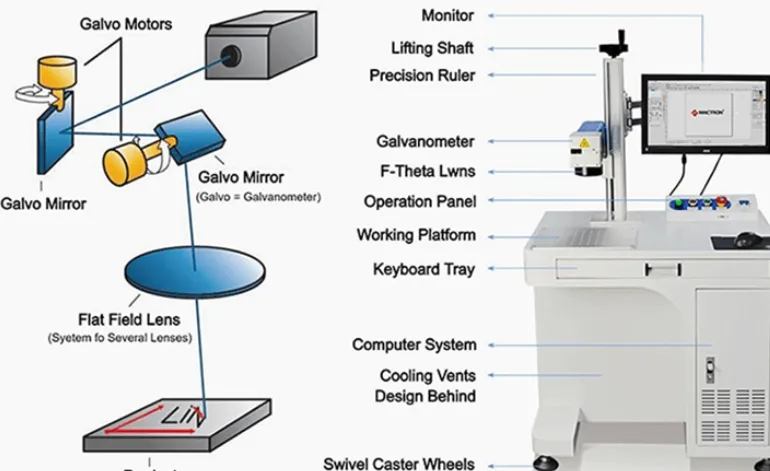
- Which galvanometer scanner is used?
- Which F-theta lens is included?
- Which control card is used?
- Which software version is supplied?
- Is a rotary axis included?
- What cooling method is used?
- Is an enclosure included?
- Is fume extraction required for the application?
- What warranty is provided?
- Will the supplier test the actual sample?
- What are the shipping terms?
- Is installation or training included?
- Are spare parts available?
- Can the machine interface with automation?
- How will barcode or Data Matrix quality be verified?
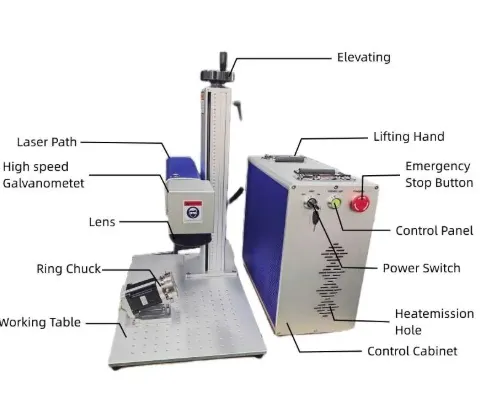
A 50W fiber laser is not a complete machine specification. The laser source, optics, scanner, control system, marking field, fixtures, software and automation configuration all affect the actual machine you are buying.
Explore Related Fiber Laser Marking Solutions
Fiber Laser Marking Machine
Explore the main fiber laser marking machine platform and technical configuration options.
View Fiber Laser Machines →20W Fiber Laser
A practical option for general metal marking and many personalization applications.
View 20W Fiber →50W Fiber Laser
For higher processing capacity, deeper engraving and demanding metal marking applications.
View 50W Fiber →MOPA Fiber Laser
Compare MOPA when pulse control and process flexibility are important.
View MOPA Fiber →Jewelry Laser Marking
Explore practical laser marking solutions for gold, silver, rings and personalized jewelry.
Explore Jewelry Applications →Not Sure Which Fiber Laser Configuration You Need?
Send us your material, marking file, workpiece dimensions, required marking result and approximate production volume. Instead of simply recommending the highest wattage, we can use the actual application to determine a more suitable configuration.
Recommended information: Material · Marking File · Marking Size · Desired Result · Production Volume
Technical References
- ISO 28219:2026 — Packaging and Direct Product Marking
- ISO/IEC 29158:2025 — Direct Part Mark Quality Testing
- U.S. FDA — Unique Device Identification
- AIAG — 2D Direct Parts Marking
Technical requirements vary by product, material, industry standard and customer acceptance criteria. The information on this page is intended as a practical purchasing and application guide and should not replace applicable regulatory or engineering requirements.
Practical Advice From a Laser Marking Engineer

LEO has more than ten years of experience in the laser marking machine industry. He has extensive experience with laser marking applications across different industries and has participated in the design and implementation of multiple automated marking projects.
His practical work includes helping customers evaluate laser power, marking materials, optical configurations, fixtures, rotary systems and production requirements.
For jewelry applications, his approach is straightforward: understand the actual material and required marking result first, then select the laser configuration. A higher-power machine is not automatically the right answer.