Fiber Laser vs UV Laser Marking Machine: Which One Should You Buy?
Choosing between a fiber laser and a UV laser is not really about which machine is “better.” The more useful question is: Which laser is better for your material, marking result and production process?
If you mainly mark stainless steel, aluminum, brass, copper, titanium or other metal parts, a fiber laser is usually the first machine we would recommend. If you are working with sensitive plastics, electronics, glass, medical components, thin films or products where heat damage is a concern, UV laser technology can make much more sense.
The Short Answer
For most buyers, the decision can be simplified like this:
Choose Fiber Laser If:
- Your main material is metal
- You need fast marking
- You need deep engraving
- You mark serial numbers or QR codes on metal
- You need high production throughput
- You want a cost-effective industrial marking system
Choose UV Laser If:
- You mainly mark plastics or sensitive materials
- You need very fine details
- Heat damage is a major concern
- You mark PCBs or electronic components
- You work with glass or thin films
- Surface quality is more important than deep engraving
Fiber Laser vs UV Laser: What’s the Difference?
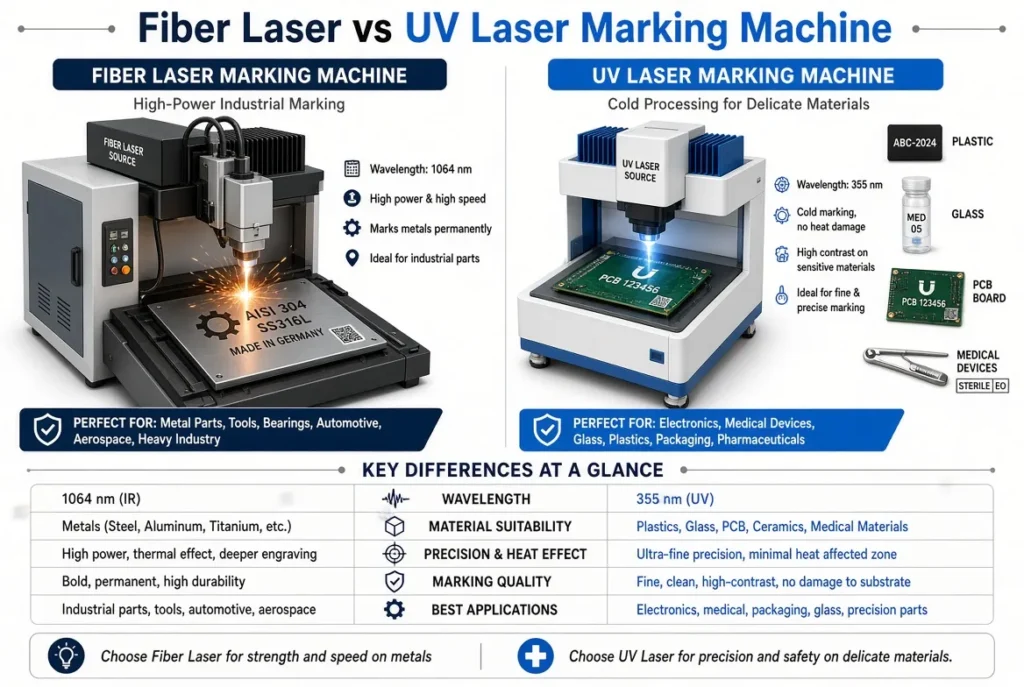
Both machines can produce permanent, precise marks, but they interact with materials differently. Fiber lasers normally use a 1064 nm infrared wavelength, while industrial UV marking systems commonly use a 355 nm ultraviolet wavelength. The shorter UV wavelength is absorbed differently by many materials and can reduce the thermal impact on sensitive surfaces.
| Feature | Fiber Laser | UV Laser |
|---|---|---|
| Typical wavelength | 1064 nm | 355 nm |
| Main strength | Metal marking and engraving | Fine, low-thermal-impact marking |
| Best-known materials | Stainless steel, aluminum, brass, copper, titanium and other metals | Plastics, glass, electronics, films and other sensitive materials |
| Heat impact | Higher thermal effect | Generally much lower thermal impact |
| Deep engraving | Excellent choice | Usually not the first choice |
| Fine micro marking | Good | Excellent |
| Typical production speed | High | Application dependent |
| Initial machine cost | Generally lower | Generally higher |
Which Laser Should You Buy for Your Material?
If you’re not sure which machine to buy, don’t start with laser power. Start with the material and the result you need.
| Material / Application | First Choice | Why |
|---|---|---|
| Stainless Steel | Fiber | Fast, durable marking and good contrast control. |
| Aluminum | Fiber | Widely used for industrial identification and engraving. |
| Brass / Copper | Fiber / UV | Fiber is normally the practical choice for production metal marking; UV can be useful when heat and surface quality are critical. |
| Engineering Plastics | UV | UV can provide cleaner marking with lower thermal impact on many plastics. |
| PCB / Electronic Components | UV | Fine detail and reduced thermal impact are important for sensitive electronic parts. |
| Glass | UV | UV can produce fine marks on glass with lower thermal stress than many conventional thermal processes. |
| Metal Deep Engraving | Fiber | Higher available power makes fiber a stronger choice for material removal and deep engraving. |
| Very Small QR / Micro Text | UV | The shorter wavelength and small spot can be advantageous for fine details. |
When a Fiber Laser Is the Better Choice
If I were helping a customer choose a laser and the customer’s main products were metal parts, my first question would not be “Do you want 30W or 50W?” I would ask: What metal are you marking, what kind of mark do you need, and how many pieces do you produce per day?
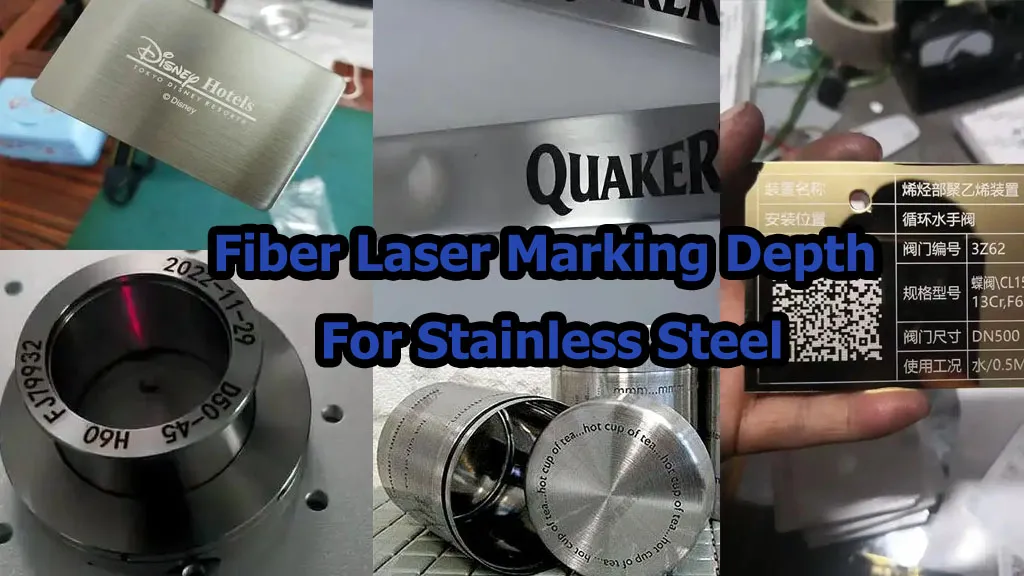
For stainless steel, aluminum, brass, copper, titanium and many other industrial metals, fiber laser marking is usually the practical starting point. Fiber systems are also widely used for serial numbers, barcodes, Data Matrix codes, QR codes, logos, part numbers and permanent identification.
Metal Marking
Stainless steel, aluminum, brass, copper, titanium and many other metal components.
High-Volume Production
A strong choice when marking speed and production throughput are important.
Deep Engraving
Better suited to removing material from metal when a deeper permanent mark is required.
Sales tip: If your products are mostly metal and you don’t have a special heat-sensitive application, don’t pay extra for UV simply because it sounds more advanced. A correctly configured fiber laser may already solve the job very well.
When a UV Laser Is the Better Choice
UV becomes interesting when the problem is not simply “Can the laser make a mark?” but rather: Can it make the mark without melting, burning, deforming or damaging the product?
UV lasers operate at a much shorter wavelength, commonly 355 nm. Their interaction with many materials can produce a lower-thermal-impact marking process, which is why UV systems are often selected for sensitive plastics, electronics, medical products, films, glass and fine-detail applications. :contentReference[oaicite:0]{index=0}
Sensitive Plastics
Useful where fiber laser heat could create unwanted melting, discoloration or deformation.
Electronics
PCB, electronic components and small parts often benefit from precise, low-thermal-impact marking.
Fine Details
Small text, fine graphics, codes and detailed marks can benefit from UV’s short wavelength.
Important: “Cold marking” does not mean zero heat or zero risk under every setting. UV is better described as a lower-thermal-impact process for many applications. Actual results still depend on material composition, laser parameters, focus and production conditions.
Fiber Laser vs UV Laser for Plastic
This is one of the most common questions we receive. And honestly, there is no universal answer because “plastic” covers hundreds of different formulations.
Some plastics contain additives that make them respond very well to a fiber laser. Others may melt, discolor or produce an unwanted surface effect. UV can be a better choice when you need a clean, fine mark with less thermal impact. Material testing is therefore much more useful than simply choosing a laser based on the word “plastic.”
| Requirement | Fiber | UV |
|---|---|---|
| Maximum production speed | Often the stronger choice | Application dependent |
| Avoiding plastic deformation | Material dependent | Usually stronger choice |
| Fine text / micro marking | Good | Excellent |
| Initial investment | Usually lower | Usually higher |
Fiber Laser vs UV Laser for Metal
For normal industrial metal marking, fiber laser is usually the more economical and practical choice. It is designed around the strong absorption of many metals at its infrared wavelength and is widely used for permanent industrial identification.
UV can still be useful on certain metals when the application requires very fine surface marking, low thermal impact or a special surface effect. But if the job is simply: “Mark 10,000 stainless-steel parts every day,” we would normally start by evaluating fiber laser rather than UV.
A Practical Rule
Metal + speed + depth = start with fiber.
Metal + very fine detail + low thermal impact = evaluate UV.
Is a UV Laser More Expensive Than a Fiber Laser?
In many configurations, UV laser systems cost more than comparable fiber systems. But comparing only the purchase price can lead to the wrong decision.
The real question is whether the additional investment solves a problem that a fiber laser cannot solve reliably. If UV prevents plastic deformation, improves code readability or eliminates rejects on a sensitive product, the higher machine price may be justified.
Fiber = Better Value When
- Most products are metal
- Production volume is high
- You need fast marking
- You need deeper engraving
- Heat is not a major issue
UV = Better Value When
- The product is heat sensitive
- Plastic quality is critical
- Very fine detail is required
- Electronics are involved
- Product rejects are expensive
A Simple Way to Decide
The Best Way to Choose? Test Your Actual Material.
A material name is not enough to guarantee a marking result. Two products that are both called “ABS plastic,” for example, can contain different additives and behave differently under a laser.
If you’re making a real purchasing decision, send the supplier your actual sample, marking artwork and required result. Then compare the mark itself—not just the machine quotation.
Request Material Testing →Send These 5 Things
- Actual product or material sample
- Logo / text / QR code artwork
- Required marking size
- Required marking appearance
- Approximate production quantity
Fiber vs UV Laser FAQ
Which is better, fiber laser or UV laser?
Neither is universally better. Fiber laser is usually the better choice for metal marking, high-speed production and deeper engraving. UV laser is often better for heat-sensitive plastics, electronics, glass and fine-detail marking.
What is the main difference between fiber laser and UV laser?
Fiber lasers commonly operate around 1064 nm, while UV marking lasers commonly operate around 355 nm. The wavelength changes how the laser interacts with the material, which affects marking quality, heat impact and material compatibility.
Is a fiber laser better for stainless steel?
Yes. Fiber lasers are widely used for stainless steel marking because they can produce fast, permanent marks and can also be configured for different effects such as engraving or annealing.
Is UV laser better for plastic?
UV is often a strong choice for plastic when the application requires fine detail and low thermal impact. However, plastic formulations vary considerably, so testing the actual material is still recommended.
Can a fiber laser mark plastic?
Yes, some plastics can be marked effectively with fiber lasers, particularly when their formulation or additives provide suitable laser absorption. But some plastics may melt or discolor, so a sample test is recommended.
Can UV laser mark metal?
Yes. UV lasers can mark certain metals, especially when the application requires fine surface marking or reduced thermal impact. However, for general high-speed metal marking and deep engraving, fiber laser is usually the more practical choice.
Which laser is better for QR codes?
Both can mark QR codes. The better choice depends on the material, code size, contrast and production speed. Fiber is commonly used for metal traceability, while UV can be advantageous for small codes on plastics and sensitive components.
Which laser is better for deep engraving?
Fiber laser is generally the better choice for deep engraving on metal because higher-power configurations can remove more material efficiently.
Is a UV laser worth the higher price?
It can be, when the application requires capabilities that a fiber laser cannot provide reliably, such as low-thermal-impact marking on sensitive plastics, electronics or certain glass applications. The correct way to judge the investment is by comparing the marking result and production cost, not just the machine price.
Should I buy a fiber laser or UV laser if I mark different materials?
If you have several very different materials, don’t choose based only on the material list. Tell the supplier your main products, the percentage of each material, required marking quality and production volume. In some cases one laser can cover most jobs; in other cases two technologies may be justified.
Don’t Choose the Laser by Wattage Alone
Tell us what material you want to mark, what the finished mark should look like, how large the marking area is and approximately how many pieces you produce. We can then recommend whether fiber or UV is the more practical choice.