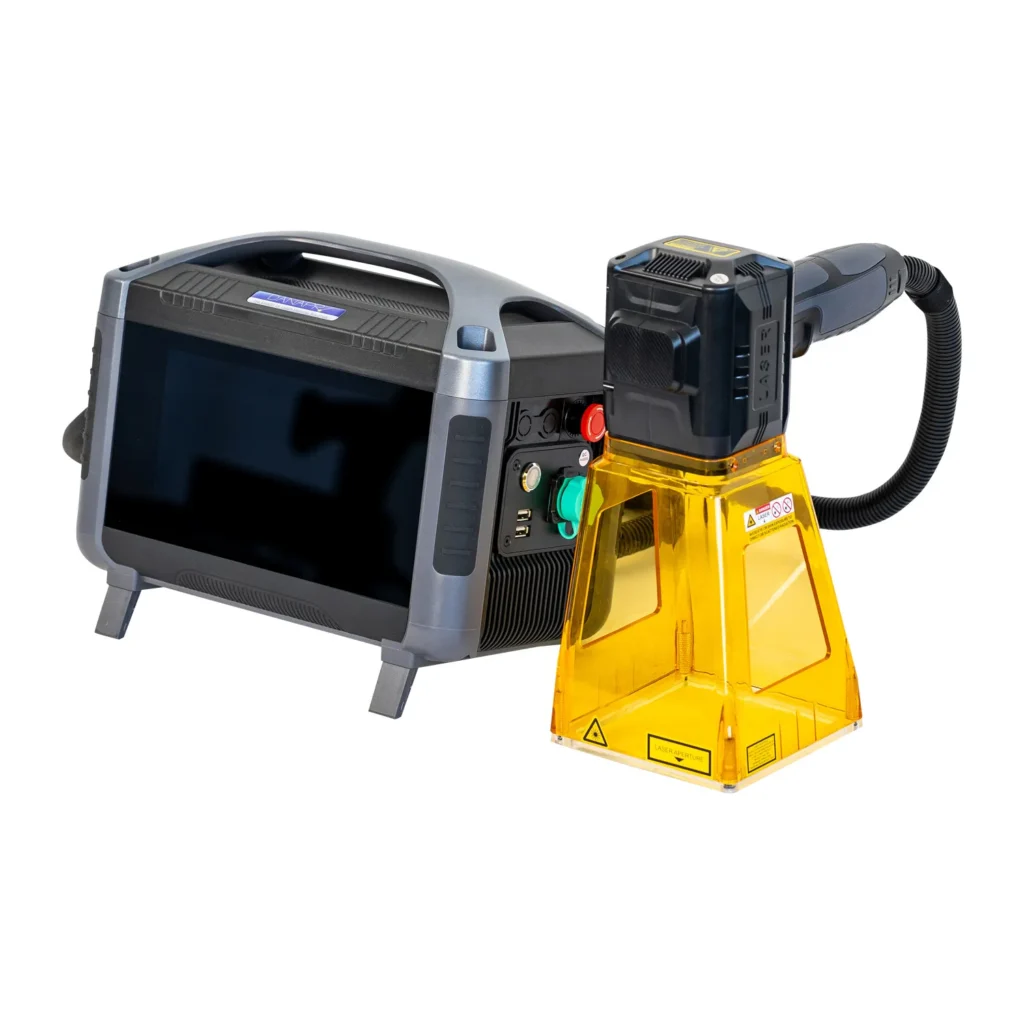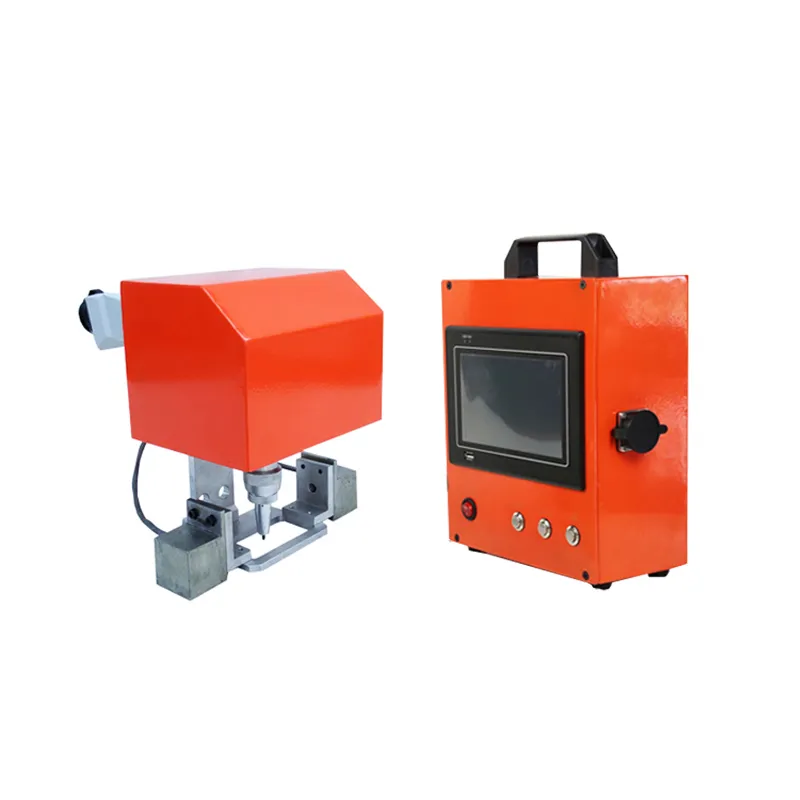
Automatic Laser Marking Machine for High-Volume Production
Automate product identification with a laser marking system designed for repetitive industrial production. Integrate fiber, MOPA or UV laser marking with conveyors, sensors, PLC control, rotary fixtures, robots and optional vision inspection.
Mark serial numbers, QR codes, Data Matrix codes, barcodes, logos and product information with a repeatable process tailored to your material, production volume and cycle-time requirements.
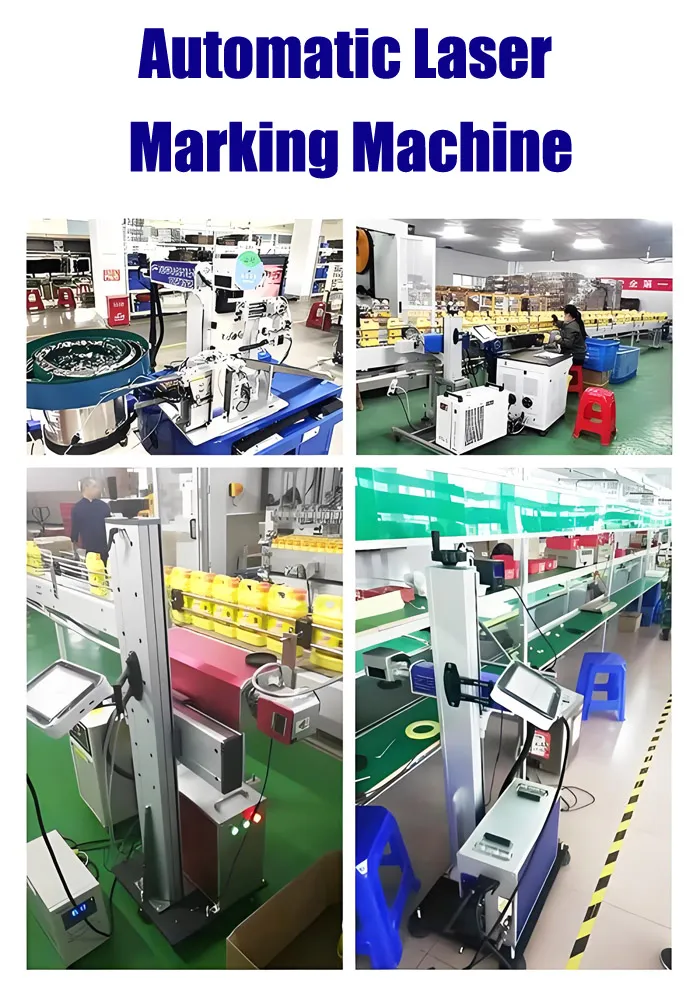
*Maximum marking speed is configuration- and application-dependent. Actual production cycle time depends on marking content, material, product spacing, positioning, conveyor speed and inspection requirements.
Table of Contents
Product Introduction
What Is An Automatic Laser Marking Machine?
An Automatic Laser Marking Machine is an advanced industrial marking system that combines laser marking technology with automatic loading, positioning, transportation and production management systems.
Unlike traditional manual laser marking machines, automatic laser markers are designed for high-volume production where speed, consistency and efficiency are critical.
The system can automatically complete:
- Product feeding
- Automatic positioning
- Laser marking
- Product unloading
- Data recording
By reducing manual operation, automatic laser marking machines improve production efficiency, reduce labor costs and ensure consistent marking quality.
They are widely used in modern smart factories for permanent identification, traceability management and industrial automation.
Why Choose Automatic Laser Marking Machine?
The Future Of Industrial Product Identification
With the development of Industry 4.0, manufacturers are increasingly upgrading from manual production to intelligent automated manufacturing. Product marking is an important step in industrial production. Traditional manual marking methods often have problems such as:
- Low production efficiency
- Inconsistent marking position
- Higher labor requirements
- Difficulty in production tracking
An automatic laser marking system solves these problems by integrating precision laser technology with automated production equipment.
The result is faster production, higher accuracy and better product traceability.
Working Principle Of Automatic Laser Marking Machine
An automatic laser marking machine works through the combination of laser technology, mechanical automation and intelligent control systems.
01. Automatic Feeding
Products enter the marking station through conveyor belts, vibration feeders or robotic systems.
02. Precision Positioning
Sensors or vision systems locate the exact marking position.
03. Laser Processing
The laser beam creates permanent marks according to preset designs.
04. Automatic Output
Finished products continue to the next production process.
Is an Automatic Laser Marking Machine Right for Your Production?
Automation is not automatically the best choice for every factory. For low-volume or highly variable production, a standard desktop or portable laser marker may be more economical. Automation becomes more attractive when marking is repetitive, production volume is high, product identification is required on every part, or manual handling is becoming a bottleneck.
High Production Volume
You mark hundreds, thousands or more parts repeatedly and manual loading is limiting production capacity.
Repetitive Product Flow
Products follow a predictable production route and can be fed by conveyor, fixture, rotary table or robot.
Variable Identification
Each product may require a different serial number, QR code, Data Matrix code, batch number or production record.
Traceability Requirements
Marking needs to become part of the production process and may need to communicate with PLC, MES, ERP or inspection systems.
Consistent Positioning
A fixture, sensor or vision system can help maintain repeatable marking position when manual placement is inconsistent.
Planned ROI
The additional automation cost makes more sense when labor, throughput, rework and traceability requirements justify it.
Automatic Laser Marking Machine Technical Specifications
Automatic marking systems are configured according to the material, marking content, product dimensions, production speed and automation requirements. The following specifications are reference configurations, not a fixed specification for every customized production line.
| Parameter | Reference Configuration | What It Depends On |
|---|---|---|
| Laser Type | Fiber / MOPA Fiber / UV / CO2 | Material and required marking result |
| Fiber Laser Power | 20W / 30W / 50W / 60W / 100W | Marking speed, contrast, depth and production cycle |
| Fiber Wavelength | 1064 nm | Fiber laser configuration |
| Reference Marking Speed | Up to approximately 7,000 mm/s | Laser source, galvo, lens and marking content |
| Typical Marking Field | 110 × 110 mm standard reference | F-theta lens and required marking area |
| Positioning Accuracy | Approx. ±0.01 mm reference | Mechanical positioning, fixture and application |
| Automation Method | Conveyor / Rotary / Robot / Custom Fixture | Product geometry and production workflow |
| Triggering | Sensor / PLC / Encoder | Stop-and-mark or mark-on-the-fly process |
| Control | PLC + Laser Marking Controller | Customer automation architecture |
| Vision | Optional | Position variation and inspection requirements |
| Software | EZCAD-compatible configuration | Controller and automation architecture |
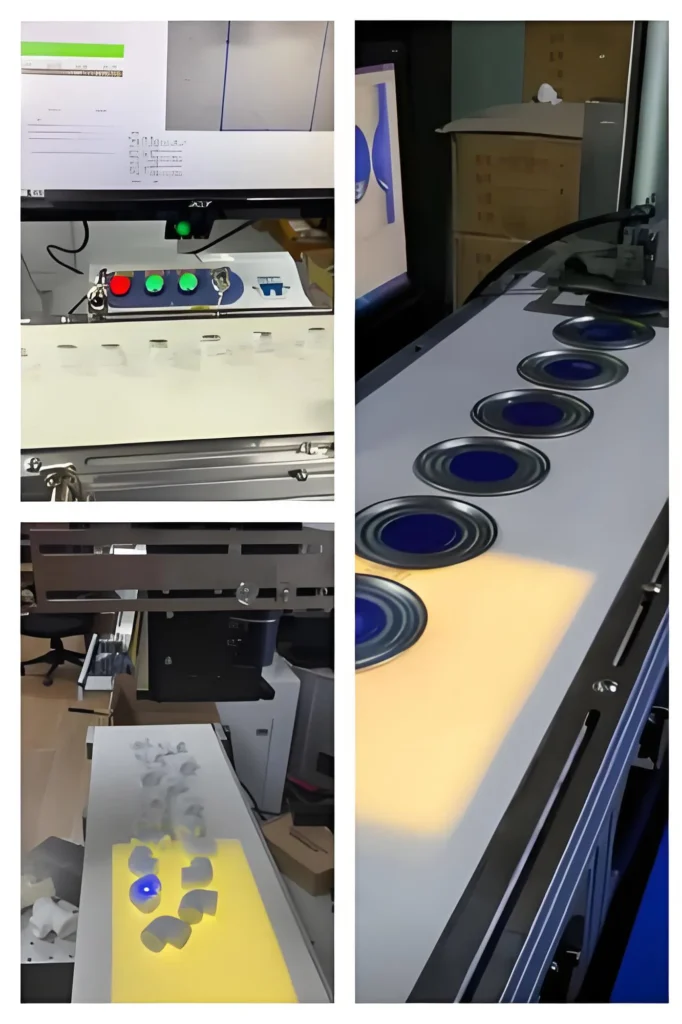
Automatic Laser Marking Machine Applications
Automatic laser marking systems are widely used in industries that require high-volume production and permanent product identification.
Automotive Industry
Engine parts, gear components, vehicle identification, traceability codes.
Electronics Industry
PCB, connectors, electronic housings, components.
Hardware Manufacturing
Tools, fasteners, metal parts, industrial products.
Medical Industry
Surgical instruments, medical devices, stainless components.
Battery Industry
Battery shells, cells, production tracking.
Machinery Industry
Industrial components, machine parts, equipment identification.
Automatic Laser Marking System Components
An automatic laser marking machine is much more than a laser source. A complete automatic marking solution combines precision optics, industrial automation, intelligent control software and customized fixtures to create a highly efficient production system. Every component plays an important role in ensuring high-speed, stable and repeatable marking performance.
Fiber Laser Source
The laser source is the core of the machine. Industrial fiber lasers provide excellent beam quality, stable output power and service life exceeding 100,000 hours.Suitable for continuous 24/7 production.
Galvanometer Scanner
High-speed digital scanning mirrors accurately control the laser beam movement.Typical marking speeds can Up to approximately 7,000 mm/s depending on the application.
Automatic Feeding System
Conveyor belts, rotary tables, vibration bowl feeders or robotic loading systems deliver products automatically.No manual positioning is required.
Vision Inspection
Industrial cameras automatically identify product position, orientation and quality, greatly improving marking accuracy.
PLC Control System
PLC automatically controls feeding, positioning, laser marking, sorting and unloading, creating a fully automated production workflow.
Laser Software
Professional software manages text, graphics, QR codes, serial numbers, database communication and MES integration.
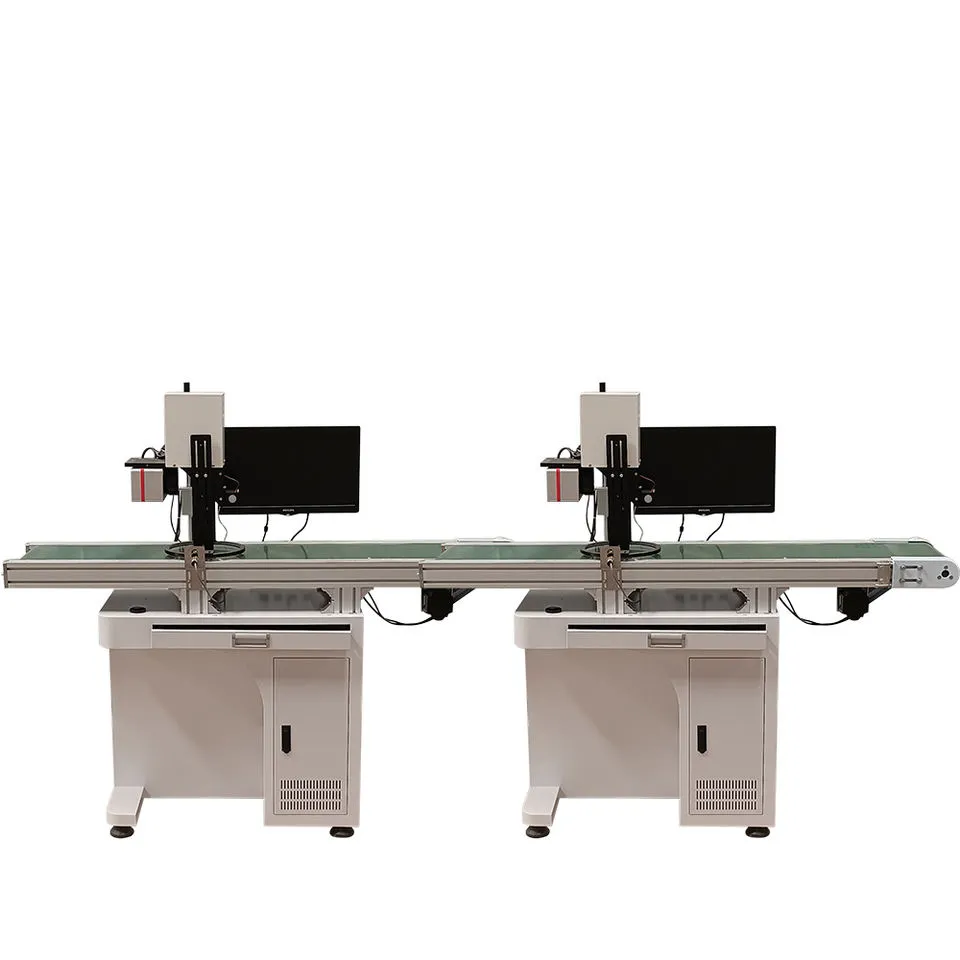
Conveyor Automatic Laser Marking Machine
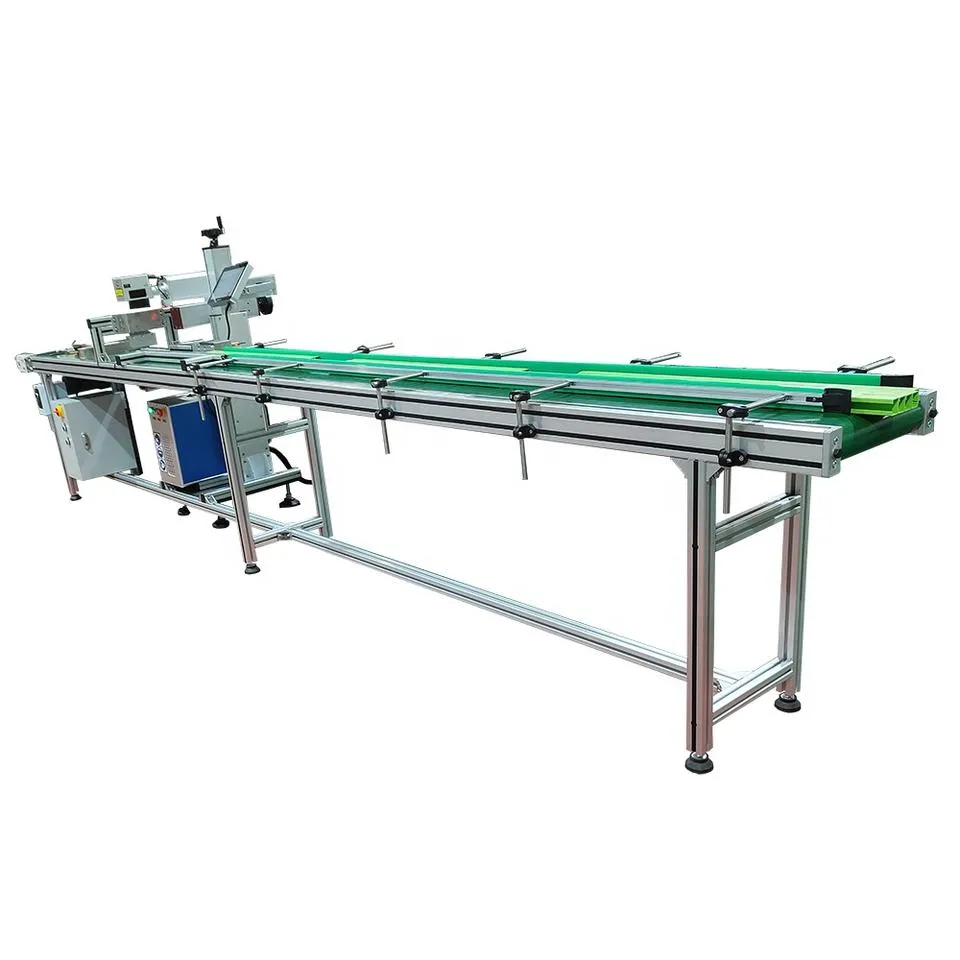
The conveyor laser marking machine is the most common automatic configuration used in industrial production lines. Products move continuously on a conveyor belt while the vision system detects their position. The laser marking head automatically adjusts the marking position and completes the marking process without stopping the production line. This significantly improves manufacturing efficiency while reducing labor costs.
Conveyor laser marking systems are widely used in:
- Automotive parts manufacturing
- Metal hardware production
- Electronic component assembly
- Plastic injection molding
- Packaging industry
- Battery production
Compared with manual laser marking, automatic conveyor systems can operate continuously for multiple shifts, making them ideal for medium and large-scale production.
Robot Integrated Laser Marking Machine
Flexible Automation For Complex Products
For large products, heavy components or irregular workpieces, robot-assisted laser marking provides maximum flexibility.Industrial robots automatically pick up products, move them to the marking position, rotate different surfaces and complete multi-angle laser engraving.
Robot laser marking systems are especially suitable for:
Automotive Engines
VIN numbersEngine blocksTransmission housings
Large Metal Parts
Steel structuresMechanical componentsIndustrial equipment
Aerospace Components
Titanium partsAircraft componentsHigh precision marking
Heavy Machinery
Construction equipmentHydraulic componentsIndustrial castings
Automatic VS Manual Laser Marking Machine
| Comparison | Automatic | Manual |
|---|---|---|
| Production Capacity | ★★★★★ | ★★☆☆☆ |
| Labor Cost | Very Low | Higher |
| Consistency | Excellent | Depends on Operator |
| Automation | PLC + Robot + Conveyor | Manual Loading |
| Production Volume | Mass Production | Small Batch |
| Return on Investment | Higher for Continuous Production | Suitable for Entry-Level Users |
Why Manufacturers Choose Automatic Laser Marking
Across the automotive, electronics, battery, medical device and industrial manufacturing sectors, product traceability has become a standard requirement rather than an optional feature. Many manufacturers use permanent identification to support internal traceability, quality control, warranty management and customer requirements. Automatic laser marking systems help manufacturers meet these requirements while improving production efficiency. Unlike manual marking, automated systems provide consistent positioning, repeatable quality and seamless integration with MES, ERP and barcode databases. Every product can receive a unique serial number, QR code or Data Matrix code without slowing down production.
For factories operating multiple shifts, automation also reduces dependence on manual labor, minimizes human error and supports stable long-term production. Combined with vision inspection, conveyor systems and robotic handling, an automatic laser marking machine becomes an important part of a smart manufacturing line.
As production volumes increase, the advantages become even more significant. Manufacturers can improve throughput, reduce rework, simplify quality control and create a complete digital traceability system that meets international industry standards.
Professional Automated Laser Marking Solutions For Global Manufacturing
Automatic Laser Marking Machine Manufacturer
Choosing a reliable Automatic Laser Marking Machine Manufacturer is essential for companies that need stable production performance, long-term equipment reliability and professional technical support. Unlike standard marking equipment, automatic laser marking systems require comprehensive engineering capability, including laser technology, mechanical design, automation integration, software development and production experience.
As a professional laser marking equipment supplier, we focus on providing complete automated marking solutions for global industrial customers. Our automatic laser marking machines are designed to meet different manufacturing requirements, from simple conveyor marking systems to fully integrated robotic laser marking production lines.
Every production environment has different requirements. Some customers need high-speed marking for thousands of products per day, while others require flexible automation systems for multiple product models. Therefore, we provide customized solutions according to:
- Product size and shape
- Production speed requirements
- Material characteristics
- Marking content
- Factory automation level
- Future expansion requirements
Our goal is not only to provide a laser marking machine, but also to help customers build a complete product identification solution that improves manufacturing efficiency and competitiveness.
Company Advantages
Why Choose Our Automatic Laser Marking Machine?
A high-quality automatic laser marking machine requires more than a laser source. It requires professional engineering, strict quality control and years of industrial application experience.
01
Professional Manufacturing
Complete production capability from machine design, assembly, testing to delivery.
02
Automation Experience
Experience in conveyor systems, robot integration and industrial automation.
03
Customized Solutions
Develop marking systems according to different production requirements.
04
Strict Testing
Every machine is tested before shipment.
05
Global Support
Provide technical support for international customers.
06
Long-Term Partnership
Focus on building reliable customer relationships.
From Application Test to Production-Ready Automation
From Design To Complete Automatic Laser Marking System
A production-line laser marking project should start with the actual product, not with a standard machine model. Before selecting the final configuration, we review the material, marking content, product geometry, production volume and required cycle time.
01. Engineering Design
Engineers analyze customer products, production speed and automation requirements before designing the solution.
02. Mechanical Manufacturing
Machine frames, fixtures, conveyor systems and precision structures are manufactured according to requirements.
03. Electrical Integration
PLC, sensors, motors and control systems are integrated professionally.
04. Software Configuration
Laser software and automation programs are configured for customer production.
05. Production Testing
Complete machine testing ensures stable operation before shipment.
06. Customer Delivery
Provide installation guidance, operation training and technical support.
Quality Control System
Reliable Performance For Industrial Production
Automation projects can fail even when the laser itself produces a good mark. For this reason, our inspection approach covers the marking process, mechanical positioning, automation signals, software and safety-related functions before shipment.
| Test Stage | What We Check | Why It Matters |
|---|---|---|
| 1. Laser Output | Laser operation and marking performance | Confirms the marking source is operating as expected |
| 2. Sample Marking | Actual product or agreed test material | Confirms the required marking result before shipment |
| 3. Positioning | Fixture, sensor and marking position | Reduces positioning errors during automated operation |
| 4. Automation Sequence | Feed → detect → mark → output sequence | Confirms the machine follows the intended production workflow |
| 5. PLC / I/O | Trigger, ready, busy, complete and fault signals where applicable | Helps prevent integration problems at the customer’s factory |
| 6. Software | Marking files, variable data and required control functions | Reduces setup and operating problems |
| 7. Safety Functions | Relevant sensors, enclosure and safety-related functions | Supports safe machine operation and site commissioning |
| 8. Final Run Test | Complete machine operation before packing | Verifies that the integrated system operates as a complete unit |
The final acceptance criteria should be agreed with the customer before production. This may include marking quality, product positioning, cycle time, variable-data communication, inspection requirements and PLC interface requirements.
Automatic Laser Marking Machine Custom Solutions
Designed For Your Production Requirements
Different industries have different production processes. A standard machine cannot always satisfy special applications.Our engineering team can customize automatic laser marking systems according to product characteristics and factory requirements.
Conveyor System
Automatic product transportation for continuous production.
Rotary Marking Device
For cylinders, rings, pipes and round products.
Vision Positioning System
Automatic product recognition for accurate marking.
Robot Integration
Flexible automation for complex products.
MES Data Connection
Connect marking data with factory management systems.
Special Fixtures
Customized positioning solutions for special workpieces.
Materials That Can Be Marked By Automatic Laser Marking Machine
Permanent Marking Solution For Different Materials
One of the biggest advantages of an Automatic Laser Marking Machine is its ability to process a wide range of materials.According to different applications, manufacturers can choose fiber laser, UV laser or CO2 laser sources to achieve the best marking results.
Compared with traditional printing methods, laser marking creates permanent identification directly on the product surface without ink, labels or chemical consumables.This makes it ideal for industries requiring durability, traceability and high-quality appearance.
01. Stainless Steel
Widely used in automotive,
medical instruments,
kitchen equipment and industrial parts.Laser marking can create:
✓ Logo
✓ Serial Number
✓ QR Code
✓ Deep Engraving
02. Aluminum
Common applications include:
Electronic housings,
machinery parts,
nameplates and aerospace components.Fiber laser provides clear,
high contrast marking.
03. Copper & Brass
Suitable for:
Electrical components,
connectors,
hardware products.Special laser parameters improve marking quality.
04. Plastic Materials
Automatic laser marking systems can process:
ABS,
PC,
PVC,
engineering plastics.Suitable for electronics and automotive parts.
05. Titanium
Used in:
Medical devices,
aerospace components,
high-end products.Provides precise permanent marking.
06. Coated Materials
Laser can remove surface coatings to create clear identification without damaging the base material.
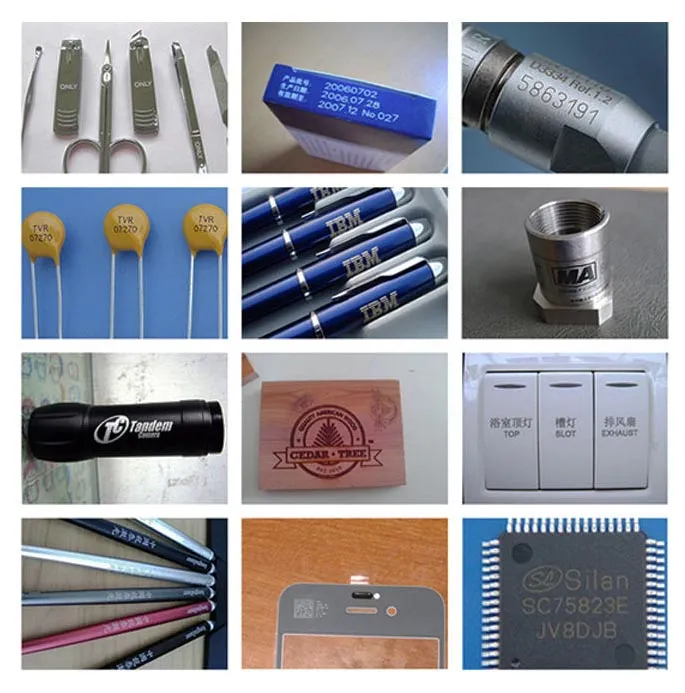
Automatic Laser Marking Machine Applications
Smart Manufacturing Applications Across Industries
Automatic laser marking systems are becoming an essential part of modern manufacturing because industries increasingly require product traceability, anti-counterfeiting identification and intelligent production management.
From small electronic components to large automotive parts, automatic laser marking technology provides fast, accurate and permanent marking solutions.
| Industry | Products | Marking Requirements |
|---|---|---|
| Automotive Manufacturing | Engine parts, gear components, brake parts | VIN code, serial number, traceability information |
| Electronics Industry | PCB, connectors, chips, housings | QR code, logo, model number |
| Medical Equipment | Surgical tools, implants, devices | Permanent identification and regulations marking |
| Battery Industry | Battery cells, battery shells | Production date, safety code, tracking number |
| Hardware Industry | Tools, fasteners, metal products | Brand marking, specifications |
Automatic Laser Marking Machine VS Traditional Marking Methods
| Feature | Automatic Laser Marking | Traditional Printing / Engraving |
|---|---|---|
| Consumables | No ink or consumables required | Requires ink, labels or tools |
| Marking Durability | Permanent marking | May fade or wear |
| Production Speed | High-speed automated production | Limited by manual operation |
| Environmental Impact | Clean processing | May produce waste materials |
| Data Integration | Supports QR, barcode, MES systems | Limited automation capability |
How To Choose The Right Automatic Laser Marking Machine
Selecting the right automatic laser marking machine requires considering production requirements, material characteristics and future expansion plans. A suitable system can significantly improve production efficiency and provide a faster return on investment.
1. Consider Your Production Volume
For low-volume production, a semi-automatic system may be enough. For thousands or millions of products per year, a fully automatic laser marking production line is usually the better choice.
2. Select The Correct Laser Source
Different materials require different laser technologies:
- Fiber Laser: Best for metals
- UV Laser: Best for sensitive plastics and precision products
- CO2 Laser: Best for wood, glass, leather and organic materials
3. Consider Automation Requirements
Customers should evaluate whether they need:
- Conveyor system
- Robot loading
- Vision positioning
- Automatic inspection
- MES data connection
4. Check Supplier Experience
A professional supplier should provide:
- Application testing
- Machine customization
- Technical support
- After-sales service
Automatic Laser Marking Machine FAQ
What is an Automatic Laser Marking Machine?
An Automatic Laser Marking Machine is an industrial marking system that combines laser technology with automatic feeding, positioning and production control systems.
What industries use automatic laser marking machines?
They are widely used in automotive, electronics, medical, battery, hardware and machinery industries.
What materials can automatic laser markers process?
They can mark stainless steel, aluminum, copper, plastic, titanium and coated materials.
How fast is an automatic laser marking machine?
Depending on configuration, industrial laser marking systems can reach speeds up to approximately 7000mm/s or higher.
Can it connect with production lines?
Yes.Automatic laser marking machines can integrate with conveyors, robots, PLC and MES systems.
Does laser marking require consumables?
No.Laser marking does not require ink, labels or chemical consumables.
What is the service life of fiber laser source?
A quality fiber laser source typically provides around 100,000 hours service life.
Can it mark QR codes?
Yes.It can permanently mark QR codes, barcodes, Data Matrix codes and serial numbers.
Can the machine be customized?
Yes.Solutions can be customized with conveyors, robot arms, fixtures and vision systems.
Is automatic laser marking suitable for mass production?
Yes.It is specifically designed for continuous industrial production.