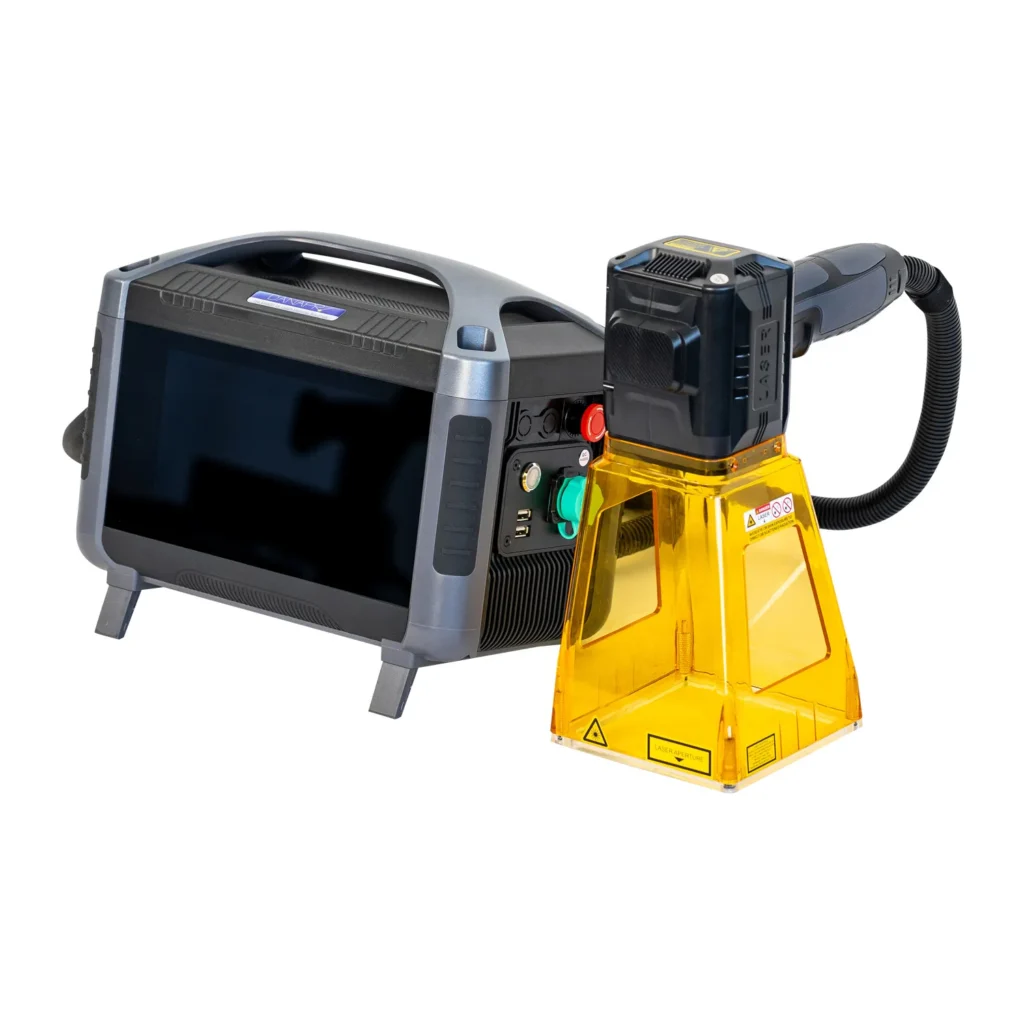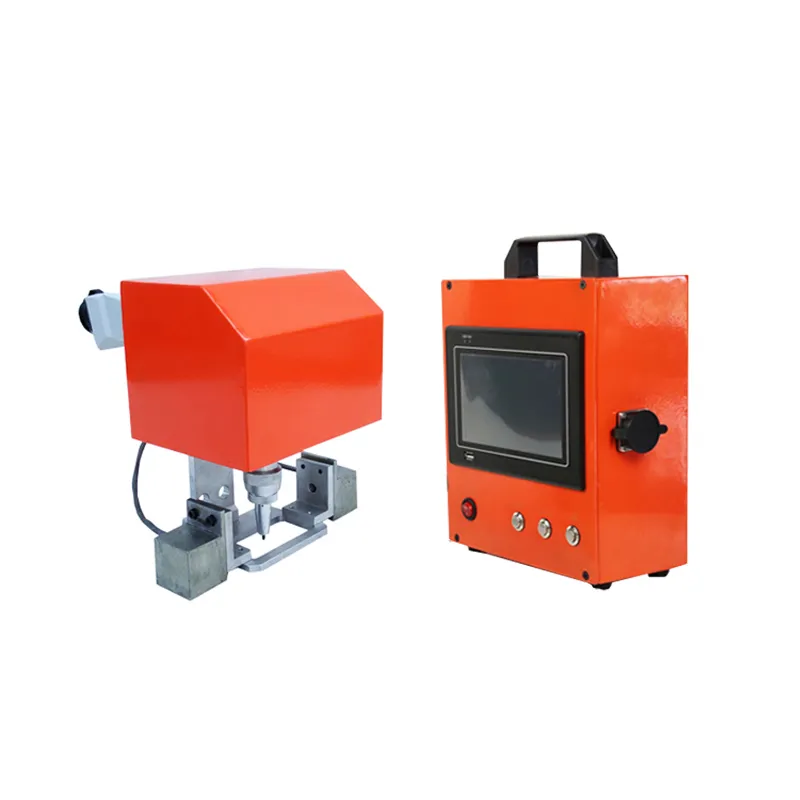
Fiber Laser Marking Machine for Stainless Steel
For stainless steel parts, the machine is only half of the equation. The marking result also depends on the steel grade, surface finish, laser parameters, required contrast and production speed.A properly configured fiber laser can produce permanent text, logos, serial numbers, QR codes and other identification marks on stainless steel.
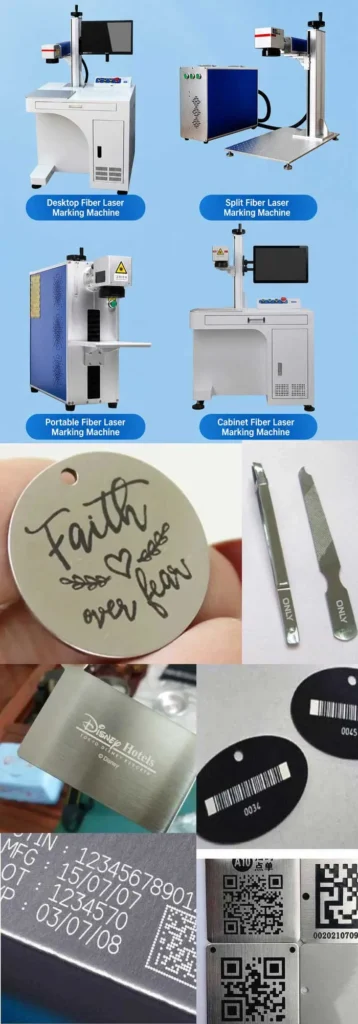
*Actual configuration depends on the selected laser, lens and machine model. Confirm the final specification before ordering.
Compare Our Fiber Laser Marking Machines
If your main application is stainless steel marking, 20W–50W fiber lasers cover many general applications. Higher power can be considered when deeper engraving or higher production throughput is required.
Why Use a Fiber Laser for Stainless Steel?
Stainless steel is widely used for components, tools, equipment, nameplates and consumer products. A fiber laser gives manufacturers a digital, non-contact way to add permanent identification without using mechanical cutting tools.For many buyers, the attraction is not simply the laser itself. It is the ability to change text, serial numbers, QR codes and logos without changing physical tooling.
Permanent Identification
Useful for serial numbers, model numbers, logos, QR codes and traceability information.
Non-Contact Process
The laser works without a mechanical engraving bit physically touching the stainless-steel surface.
Digital Marking
Text, logos and variable serial numbers can be changed through software.
Why Use a Fiber Laser for Stainless Steel?
Stainless steel is widely used for components, tools, equipment, nameplates and consumer products. A fiber laser gives manufacturers a digital, non-contact way to add permanent identification without using mechanical cutting tools.For many buyers, the attraction is not simply the laser itself. It is the ability to change text, serial numbers, QR codes and logos without changing physical tooling.
Permanent Identification
Useful for serial numbers, model numbers, logos, QR codes and traceability information.
Non-Contact Process
The laser works without a mechanical engraving bit physically touching the stainless-steel surface.
Digital Marking
Text, logos and variable serial numbers can be changed through software.
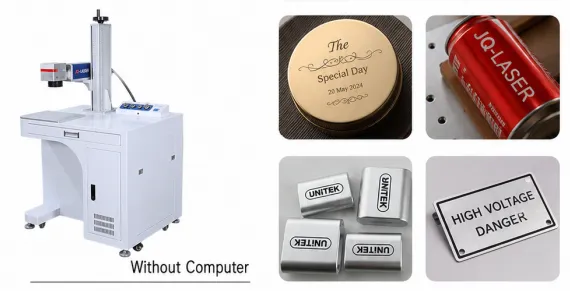
How Does Stainless Steel Surface Finish Affect Laser Marking?
If your stainless-steel parts have different surface finishes, do not assume the same marking parameters will produce identical results.This is especially important when the visual appearance of the mark matters.
Brushed Stainless Steel
The existing directional texture can affect how the mark is visually perceived. Test the actual production surface.
Polished Stainless Steel
Highly reflective surfaces can require careful parameter selection and positioning.
Sandblasted / Matte Surface
The surface texture can change contrast and visual appearance compared with polished material.
Black Marking or Deep Engraving on Stainless Steel?
These are not the same application.If your requirement is simply a high-contrast identification mark, you may not need a high-power laser.If you need material removal and measurable engraving depth, the machine configuration and processing time become different.
| Requirement | Black / High-Contrast Mark | Deep Engraving |
|---|---|---|
| Main Objective | Visual contrast | Material removal |
| Typical Application | Logos, QR codes, serial numbers | Tools, molds, industrial parts |
| Power Requirement | Often lower | Often higher |
| Processing Time | Usually shorter | Usually longer |
| Best Approach | Optimize contrast | Optimize depth and cycle time |
20W vs 30W vs 50W for Stainless Steel Marking
For stainless steel, I would not choose the laser power simply because the higher number sounds better.Start with the actual marking requirement: contrast, depth, artwork, part quantity and cycle time.
| Application | 20W | 30W | 50W |
|---|---|---|---|
| Serial Numbers | Excellent | Excellent | Excellent |
| QR / Data Matrix | Excellent | Excellent | Excellent |
| Black Marking | Suitable | Very Suitable | Very Suitable |
| Deep Engraving | Limited | Better | Better suited |
| High Production Volume | Good | Better | Better |
| General Recommendation | Entry / light marking | Best balance | Deeper / faster work |
20W vs 30W vs 50W for Stainless Steel Marking
For stainless steel, I would not choose the laser power simply because the higher number sounds better.Start with the actual marking requirement: contrast, depth, artwork, part quantity and cycle time.
| Application | 20W | 30W | 50W |
|---|---|---|---|
| Serial Numbers | Excellent | Excellent | Excellent |
| QR / Data Matrix | Excellent | Excellent | Excellent |
| Black Marking | Suitable | Very Suitable | Very Suitable |
| Deep Engraving | Limited | Better | Better suited |
| High Production Volume | Good | Better | Better |
| General Recommendation | Entry / light marking | Best balance | Deeper / faster work |
Stainless Steel Laser Marking Applications
Stainless Steel Nameplates
Model numbers, specifications, serial numbers, logos and QR codes.
Automotive Components
Part numbers, traceability codes, serial numbers and identification marks.
Kitchen & Food Equipment
Product identification, logos, specifications and permanent markings.
Industrial Equipment
Asset numbers, maintenance information and component identification.
Tools & Hardware
Branding, model numbers, serial numbers and product identification.
Medical Components
Identification and traceability marks on suitable stainless-steel parts.
Electronics Housings
Product codes, serial numbers and logos on stainless-steel housings.
Kitchenware
Logos, product identification and customized markings.
Industrial Fabrication
Permanent identification on fabricated stainless-steel components.
Fiber Laser Marking Machine for Stainless Steel Specifications
| Parameter | Typical Configuration | Buyer Note |
|---|---|---|
| Laser Type | Fiber Laser | Common choice for stainless steel |
| Laser Power | 20W / 30W / 50W / 100W | Select according to application |
| Wavelength | 1064nm | Typical fiber laser wavelength |
| Marking Area | 110×110mm standard | Other lenses available |
| Cooling | Air Cooling | Common for standard configurations |
| Control Software | EZCAD / JCZ | Confirm exact controller and software version |
| Rotary Axis | Optional | For cylindrical stainless-steel parts |
| Positioning | Red-light positioning | Camera positioning optional |
| Power Supply | 110V / 220V | Confirm destination voltage |
Specifications are configuration-dependent. Final laser source, scanner, lens, marking field and electrical configuration should be confirmed in the quotation.
Fiber Laser or UV Laser for Stainless Steel?
| Factor | Fiber Laser | UV Laser |
|---|---|---|
| General Stainless Steel Marking | Excellent | Possible |
| Industrial Metal Marking | Strong choice | Application dependent |
| Deep Engraving | More suitable | Usually not first choice |
| Heat-Sensitive Materials | Not the main advantage | Stronger advantage |
| Typical Recommendation | Start here for normal stainless steel | Consider for specialized applications |
More Fiber Laser Metal Marking Solutions
Stainless steel is only one of the common metals processed with fiber lasers. If your application uses another metal, compare the corresponding material-specific solution.
What Should You Ask Before Buying a Stainless Steel Laser Marker?
304, 316 or another grade?
Polished, brushed, matte or coated?
These require different processing strategies.
Confirm the required marking field and lens.
Cycle time can affect the recommended laser power.
Ask for the actual brand and model.
Important for cylindrical stainless-steel parts.
This is one of the most important questions.
Test Your 304 or 316 Stainless Steel Before You Buy
Send us your stainless-steel sample, material grade, surface finish, marking artwork and required production quantity.We can evaluate the marking result and help you decide whether 20W, 30W or 50W is more appropriate for the application.
Fiber Laser Marking Machine for Stainless Steel FAQ
Can a fiber laser mark stainless steel?
Yes. Fiber lasers are widely used for permanent marking on stainless steel, including serial numbers, logos, QR codes, Data Matrix codes and product identification.
Can a fiber laser make black marks on stainless steel?
Yes. High-contrast black marking is possible with suitable parameters. The final appearance depends on the stainless-steel grade, surface finish and laser settings.
Can a 20W fiber laser mark stainless steel?
Yes. 20W systems can be suitable for many stainless-steel identification applications. The correct power depends on the required contrast, marking size, production speed and depth.
Is 30W better than 20W for stainless steel?
Not automatically. 30W provides more processing capacity, but if the application is simple identification, 20W may already be sufficient. The decision should be based on the actual production requirement.
Is 50W necessary for stainless steel?
Not for every application. 50W becomes more attractive when deeper engraving or higher production throughput is important.
Can it mark 304 stainless steel?
Yes. 304 stainless steel is a common fiber laser marking material. Surface finish and the required marking appearance should still be tested before production.
Can it mark 316 stainless steel?
Yes. 316 stainless steel can also be marked with fiber laser systems. The exact parameters should be confirmed with a sample of the actual production material.
Can it mark polished stainless steel?
Yes. Polished surfaces can be marked, but their reflective properties and visual finish make parameter testing particularly important.
Can it mark brushed stainless steel?
Yes. Brushed stainless steel can be marked. The existing surface texture can affect the visual appearance of the finished mark.
Can a fiber laser engrave stainless steel deeply?
Yes. Fiber lasers can be configured for deeper engraving, but depth depends on laser power, material, number of passes, parameters and processing time.
How much does a stainless steel laser marking machine cost?
The price depends on laser power, laser source, marking field, scanner, rotary axis, enclosure, automation and shipping terms. A complete configuration should be compared rather than laser wattage alone.
Should I test my stainless steel before buying?
Yes. This is strongly recommended when marking contrast, appearance, depth or cycle time is important. The actual production material gives a much more useful result than a generic demonstration sample.
Let’s Test Your Stainless Steel Before You Buy
Send us your stainless-steel grade, surface finish, marking artwork, required marking size and expected production volume.We can help you compare 20W, 30W and 50W configurations based on the actual application.