CO2 Laser Marking Machine For Plastic
Permanent Marking And Engraving For Plastic Parts, Bottles, Packaging And Industrial Products
Our CO2 Laser Marking Machine For Plastic is designed for manufacturers that need clear, durable and repeatable marking on suitable plastic materials. It can be used for product identification, logos, serial numbers, batch codes, barcodes and other industrial markings.
Table of Contents
Why Use A CO2 Laser Marking Machine For Plastic?
Plastic marking is not simply about putting a logo on a surface. Manufacturers may need to identify every part, add a production code, create a permanent serial number or mark packaging without adding labels or ink. A CO2 laser can be a practical choice when the plastic absorbs the laser wavelength well and the required marking effect is compatible with thermal processing.
Permanent Identification
Create durable product information directly on suitable plastic surfaces without applying labels.
Clear Product Branding
Mark logos, names, symbols and product information for industrial and consumer products.
No Ink Or Labels
Laser marking is a direct, non-contact process, which can reduce dependence on printing consumables.
Easy Digital Changes
Change text, serial numbers, logos or production codes through marking software without making physical plates.
What Plastics Can A CO2 Laser Mark?
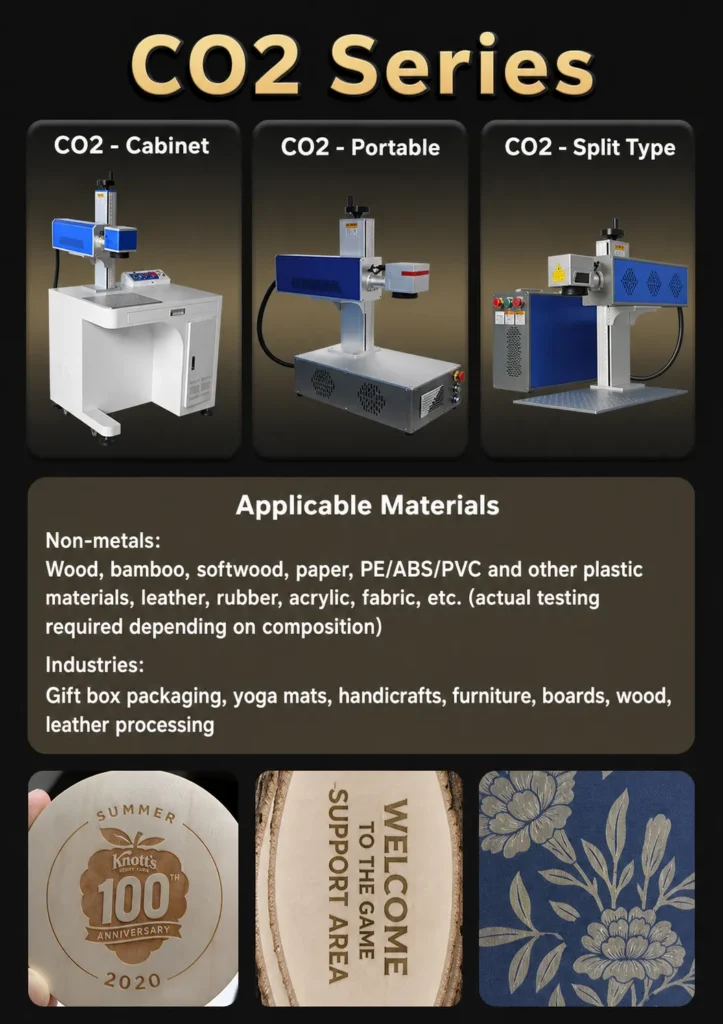
CO2 laser marking works well on many plastic materials, but there is no single laser setting that works for every plastic product. The polymer itself, color, additives, fillers, surface coating and required marking appearance can all change the result.
For this reason, we recommend testing your actual plastic parts before choosing a production configuration. A sample test can help determine the appropriate laser power, speed, frequency and marking method.
| Plastic Material | Typical Applications | CO2 Laser Consideration |
|---|---|---|
| Acrylic / PMMA | Signs, displays, decorative products | Generally well suited for CO2 engraving |
| PET | Bottles, containers, packaging | Can be suitable depending on formulation and required contrast |
| PE / HDPE | Containers, industrial products, packaging | Test marking parameters and material formulation |
| PP | Caps, containers, automotive parts | Results depend strongly on additives, color and surface composition |
| ABS | Electronic housings, industrial components | Can be marked, but UV may be preferable for some high-contrast applications |
| PC / Polycarbonate | Electronic and industrial components | Requires application testing to control heat effects and contrast |
For sensitive plastics or applications where heat must be minimized, compare this solution with our UV Laser Marking Machine For Plastic .
CO2 vs UV Laser For Plastic: Which One Should You Choose?
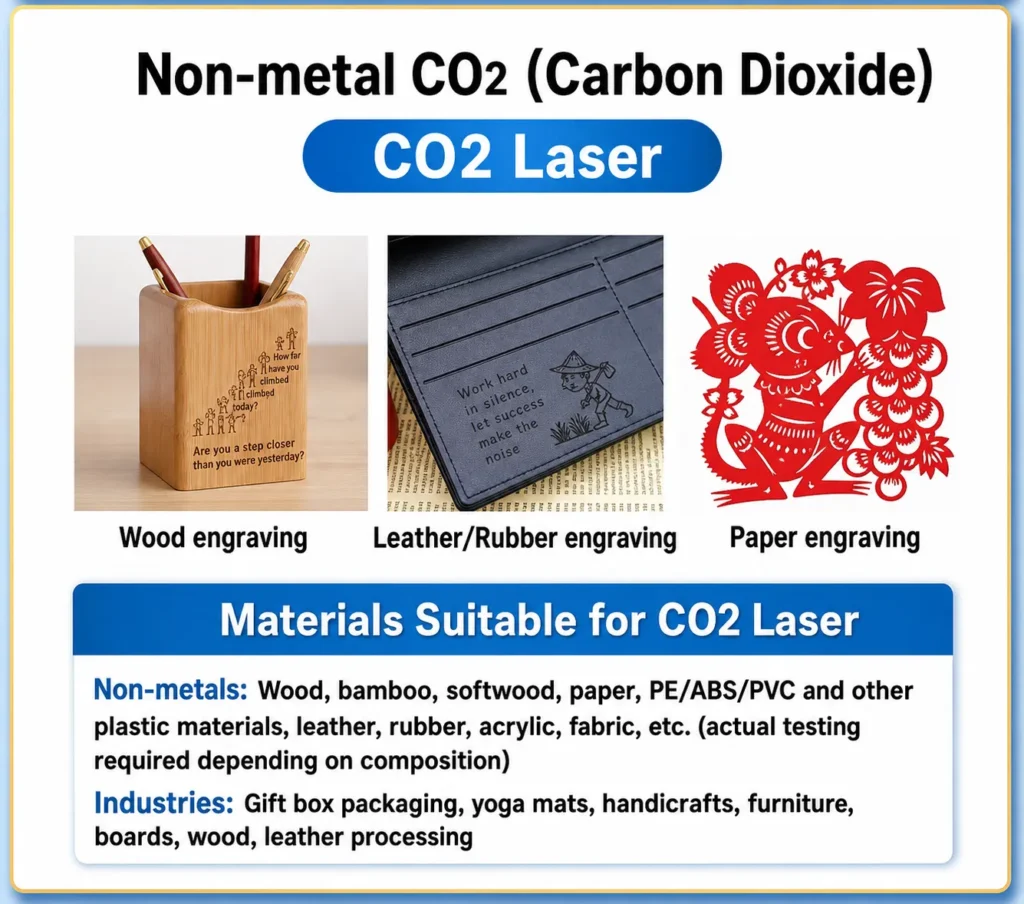
Both CO2 and UV lasers can be used for plastic marking, but they work in different ways. CO2 lasers use a much longer wavelength and rely more heavily on thermal interaction with the material, while UV lasers can produce marking through a photochemical process with much lower heat input.
| Consideration | CO2 Laser | UV Laser |
|---|---|---|
| Typical Wavelength | 10.6 μm | 355 nm |
| Marking Mechanism | Primarily thermal material removal | Primarily photochemical interaction |
| Acrylic | Excellent candidate | Can also mark |
| Heat-Sensitive Plastic | Requires careful parameter testing | Often the better option |
| Deep Engraving | Strong candidate | Usually selected for precision marking rather than thermal engraving |
| Packaging | Very useful for suitable films, containers and packaging | Useful where low heat and fine detail are priorities |
Not Sure Which Laser Is Right For Your Plastic?
Send us your plastic sample or product information. We can recommend a suitable laser source after evaluating the material and the marking result you need.
Ask For A Material TestPlastic Products That Can Be Marked With A CO2 Laser
CO2 laser marking is not limited to raw plastic sheets. Depending on the material and required result, manufacturers can use it for finished components, containers, packaging and consumer products.
Plastic Bottles & Containers
Mark product information, batch codes, logos and identification information on suitable plastic containers.
Electronic Housings
Add model numbers, symbols, logos and identification information to suitable plastic housings and components.
Automotive Plastic Parts
Create permanent part numbers, serial numbers and production identification on selected automotive components.
Plastic Packaging
Mark product codes, logos, batch information and other identification information on suitable packaging materials.
Acrylic Products
Engrave text, graphics, logos and decorative patterns on acrylic signs, displays and custom products.
Explore Acrylic Laser Marking →Industrial Plastic Components
Permanent identification can help manufacturers track components throughout production and service.
View Traceability Solution →Plastic Laser Marking vs Plastic Laser Engraving: What’s The Difference?
If you are looking for a plastic laser marking machine, you may also see terms such as plastic laser engraving machine or CO2 laser engraver for plastic. These terms are closely related, but they do not always describe exactly the same result.
Laser marking usually focuses on creating readable identification such as logos, serial numbers, batch codes, barcodes and other product information. Laser engraving goes further by removing more material from the surface to create a visible engraved effect or depth.
| Feature | Laser Marking | Laser Engraving |
|---|---|---|
| Main Purpose | Product identification | Material removal and visible engraving |
| Typical Content | Serial numbers, QR codes, logos, batch codes | Text, logos, graphics, decorative designs |
| Processing Depth | Usually shallow | Can remove more material when the application requires it |
| Common Industries | Industrial manufacturing, packaging, electronics | Signs, gifts, consumer products and customized products |
Looking For A Plastic Laser Engraver?
A CO2 laser can be configured for both marking and engraving applications when the plastic material is suitable. The correct settings depend on the material, desired depth, surface appearance and production speed.
Plastic Bottle Laser Marking Machine
Plastic bottles are used for beverages, cosmetics, household products, chemicals and many other applications. When manufacturers need permanent product identification, a laser can eliminate the need for separate labels or printing processes on suitable materials.
A CO2 laser marking machine can be considered for suitable plastic bottles when the material absorbs the laser energy effectively and the required marking result can be achieved without excessive melting or deformation.
Bottle Logos
Mark brand logos and product names directly onto suitable plastic bottle surfaces.
Batch Numbers
Add production batch information to help identify products during manufacturing and distribution.
Serial Numbers
Create unique identification numbers for selected industrial plastic containers and products.
QR Codes
For suitable surfaces and code sizes, laser marking can create machine-readable identification codes.
If your application involves packaging production, you can also see our CO2 Laser Marking Machine For Packaging for a broader packaging solution.
CO2 Laser Marking Machine For Plastic Packaging
Plastic packaging manufacturers often need to add product information quickly without changing printing plates or maintaining conventional ink systems. Depending on the packaging material and required result, CO2 laser marking can be used for direct identification on suitable plastic packaging.
Typical marking content: product name, logo, batch number, production code, serial number, barcode and other variable information.
Common Plastic Packaging Applications
- Plastic containers
- Caps and closures
- Plastic bottles
- Flexible packaging
- Industrial packaging
- Household product packaging
- Cosmetic packaging
- Chemical product containers
For high-speed production environments, the marking system can be combined with conveyors, sensors, rotary devices or other automation equipment depending on the production line.
Related solution: Automation Marking Solution
What Can You Mark On Plastic Products?
A plastic laser marking machine can be used for much more than simple text. Depending on the material and required contrast, manufacturers can mark variable production information as well as fixed graphics.
Company Logos
Brand identification for plastic components, containers and finished products.
Serial Numbers
Unique product identification for manufacturing and traceability.
QR Codes
Digital product identification and links to product information.
Barcodes
Machine-readable product and production information.
Batch Numbers
Useful for production tracking and batch identification.
Product Codes
Model numbers, specifications and other product identification information.
For applications where traceability is a major requirement, see our Product Traceability Solution .
You can also learn more about our QR Code Marking Solution for machine-readable product identification.
Can A CO2 Laser Engrave Plastic?
Yes, a CO2 laser can engrave certain plastic materials by removing material from the surface. However, the achievable engraving depth and appearance depend heavily on the plastic type, thickness, color, additives and laser parameters.
For simple product identification, a shallow marking may be enough. For decorative products or applications that require visible material removal, multiple laser passes can be used to increase the engraving effect when the material allows it.
Shallow Marking
Suitable for logos, product numbers and other identification information.
Surface Engraving
Creates a more visible engraved appearance by removing material from the surface.
Multi-Pass Engraving
Multiple passes may be used when a deeper result is required and the material can tolerate the additional heat.
Important: Test The Material First
Deep engraving increases the amount of heat delivered to the material. For plastics that are sensitive to heat, a UV laser or another marking method may provide a better result. Sample testing should be completed before production.
Key Features Of A CO2 Laser Marking Machine For Plastic
A good plastic marking machine is not only about laser power. The laser source, scanning system, lens, software, work area and production setup all affect the final marking result.
10.6 μm CO2 Laser Source
CO2 laser technology is widely used for processing many non-metallic materials and suitable plastic applications.
Non-Contact Processing
The laser works without physically touching the product, reducing mechanical contact with the surface.
High-Resolution Graphics
Suitable configurations can reproduce text, logos, symbols and detailed graphics with good consistency.
Digital Marking Software
Operators can edit marking content and variable information through software without replacing physical plates.
Rotary Marking Option
A rotary attachment can be considered for cylindrical products when the application requires marking around curved surfaces.
Production Line Integration
The system can be configured for automated production environments using sensors, conveyors and other equipment.
Rotary CO2 Laser Marking For Cylindrical Plastic Products
Not every plastic product has a flat surface. Bottles, tubes and cylindrical components may require the laser to follow a curved surface. In these applications, a rotary attachment can rotate the product while the laser marks the required area.
Plastic Bottles
Mark logos, names and identification information around cylindrical bottle surfaces.
Plastic Tubes
Suitable for selected cylindrical tubes and containers that require direct product marking.
Cylindrical Components
Mark industrial plastic components where the marking area follows a curved surface.
If your main application is bottle production and packaging, you may also want to compare this page with our CO2 Laser Marking Machine For Bottles .
CO2 Laser Marking Machine For Plastic: Technical Specifications
The right configuration depends on your plastic material, marking content, product size and production speed. The following specifications represent a typical configuration range. Final specifications can be customized according to the actual application.
| Parameter | Typical Configuration | Why It Matters |
|---|---|---|
| Laser Type | CO2 Laser | Suitable for many non-metallic materials and selected plastic applications |
| Wavelength | 10.6 μm | Affects how the laser interacts with the material |
| Laser Power | 20W / 30W / 60W / 100W | Higher power can provide more processing capability, depending on the material and application |
| Marking Speed | Application dependent | Actual production speed depends on marking content, material and required contrast |
| Marking Area | 70×70 mm / 110×110 mm / 175×175 mm / Custom | Determines the maximum marking area in one setup |
| Cooling | Air cooling or water cooling depending on configuration | Supports stable operation of the laser system |
| Marking Method | Raster / Vector Marking | Allows different types of text, logos and graphics |
| Optional Rotary Axis | Available | Useful for cylindrical plastic products |
Specifications may vary according to the selected laser source, scanning system, lens and automation configuration. Please contact us for a configuration based on your actual plastic product.
What CO2 Laser Power Do You Need For Plastic?
More laser power does not automatically mean better marking. For plastic products, the ideal power depends on the material, color, marking depth, marking speed and the appearance you want to achieve.
20W–30W CO2 Laser
A practical starting range for many standard marking applications where the required processing depth and production volume are moderate.
60W CO2 Laser
A higher-power option for applications that require greater processing capability, deeper engraving or higher production throughput.
100W CO2 Laser
Typically considered for demanding industrial applications where higher power and processing capability justify the additional investment.
Don’t Choose Power Based On The Number Alone
For plastic marking, the material response is more important than simply choosing the highest-power laser. We recommend testing your actual sample before deciding on the final laser configuration.
CO2 Laser Marking Speed For Plastic Products
Marking speed is one of the most important factors for production applications, but the maximum scanner speed is not the same as the actual production output.
A small serial number can be marked much faster than a large filled logo or detailed graphic. Material response, required contrast, marking density and product positioning also affect the cycle time.
Small Serial Numbers
Usually require less processing time than large filled graphics.
QR Codes & Barcodes
Actual cycle time depends on code size, density and readability requirements.
Large Logos
Filled graphics may require more laser passes and therefore more processing time.
Deep Engraving
Deeper material removal normally requires more processing time than surface marking.
How Much Does A CO2 Laser Marking Machine For Plastic Cost?
The cost of a CO2 laser marking machine for plastic depends on much more than laser power. A basic desktop system and a fully automated production-line system can have very different prices because their configurations and production capabilities are not the same.
| Configuration | Typical Buyer | Main Cost Factors |
|---|---|---|
| Standard Desktop System | Small manufacturers, workshops | Laser source, scanner, lens and enclosure |
| Industrial Workstation | Factories and production departments | Higher-performance components, larger work area and production accessories |
| Rotary Marking System | Bottle and cylindrical-product manufacturers | Rotary axis and positioning system |
| Automated Production System | High-volume manufacturers | Conveyor, sensors, vision, PLC and production-line integration |
Want To Know The Actual Cost For Your Application?
Instead of choosing a machine from price alone, send us your material, product dimensions, marking content and expected production volume. We can recommend a suitable configuration and provide a quotation.
Get A CO2 Laser QuoteCO2 Laser Marking Machine For Automated Plastic Production Lines
If you are marking hundreds or thousands of plastic products every hour, manually placing each product under the laser may not be the most efficient approach. A CO2 laser marking system can be integrated with your existing production line to automate product positioning and marking.
Conveyor Integration
Products can move through the marking station automatically.
Photoelectric Sensors
Sensors can detect product position and trigger the marking process.
Vision Positioning
Vision systems can help locate the correct marking position on products.
PLC Integration
The marking system can communicate with other production equipment when required.
Automatic Product Positioning
Fixtures and positioning systems can improve marking consistency in repetitive production.
Variable Data Marking
Different serial numbers, batch codes or production information can be generated during production.
Flying CO2 Laser Marking For High-Speed Plastic Production
For continuous production lines, a flying laser marking system can mark products while they are moving on a conveyor. This approach can reduce the need to stop products individually and is especially useful when the marking process needs to be synchronized with production.
Continuous Production
The laser can be synchronized with moving products on suitable production lines.
Online Product Coding
Useful for continuous product identification and packaging applications.
Variable Information
Serial numbers, batch codes and other variable data can be changed digitally.
For a dedicated online marking solution, see our Flying Laser Marking Machine .
How To Choose The Right CO2 Laser Marking Machine For Plastic
Choosing a plastic laser marking machine should start with the product, not the machine specification. Before asking for a quotation, it helps to define exactly what you need to mark and what the final result should look like.
Identify The Plastic
Tell us the exact plastic type whenever possible. Material formulation can significantly affect laser marking results.
Define The Marking
Decide whether you need a logo, text, QR code, barcode, serial number, shallow marking or deeper engraving.
Check Product Size
The product dimensions determine the appropriate marking area, lens and positioning method.
Calculate Production Volume
Production volume determines whether a manual workstation or automated marking line makes more sense.
Test The Material
A real sample test is the best way to confirm marking contrast, depth, speed and surface appearance.
Plan Future Production
If production volume is expected to grow, consider automation and variable-data marking from the beginning.
Not Sure If CO2 Laser Is Right For Your Plastic?
Send us your plastic sample, product photo or material information. We can evaluate the application and recommend a suitable laser configuration based on the marking result you need.
Frequently Asked Questions About CO2 Laser Marking Machines For Plastic
Here are some of the most common questions buyers ask before choosing a CO2 laser marking machine for plastic products.
Can a CO2 laser mark plastic?
Yes. CO2 lasers can mark or engrave many suitable plastic materials. However, not every plastic responds to a CO2 laser in the same way. The exact result depends on the plastic type, color, additives, surface finish and laser settings. A sample test is recommended before production.
What plastics can a CO2 laser engrave?
CO2 lasers can be used with many non-metallic materials and selected plastics. Common applications may include acrylic, certain ABS products, plastic packaging, plastic components and other laser-compatible materials. Because plastic formulations vary, testing the actual material is the safest way to confirm the result.
Can a CO2 laser mark plastic bottles?
Yes, suitable plastic bottles can be laser marked with a CO2 laser. Logos, product names, batch numbers, codes and other identification information can be marked depending on the bottle material and surface characteristics. A rotary attachment can also be considered for cylindrical products.
Can a CO2 laser engrave acrylic?
Yes. Acrylic is one of the common non-metallic materials processed with CO2 lasers. Depending on the application, a CO2 laser can be used for cutting, surface engraving and marking acrylic products. The correct parameters depend on the acrylic type, thickness and desired finish.
Is CO2 or UV laser better for plastic marking?
It depends on the plastic and the required marking result. CO2 lasers are commonly considered for many non-metallic materials, while UV lasers are often preferred when a very fine, low-heat marking process is required. If you are unsure, compare the two technologies using an actual product sample.
See our UV Laser Marking Machine For Plastic for more information.
Can a CO2 laser mark QR codes on plastic?
Yes, a CO2 laser can mark QR codes on suitable plastic surfaces. The important factors are contrast, code size, marking quality and readability. For industrial traceability applications, the final QR code should be tested with the reader or verification system used in production.
Can a CO2 laser mark barcodes and serial numbers on plastic?
Yes. Barcodes, serial numbers, batch numbers, model numbers and other variable information can be marked on suitable plastic products. This makes CO2 laser marking useful for product identification and traceability applications.
What laser power do I need to mark plastic?
There is no single power level that is best for every plastic application. The required power depends on the material, marking speed, marking depth, product size and desired appearance. Lower-power systems may be suitable for basic marking, while higher-power systems may be considered for more demanding engraving or production applications.
Does laser marking melt plastic?
It can, depending on the plastic and the laser settings. Excessive heat may cause melting, discoloration or deformation on some materials. Proper laser parameters are therefore important. The goal is to achieve the required marking result without unnecessarily heating the surrounding material.
Can a CO2 laser engrave plastic deeply?
A CO2 laser can remove material from some suitable plastics, allowing a deeper engraving effect. However, deep engraving normally requires multiple passes and generates more heat. The achievable depth depends on the material and application, so sample testing is recommended.
Can a CO2 laser mark moving plastic products?
Yes. A CO2 laser can be integrated into suitable production lines for online marking. With conveyors, sensors and appropriate control systems, products can be marked while moving through the production line. A flying laser marking system can be considered for continuous production applications.
Can the machine mark cylindrical plastic products?
Yes. A rotary attachment can be used for suitable cylindrical products such as plastic bottles, tubes and other round components. The rotary system rotates the product so the laser can mark the required area on the curved surface.
How much does a CO2 plastic laser marking machine cost?
The price depends on the laser source, power, marking area, scanner, enclosure, rotary axis, automation equipment and other configuration requirements. A basic manual system and a fully automated production-line system can have very different costs. Contact us with your application details for a specific quotation.
How can I know if my plastic is suitable for CO2 laser marking?
The best way is to test the actual material. Send the material sample, product photo or material information to us and we can evaluate the application. Sample testing can help determine marking contrast, speed, depth and surface appearance before you purchase a machine.
Explore More CO2 Laser Marking Machines
Choose a specialized CO2 laser marking solution based on your material and production requirements.
CO2 Laser Marking Machine
Explore our complete range of CO2 laser marking systems for non-metallic materials.
View Product →CO2 Laser Marking Machine For Packaging
Laser marking solutions for suitable plastic packaging and production applications.
View Product →UV Laser Marking Machine For Plastic
Compare UV laser technology for fine and low-heat plastic marking applications.
Compare UV Laser →Flying Laser Marking Machine
Online marking solutions for continuous production and moving products.
View Flying Laser →Let’s Find The Right Laser For Your Plastic Product
Not sure whether CO2 laser marking, UV laser marking or another technology is right for your product? Send us your material information, product photos and marking requirements. We can help you evaluate the application before you choose a machine.